Distinguished Chinese scholar Yan Xuetong has dismissed the idea of a US-China “G-2,” arguing that the global order is instead heading toward an era of “G-0,” defined by the absence of clear leadership.
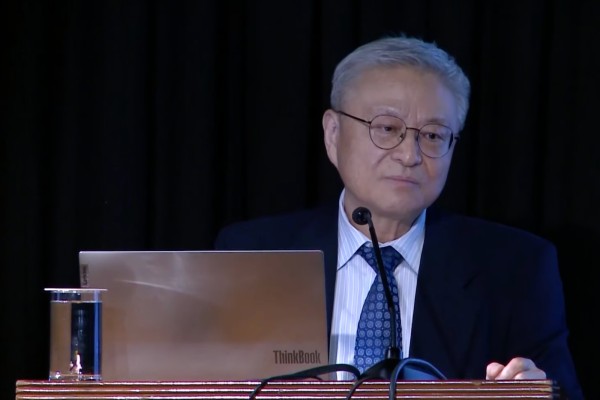
Speaking on “Trump’s Challenge to the Global Order” at an event at the India International Centre in New Delhi on Tuesday, Yan said the relationship between Washington and Beijing is inherently competitive.
“Relationship between the United States and China is that of competition and not cooperation… These two countries cannot offer a G-2 leadership … If the Soviet Union and the US could not make a G-2 (during the Cold War), then how can the US and China do it now?” he said during the discussion, which was moderated by former foreign secretary Shyam Saran.
Yan, a Distinguished Professor at Tsinghua University, was responding to the renewed use of the term “G-2” by US President Donald Trump ahead of his October 2025 meeting with Chinese President Xi Jinping, a framing that unsettled parts of Asia and Europe.
“G-2 means bipolarity, meaning these two countries having global influence,” Yan said, adding that experts increasingly see a world order without leadership. “In the coming decade, the global order will be based on no leadership.”
He said this was why countries such as China, India and Russia are emphasising multilateralism. “Multilateralism is where several countries work together to provide a kind of leadership to shape the global order. That means not any single country has the resources, capability and even the will to provide a global leadership for the world,” he said.
Yan also argued that artificial intelligence will fundamentally reshape international competition.
“This cyberspace is of another nature. This is created by human beings, by us. It is different from the natural space or geo-space created by God. These are two different spaces,” he said, adding that rivalry will increasingly shift from geography to cyberspace.
On ideology, Yan said globalisation is being challenged less by nationalism and more by populism.
“In populism, anything foreign is a threat…. So populism is also xenophobia. Nationalism never talks about xenophobia. Populism always talks about xenophobia. Therefore, this kind of an ideology drives the trend of a counter-globalisation,” he said.
Referring to US policy under Trump’s second term, Yan said China was suffering from tariffs, but America was harming itself more. “Today we see for the first time, American intellectuals trying to leave the United States looking for jobs and opportunities outside the US … Trump’s policies have undermined America’s national comprehensive capability,” he said.
He added that US strength historically lay in immigration. “Their immigration policy for the last 200 years absorbed elite talent from all other countries… Indians are CEOs in American companies today. Chinese scientists working in America … But now Trump has closed the door (of immigration) and that is leading to American intellectuals and scientists leaving the country,” he said.
Yan also said bilateral ties between India and China would improve in 2026 and that this would happen “not because of the changing world order or for Trump’s policies but because of Chinese President Xi Jinping and Prime Minister Narendra Modi’s joint decision to take the ties forward.”