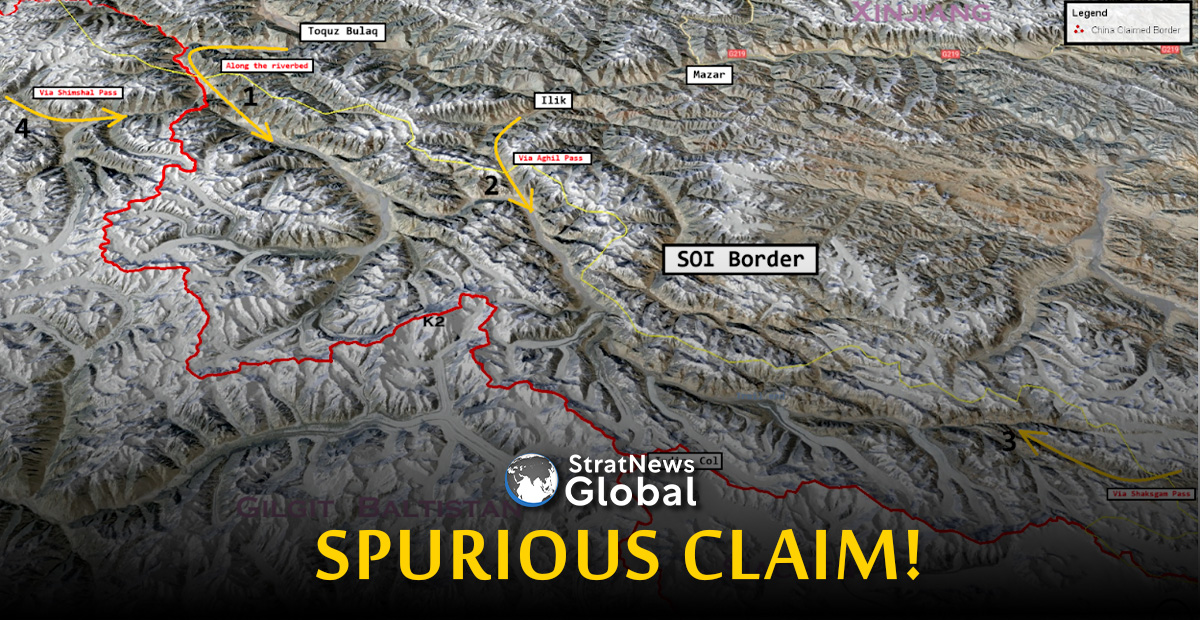
India and China continued official-level engagement this week even as New Delhi rejected Beijing’s renewed territorial claims over the Shaksgam Valley, highlighting the subtle balance between diplomatic outreach and unresolved boundary disputes.
Foreign Secretary Vikram Misri on Tuesday met Sun Haiyan, the visiting Vice Minister of the International Department of the Communist Party of China. They reiterated the push for normalisation with the focus on people-centric exchanges, business engagement and sustaining dialogue.
Sun Haiyan briefed the Foreign Secretary on her interactions in India, including discussions with media, think tanks and political stakeholders, and indicated interest in expanding exchanges.
Shaksgam Valley
The visit, however, coincided with renewed assertions from Beijing over the Shaksgam Valley, a territory of 5,180 sq km north of the Karakoram watershed and part of the erstwhile princely state of Jammu and Kashmir. India considers the valley as part of its sovereign territory.
But Beijing said the Shaksgam Valley “belongs to China”. Foreign Ministry spokeswoman Mao Ning said “The territory belongs to China. It’s fully justified for China to conduct infrastructure construction on its own territory.”
She added that China and Pakistan had signed a boundary agreement in 1960s and demarcated borders between the two countries and that the settlement was an exercise of the rights of two sovereign states. But the fine print of the agreement tells a different story.
Article 6 of the treaty says “The two Parties have agreed that after the settlement of the Kashmir dispute between Pakistan and India, the sovereign authority concerned will reopen negotiations with the Government of the People’s Republic of China on the boundary, as described in Article Two of the present Agreement, so as to sign a formal boundary treaty to replace the present Agreement, provided that, in the event of that sovereign authority being Pakistan, the provisions of the present Agreement and of the aforesaid Protocol shall be maintained in the formal Boundary Treaty to be signed between the People’s Republic of China and Pakistan .”
What Mao Ning stated in the press interaction is actually contradictory to the temporary provision of the agreement regarding sovereignty. The 1963 agreement in effect does not recognise Pakistan as the final sovereign authority of J&K.
It therefore provides a caveat for “renegotiation of the agreement ” with the sovereign authority after settlement of J&K. This fact runs against the sense of finality conveyed by Mao Ning.
Another point to note is that this agreement between China and Pakistan happened soon after the 1962 Sino-Indian War and despite the strong negative sentiment against India then, China did not accord a finality to its settlement with Pakistan.
In this context, note the title: “Agreement between the Government of People’s Republic of China and the Government of Pakistan on the Boundary between China’s Sinkiang and the Contiguous Areas the Defence of which is under the actual control of Pakistan”.
The words “contiguous areas…under actual control of Pakistan” are important and can be used to advantage by India. India has consistently rejected that agreement, maintaining that Pakistan had no legal authority to cede the territory and that the arrangement is illegal and invalid.
Official spokesperson Randhir Jaiswal also reiterated that India does not recognise the China–Pakistan Economic Corridor, which passes through Indian territory under illegal occupation.
The MEA said India has repeatedly conveyed its objections to attempts to alter the ground situation in the Shaksgam region and has reserved the right to take necessary measures to safeguard its interests.