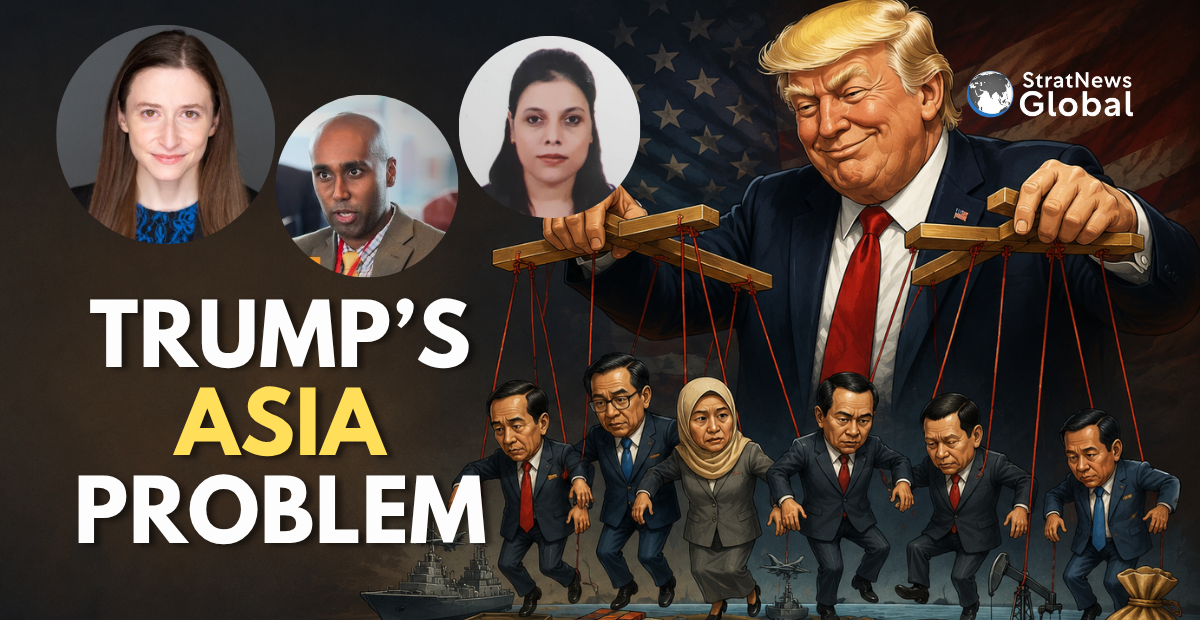
An American scholar and China specialist has warned that the US is not differentiating between allies and adversaries. Henrietta Levin, Senior Fellow at the Center for Strategic and International Studies (CSIS), was speaking at an event organised by Observer Research Foundation (ORF) in Delhi on Donald Trump’s Asia policy.
Southeast Asia Becoming ‘Transactional’
Relationships are increasingly viewed through a transactional lens focused on immediate gains, burden-sharing and deal-making, she said. This has created a “strategic drift” with regional friends and allies less certain about US long term political commitments even though military co-ordination and alliance structures continue to function.
South-East Asia is increasingly being treated less as a strategically important region in itself and more as a platform for advancing specific US priorities such as military access, trade rebalancing, technology competition and energy dominance. She argued that South-East Asia was increasingly becoming “more of a transactional region” under Trump, and all to China’s benefit.
China has long used the appearance of improving ties with Washington to make countries in the region less confident about US commitments. By projecting closer relations with the US, Beijing can create uncertainty among America’s allies and increase its own influence across Asia.
She cited the White House fact sheet released after the recent Trump–Xi summit as an example. The document focused heavily on economic outcomes for American workers, farmers and industry, but made little mention of allies, national security or strategic competition. For Levin, that omission was telling.
Concerns Over Long-Term US Strategy
Prashanth Parameswaran, Fellow at the Institute for Indo-Pacific Security and founder of the ASEAN Wonk newsletter, argued that instead of treating the region as strategically important in itself, Washington is increasingly prioritising countries that are aligned with its objectives on military access, trade rebalancing, technology and energy dominance.
South-East Asian states are uneasy with Washington’s growing emphasis on using market access, trade leverage and strategic pressure to secure economic and security advantages, he said. Add to that renewed focus on the Western Hemisphere, “homeland prorities” and domestic political concerns while pursuing coercive trade and industrial policies.
He acknowledged that important elements remain intact, particularly the expanding role of the Philippines in US military planning and deterrence strategy. But he warned that the larger challenge lies in the widening gap between transactional wins and long-term strategic direction.
Beijing Sees Opportunity
Antara Ghoshal, China Fellow at ORF’s Strategic Studies Programme, argued that many in Beijing believe the US is attempting to pressure third countries connected to Chinese supply chains into limiting engagement with China, rather than confronting Beijing directly.
Chinese strategists also suspect Washington is trying to reshape maritime balances across the first island chain in ways unfavourable to China. At the same time, Ghoshal argued that Beijing sees opportunities in the apparent weakening of America’s broader Indo-Pacific strategy.
She highlighted an emerging Chinese narrative on Taiwan with some Chinese scholars arguing that Taiwan’s return to China was part of the post-Second World War order created jointly by China and the United States after their alliance against Japan. She said this narrative was aimed at persuading Washington, particularly under Trump, to avoid being drawn into conflict with Beijing over Taiwan.