Basu: How would you assess the current state of India-Australia relations? Both sides did not have the 2+2 dialogue last year and the Quad Summit also did not take place.
Abbott: The trade relationship is significantly expanding. My understanding is that in the last five years, under the influence of the trade deal that was done by the (former) Scott Morrison government with my help, our two way trade has gone from about $25 billion a year to about $50 billion a year – that’s a significant improvement.
The security and defense relationship is improving all the time. India is now a regular participant in the Talisman Sabre military exercise, which is one of the world’s largest that happens in Queensland every two years. I understand that there’ll be some hundreds of Indian personnel involved in the next edition. So, I think the relationship is going very well.
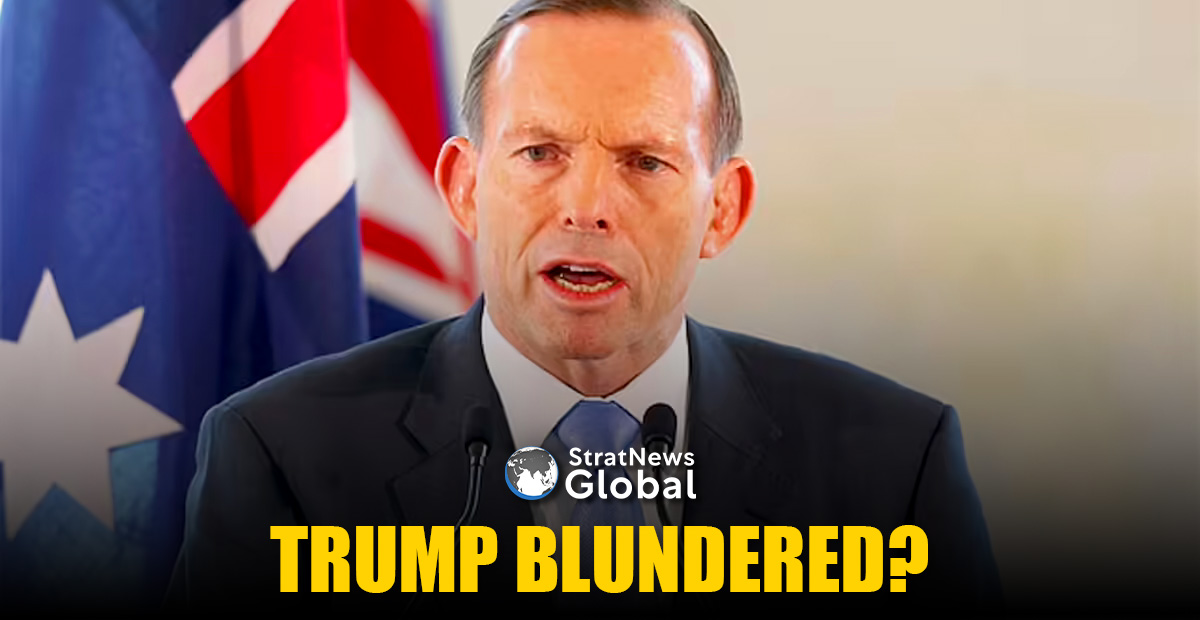
The pity is that the steam has come out of the Quad and that’s understandable given that there have been a few mishits by Donald Trump in relation to India. I’m a big supporter of what Donald Trump is trying to do in Iran. I think Trump has been far more a force for good than bad, but there is no doubt he has mishandled India with the punitive tariffs, with the gratuitous boasting about his role in ending conflict, and his apparent involvement with the Pakistani armed forces.
Q: So, in your assessment Trump’s actions have impacted the Quad countries. How crucial is the Quad for Australia at this when the world is riddled with conflicts?
A: The Quad is potentially a massive strategic game changer. But the Quad, like the Five Eyes, is an informal arrangement based on trust and familiarity. Now, the Five Eyes arrangement has been in place for almost 80 years, the Quad has really only been in place for about a decade, and leader-level meetings really only began in 2020. And so the fact that the leader-level meeting that was supposed to take place last year didn’t is a big problem. Now, my understanding is that it’s likely to be a foreign minister’s meeting sometime soon. But a foreign minister’s meeting doesn’t have nearly the same weight as a leaders’ meeting. And in the end, it will be a force of habit, and ingrained familiarity and trust that makes the Quad everything that it could and should be.
Q: Does Australia want the Quad to get more securitised, looking at the China challenge and of course, with what is happening around the world?
A: All sorts of arrangements can be done bilaterally and pluri-laterally. But the bedrock of any intimate relationship is a congruence of interests and values. As a democracy under the rule of law, which is rightly suspicious of Beijing’s ambitions in the Indo Pacific, I think that there is a natural partnership between the four big Indo-Pacific democracies, namely India, the United States, Japan, and Australia.
So I think the foundations of a long-term, intimate Five Eyes-style partnership are there, but it won’t happen unless key people in all four countries drive it and keep driving and their successors keep driving, and their successors’ successors drive it and keep driving it in the same way that the Five Eyes has been driven by successive leaders at the political level, at the military level, at the intelligence level and at the security level.
Q: But the Five Eyes is purely about intelligence gathering, Quad does not operate in that framework?
A: The Five Eyes at one level is about intelligence gathering. But at another level, it’s about profound interoperability across the respective militaries with routine exchanges of personnel at every level. Because there’s just an instinctive like mindedness on the big issues, an instinctive congruence of interests and values between the five individual countries.
Q: So does Australia feel that the tension between India and the United States is spilling over into the Quad?
A: It’s a pity and to get the Quad back on track, there will need to be further leaders’ meetings. All sorts of things can happen at the foreign ministers level and at the level of officials, but for this thing to become as well-entrenched as the Five Eyes arrangement has become over the decades, it’s going to require at least for the next few years, regular leaders-level meetings.
Q: The India-Australia Comprehensive Economic Cooperation Agreement (CECA), is still pending, while the Economic Cooperation and Trade Agreement is performing well for both sides. How crucial is it for Canberra to see that the CECA goes through this year?
A: Well, part one was a good deal. Yes. If it’s possible to get a better deal, let’s try to get it. I’m always in favor of getting a better deal. But, I don’t think that India should despair of the economic relationship with the United States. And sure the current administration’s tariff policy is unpredictable and erratic. But at some stage it will settle down and I think it’s important for India and America to have the best possible trade relationship.
Q: Now that Trump’s tariff measures have impacted trade so severely, do you think India should have joined the Regional Comprehensive Economic Partnership (RCEP) of which Australia is a key part?
A: I think India was right to pull out of the RCEP … (Prime Minister) Modi understood it in a way that people down the line didn’t, that RCEP was really an attempt by Beijing to extend its sway, and I think it was very shrewd of Modi not to join. And I think it was a sign of Modi’s clear-eyed view about China’s long term strategic ambitions and the perils of a form of economic colonization.
Q: Does Australia also see and analyse that the rules-based global order has collapsed under Donald Trump?
A: The global rules-based order has been under massive challenge for the last few years from Russia, which wants to recreate the empire of ‘Peter the Great’, from Xi Jinping, who wants China to be the global hegemon by mid-century and from the now admittedly somewhat enfeebled Iran, which still under the Ayatollahs wants to create a global caliphate. I mean, it’s these three dictatorships, which are the real threat to the rules-based global order, not Trump. What Trump is actually doing has been just to strengthen what’s left of the rules-based order, by punishing the predator countries who are threatening it.
Q: So you think Iran was attempting to create a global caliphate? And the US has failed to carry out regime change there?
A: Of course, it was… And, the regime change hasn’t yet taken place, but what we know is that the regime faced a challenge on the streets of unprecedented proportions to which it reacted with unprecedented savagery. We also know that there were millions of Iranians rejoicing at the death of Khamenei. So there are vast swathes of the Iranian population who would like a very different government and whether that’s going to be enough to bring about regime change, we don’t know. But certainly, if the regime does survive, it would be vastly enfeebled.
Q: Where do you see the endgame lies as far as the Iran war is concerned?
While the American and Israeli air campaign is continuing, Iran’s missile barrage is rapidly diminishing, precisely because the main objective of the campaign to utterly destroy the Iranian war machine is working and is working very well.
Q: By doing all these campaigns, do you see the US’ focus is drifting away from the Indo-Pacific? The US and China may soon sign a trade deal, then what? Pax Silica?
A: Australia and China had a trade deal that I did and as soon as it suited China to break it, China broke it. So no deal with China can be relied upon if it’s in China’s interest to break the deal. I mean, China sees every other country as a tributary, essentially. That’s the historical position and nothing has changed.
Q: What do you think needs to be done to take the India-Australia bilateral relationship to the next level?
A: I think that the relationship is on a very good and strong foundation. Trade is increasing. There’s a large and successful and prosperous and well-integrated Indian community in Australia. The defense and security relationship is going from strength to strength. I think the best thing that could happen to further consolidate what’s already a very strong partnership would be regular visits at the top level of Australian Indian leaders to each other’s country. Now, Prime Minister Modi is coming to Australia soon, and I think that’s going to be a very successful visit.
Australia is very conscious of the nature of stronger alliances, and the Quad has vast strategic potential. And I think the Quad was widely welcomed in Australia when it really started to develop under Prime Ministers Modi and (Japanese PM Shinzo) Abe, then when Biden took it to the next level, I think Australians welcomed that. And let’s hope that’s where it can be again as quickly as possible.