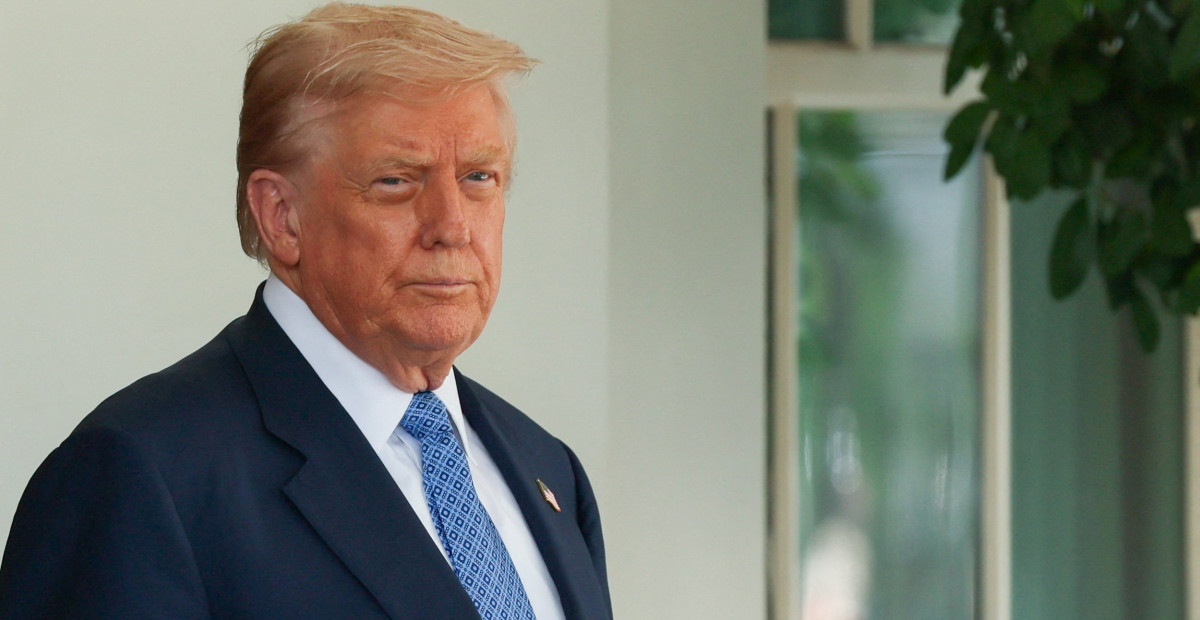
Was President Donald Trump wrongly briefed by his close advisors about the so-called U.S. role in stopping India’s Operation Sindoor against Pakistan, officials in New Delhi and Washington, DC are wondering.
Although he has imposed a stiff 50 per cent tariff plus penalties on India, ostensibly for India buying Russian crude, Trump’s ire against India is more personal than professional, most people aware of the internal discussions have concluded.
Exactly three months after India paused Operation Sindoor following the panic call by Pakistan’s Director General of Military Operations (DGMO) to his Indian counterpart, officials are yet to figure out why Trump continues to wrongly claim that he stopped a potentially dangerous escalation between India and Pakistan.
An analysis of the sequence of events on May 9 and 10 shows U.S. Vice President JD Vance called Prime Minister Narendra Modi on the night of May 9. His response to Vance (that India will hit back with greater ferocity than before) is by now well-known.
As Pakistan attacked in the intervening night of May 9 and 10, India unleashed a punitive strike in four waves that not only crippled Pakistan’s two mobile command and control centres, but also downed half a dozen Pakistani Air Force jets besides damaging airfields and other assets on the ground, forcing Pakistan to go running to U.S. in panic. (Read the entire details here)
U.S. Secretary of State Marco Rubio then called India’s External Affairs Minister Dr S. Jaishankar on May 10 who told him to instruct the Pakistanis to use the DGsMO channel to commence the discussion on when to stop firing. Simultaneously, the Saudi Arabian and UAE leadership were also making calls to both India and Pakistan, seeking to dial down the tension. Even the Iranians apparently asked India at one point if they could be of any help. Presumably, all sides were talking to the Pakistanis as well. India’s message was consistent: Let the Pakistani military call.
As is well known by now, the DGMO of Pakistan initiated the call, had a conversation with his Indian counterpart. They both then agreed to stop firing from 5 pm that evening.
This is where it becomes hazy. Rubio and team appear to have briefed Trump on all the conversations and the agreement that India and Pakistan had reached. What was Trump told? Was he informed about the exact sequence of events, the nuances of the conversations? Or was he simply told, ‘Mr President, it was your intervention alone that has prevented a nuclear war,’ or something to that effect? Who knows.
Given the nature of current White House functioning, it is not beyond belief that the briefings may have exaggerated Trump and the U.S. role in effecting the pause in firing. Once Trump concluded in his mind that it was his administration that stopped the war, there was no stopping the American President.
He clearly wanted India and particularly Prime Minister Narendra Modi to thank him personally. The establishment in New Delhi however did not see the U.S. role in the same light as perhaps some of the senior U.S. interlocutors projected it to Trump. Unlike India, the Pakistanis, past masters in flattery, were quick to credit Trump for preventing the escalation and stopping the firing. The U.S. President immediately rewarded newly minted Field Marshal Asim Munir with a meeting in the White House and signalled more help to Pakistan.
The egoist that he is, Trump appears to have taken Prime Minister Modi’s refusal to stop over in DC on his way back from Canada where he attended the G-7 meeting, as a personal insult too. Perhaps he was trying to get Modi and Munir in the same room as he did with the leaders of Azerbaijan and Armenia last week for a peace agreement. India was not grateful enough, the President may have thought and that’s when the script went awry.
Indian and American teams negotiating the trade agreement were ready for an ‘early harvest’ tranche of the pact to be followed by the final document later this year but when Trump unilaterally announced a 50 per cent tariff, plus penalties, the carefully nurtured Indo-U.S. relationship was on a rapid downward spiral.
What next? The understanding among those who specialise in watching and analysing the Delhi-DC relationship is it will get worse before it gets better. In private conversations several observers point out that officials who stitch together many agreements and are constantly talking at the working level do not share the ‘scorched earth’ policy that Trump seems to have adopted just to satisfy his ego but at the moment, there is no alternative but to ride the storm. The question is: How long will the storm last? And how extensive the damage would be in the long run? There is no alternative but to wait and watch.