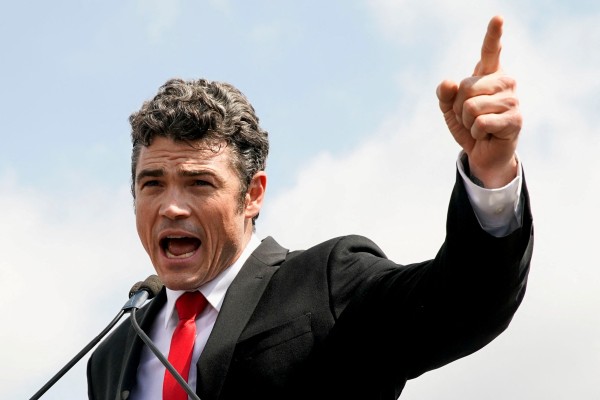
The resignation of Joe Kent as Director of the National Counterterrorism Center has exposed a deepening ideological fault line within the MAGA movement.
When Kent, a 20-year Army veteran whose wife was killed by ISIS in Syria, sat down with Tucker Carlson just hours after quitting, he did not simply critique the war with Iran—he articulated a worldview that places Israeli influence at the centre of America’s drift toward perpetual conflict.
This intervention has widened the existing fissure between Zionist and anti-Zionist factions within the conservative movement, forcing a long-simmering civil war into the open at a difficult moment for a White House struggling to justify an increasingly costly campaign.
Before examining the populist challenge, it is worth briefly noting the three dominant analytical frameworks that have shaped Washington’s conversation about the war—each of which, in its own way, avoids the uncomfortable questions now being raised.
The Establishment Consensus frames the conflict as a moral imperative against an “evil” Iranian regime, uniting neoconservatives and neoliberal interventionists in ritualistic condemnation that serves as an entry ticket to respectable discourse.
This dynamic was illustrated by Nobel laureate Paul Krugman, who recently prefaced his economic analysis of the war’s fallout with what might be called an “obligatory disclaimer”: “The Iranian regime is evil, and it would be a good thing if this war leads to its demise.” This ritualised framing allows critique of the war’s execution while affirming its fundamental premise.
The Structural Imperialist school views the war as an inevitable expression of American imperial imperatives—securing energy supplies, countering rivals, and maintaining global primacy. In this view, Israel is a proxy within U.S. strategy, not the driver of policy.
The “Greater Game” argument frames the conflict as a strategic manoeuvre against China. By weakening Iran—a key node in Beijing’s energy security and a partner in its anti-Western alignment—the United States is seen as positioning itself for future great-power competition. Israel’s role is acknowledged but subordinated to this larger objective.
All three frameworks provide convenient lenses that deflect attention from the populist conservative argument, advanced most forcefully by Tucker Carlson, that American power is being eroded in conflicts that benefit Israeli regional interests while costing the United States blood, treasure, and strategic focus.
Joe Kent has asserted that Iran posed “no imminent threat” to the U.S., claiming the administration “started this war due to pressure from Israel and its powerful American lobby”.
Kent’s central claim directly challenges the administration’s “imminent threat” justification. In his interview with Carlson, he described a coordinated ecosystem through which information flows from Israeli officials to influential U.S. media figures and think tanks, shaping the boundaries of American policy debate.
This, he argues, shifted policy goals from preventing nuclear weapons to the maximalist demand of prohibiting any enrichment—effectively foreclosing the possibility of a negotiated settlement. The result, in his view, has been strategically damaging: the war drains U.S. resources while leaving the Pacific theatre more exposed, potentially advantaging China.
The consequences extend beyond great-power competition. The war has also eroded trust among traditional U.S. allies in the Middle East, who increasingly question Washington’s ability to defend them as regional energy infrastructure comes under attack. For critics, this combination of strategic drain, allied unease, and potential Chinese advantage runs counter to the “America First” mandate.
Kent’s resignation has done more than highlight a policy dispute; it has intensified a volatile debate over antisemitism within the conservative movement.
His resignation and subsequent appearance on Tucker Carlson’s podcast drew sharp condemnation from establishment figures. Matt Brooks, president of the Republican Jewish Coalition, described it as “part of an ongoing problem”, noting that his group had opposed Kent’s nomination over alleged ties to right-wing extremism. Senator Mitch McConnell went further, calling Kent’s resignation letter “virulent antisemitism”.
Kent’s resignation letter contained some of the most controversial claims. He explicitly blamed “high-ranking Israeli officials and influential members of the American media” for encouraging the conflict, invoking what he described as a familiar tactic used “to draw us into the disastrous Iraq war”.
Most personally, he wrote that his wife, a Navy cryptologist killed by a suicide bomber in Syria, died “in a war manufactured by Israel”.
These assertions lie at the core of the populist anti-Zionist argument but also prompt immediate accusations of invoking antisemitic “puppet master” tropes. Congressman Josh Gottheimer stated that “scapegoating Israel isn’t just a tired antisemitic trope—it’s anti-American.”
Reactions across conservative media suggest the movement is now deeply divided over where to draw the line between criticism of Israeli influence and outright bigotry.
The schism is playing out in real time among prominent right-wing media figures. Megyn Kelly, while critical of the war, criticised “Israel-firsters, like Mark Levin” for advocating the conflict—drawing a sharp response from Levin, who called her an “emotionally unhinged, lewd and petulant wreck”.
Ben Shapiro, co-founder of The Daily Wire, has denounced Carlson’s approach as “an act of moral imbecility” rooted in conspiracy thinking. Meanwhile, Candace Owens has faced backlash for promoting antisemitic conspiracy theories, with commentator Dennis Prager writing that he could not think of anyone “engendering as much suspicion of Jews, Zionism and Israel”.
This internal conflict now intersects with Donald Trump’s broader political standing. His approval ratings have slipped as the war drags on without a clear exit strategy and costs continue to mount. His political base appears split: one faction accuses him of yielding to foreign influence, while another warns that any retreat would empower an antisemitic fringe. For a president whose political identity rests on loyalty and winning, this division strikes at the core of his coalition.
In this environment, continuing the war risks further political erosion. Anti-war populists, energised by Kent’s resignation, frame ongoing fighting as proof that entrenched interests still shape policy. Meanwhile, the pro-Israel establishment remains poised to interpret any shift as a betrayal.
With political pressure mounting, the growing rift within the conservative movement may ultimately force a reassessment of the conflict—not necessarily on strategic grounds, but due to its rising political cost.