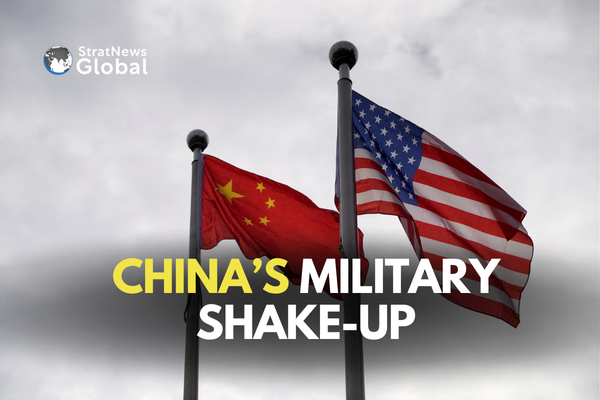
China’s sweeping removal of senior military commanders has cast new doubt over Beijing’s strategic intentions, complicating already fragile efforts by the United States to reduce the risk of conflict, particularly over Taiwan.
The latest upheaval follows the dismissal of General Zhang Youxia, once China’s most senior uniformed officer and a close confidant of President Xi Jinping, according to Chinese state media. Zhang’s removal is part of a broader purge that has seen dozens of top commanders sidelined over the past two years, including figures responsible for nuclear forces and Taiwan-related operations.
The changes come as Washington and Beijing struggle to restore military-to-military dialogue aimed at preventing accidental confrontation amid rising tensions in the Asia-Pacific.
Senior Commanders Removed
Zhang, a combat veteran of China’s 1979 war with Vietnam and long regarded as Xi’s most trusted military adviser, was dismissed last month, Chinese media reported. His departure followed the removal of several other senior officers, leaving China’s Central Military Commission the country’s top defence body largely stripped of its original members.
Analysts say the purge has disproportionately affected commanders linked to China’s nuclear deterrent and the Eastern Theatre Command, which oversees any potential military action against Taiwan.
Chinese official statements have cited corruption as the reason for the dismissals, with military publications accusing unnamed senior figures of misusing defence funds. One article in the People’s Liberation Army (PLA) Daily referred to senior offenders as “big rats” draining resources from the armed forces.
In an unusually blunt assessment, another PLA Daily commentary recently described the military as a “paper tiger”, language rarely used by Chinese state media to characterise national defence capabilities.
Implications for Taiwan
U.S. officials say Xi has instructed the PLA to be capable of prevailing in a conflict over Taiwan by 2027, though they stress this does not amount to a firm decision to invade.
With that deadline approaching, analysts say the leadership may be dissatisfied with the military’s readiness. The removal of senior commanders responsible for Taiwan planning has raised questions over whether Beijing is recalibrating its timeline or struggling with internal divisions.
China has stepped up military drills around Taiwan in recent years, presenting them as a warning that reunification is inevitable. However, the current leadership turmoil appears to undermine that messaging, at least temporarily.
Some analysts caution that the appearance of military disarray could also be deliberate, designed to mask continued preparations. Others believe Beijing may be waiting for political developments, including Taiwan’s 2028 election and the outcome of the U.S. presidential race the same year.
U.S.-China Military Dialogue at Risk
The upheaval threatens fragile attempts to rebuild communication between the world’s two largest militaries.
In August 2024, U.S. National Security Adviser Jake Sullivan met Zhang in Beijing as part of efforts to reopen channels suspended after former U.S. House Speaker Nancy Pelosi visited Taiwan in 2022.
That meeting led to limited engagement between U.S. and Chinese theatre commanders, including a visit by the PLA’s Southern Theatre commander to Hawaii to discuss tensions in the South China Sea.
Plans to expand dialogue to include commanders responsible for Taiwan have since stalled. Several officers who were expected to participate in future talks now appear to have been removed.
Western officials say access to senior PLA figures has become increasingly rare, even through informal academic and policy channels that were once common.
Wider Strategic Questions
The purge comes amid concerns in Washington that instability within China’s military could increase, rather than reduce, the risk of miscalculation.
U.S. intelligence agencies continue to monitor China’s military closely, including its rapid expansion of nuclear missile facilities. Reports of construction flaws and corruption within those programmes have circulated widely, though they remain difficult to verify.
A Wall Street Journal report suggested Zhang may have been accused of discussing sensitive nuclear issues with U.S. counterparts, a claim that has not been officially confirmed.
If contact with Western militaries is increasingly viewed in Beijing as a liability, analysts warn that crisis-management mechanisms could erode further.
As Xi, 73, consolidates control ahead of what could be a sensitive political period, the uncertainty surrounding China’s military leadership adds another layer of unpredictability to an already strained global security environment.
(With inputs from Reuters)