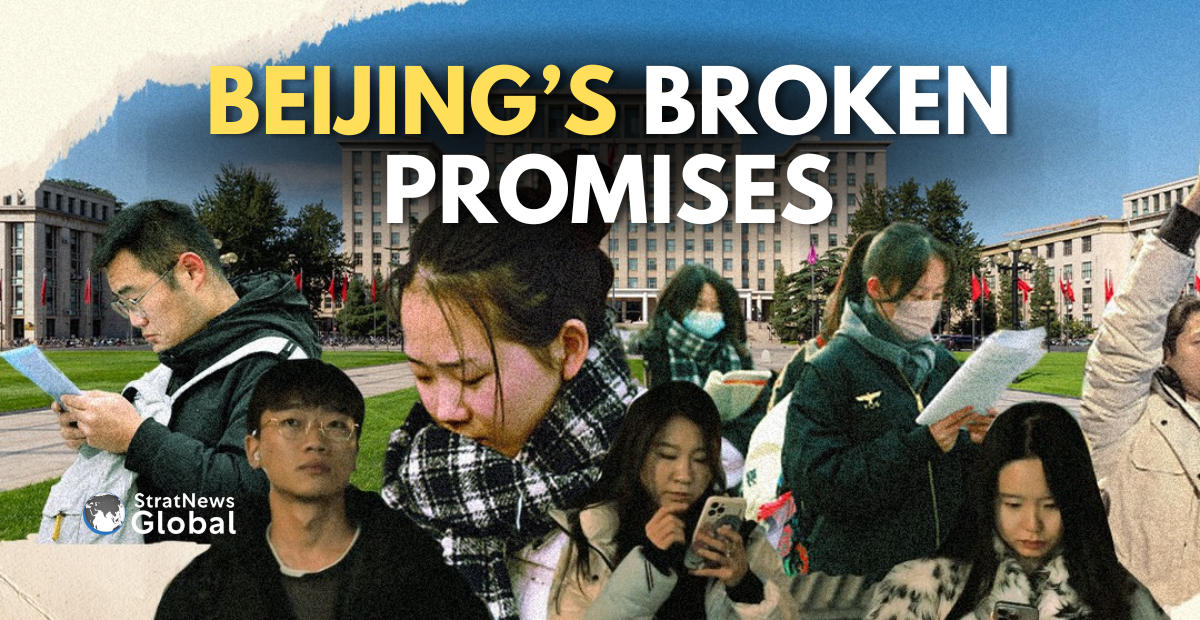
China’s Ministry of State Security has entered the culture wars and the target this time is its own youth.
In a striking WeChat post this week, the MSS – China’s primary civilian intelligence and secret police agency – accused unnamed overseas organizations of orchestrating a deliberate campaign to demoralize Chinese young people.
The alleged weapon: promoting “lying flat,” the now-iconic phrase for a generation-wide rejection of overwork, ambition, and societal pressure.
Given China’s highly censored domestic social media infrastructure the accusation looks ironic, revealing not for what it says about foreign interference, but for what it inadvertently exposes about Beijing’s deepening anxiety over a domestic crisis years in the making.
For the better part of a decade, as China’s boom years faded, millions of young Chinese have quietly abandoned the script their parents followed to succeed: study hard and work harder.
With well-paid jobs increasingly scarce, many have instead embraced a philosophy of intentional withdrawal – doing the minimum, or nothing at all.
Some call it “letting it rot.”
In an era of declining opportunity, disengagement has become an act of quiet protest.
The numbers behind the mood are dispiriting.
Urban youth unemployment for those aged 16 to 24 hit 17% in March whereas for 25-to-29-year-olds, the rate reached a record 7.7%.
Meanwhile, AI has further eroded the situation, steadily hollowing out the white-collar roles that once represented the aspirational ‘endpoint’ of China’s punishing education system.
Citigroup’s chief China economist recently warned that “AI-driven displacement” is intensifying, hitting early-career workers – the most exposed cohort – hardest.
The rise in unemployment insurance spending and a swelling gig economy further deepen the picture.
Yet Beijing’s response has been to look outward for blame.
The MSS framed the lying-flat trend as ideological infiltration, warning that foreign forces “only want our youth to lie flat so that we hand over our progress, opportunities and future.”
Xi Jinping, for his part, has repeatedly urged young people to embrace hardship and stiffen their spines, seemingly unaware that this generation has little appetite for what he endured during Mao’s Cultural Revolution.
Chinese social-media users were unconvinced and annoyed. Many pushed back in comments, pointing to brutal working hours and demanding better labour law protections. The foreign-forces framing, some noted bitterly, has become a go-to excuse for any inconvenient social reality and many are simply tired of it.
What Beijing appears to misread is the nature of the problem. Lying flat is less a foreign import than a rational response to a broken promise that hard work would be rewarded.
And that promise runs in both directions. The CCP’s legitimacy rests on delivering prosperity to its people. Its ambitions and vision of ‘The Chinese dream’ depend on this same generation to realise them. A party that neglects its youth allowing them to drift into despondency while expecting them to carry its vision forward is, in the end, working against itself.
Until that promise is credibly renewed, no spy agency can put the movement to bed.