Microsoft unveiled a sweeping range of artificial intelligence initiatives at its annual Build developer conference, signalling a major shift beyond traditional software and towards AI-powered computing.
The announcements included autonomous AI agents, specialised devices, new AI models, and powerful PCs designed to run advanced AI workloads.
Chief Executive Satya Nadella said the industry was entering a new era where AI agents, rather than conventional applications, would increasingly perform tasks on behalf of users.
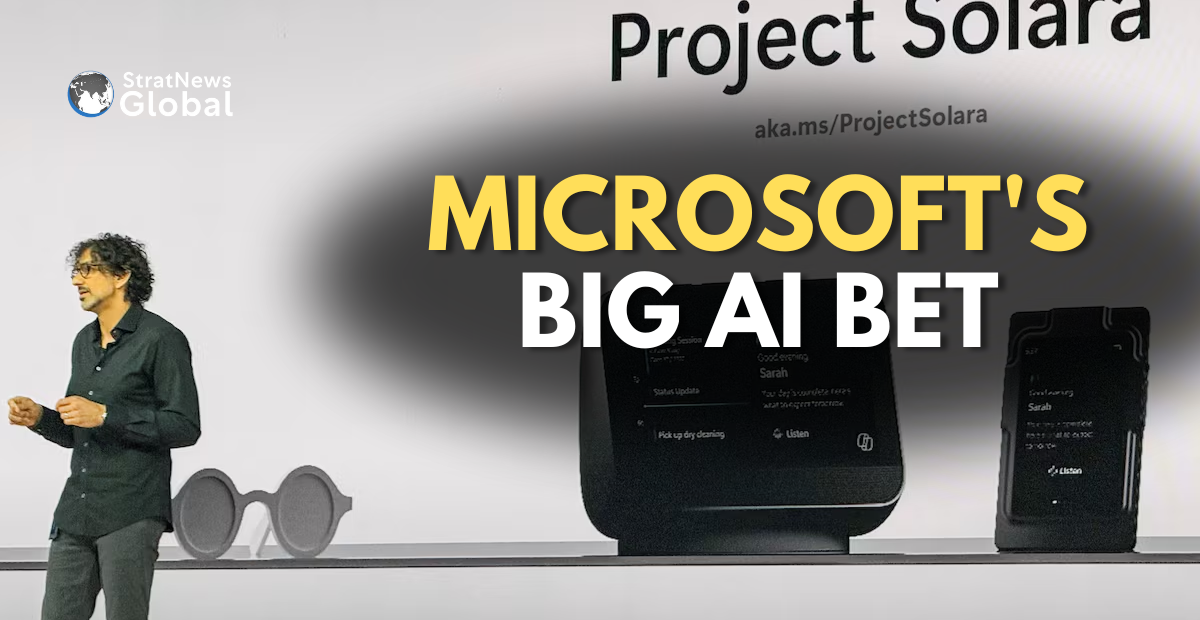
Project Solara: Computing Beyond Apps
One of Microsoft’s most significant announcements was Project Solara, a new family of AI-first devices powered by chips from Qualcomm and MediaTek.
The prototypes range from smart-speaker-sized devices to badge-like gadgets equipped with screens and microphones.
Unlike smartphones or traditional computers, the devices are designed to run AI agents that communicate directly with cloud systems to complete specific tasks, such as documenting medical consultations or managing workflows.
Microsoft believes these devices could redefine how people interact with technology by reducing reliance on conventional apps and operating systems.
Nvidia-Powered ‘Dream Machine’
Microsoft also showcased the Surface RTX Spark Dev Box, a new AI-focused computer powered by advanced Nvidia hardware.
Nadella described the device as a “dream machine” capable of running highly sophisticated AI models directly on a PC.
The company demonstrated a model containing 120 billion parameters, highlighting the growing push to bring advanced AI capabilities onto personal computers rather than relying entirely on cloud infrastructure.
The move places Microsoft in more direct competition with premium offerings from companies such as Apple.
New AI Agents Join Copilot
Microsoft introduced a new AI agent called Scout within its Copilot ecosystem.
The assistant is designed to autonomously gather emails, messages and information that require a user’s attention, helping streamline decision-making and workplace productivity.
The company also announced tools aimed at making open-source AI agent systems safer for enterprise environments, particularly when handling sensitive corporate data.
Microsoft Expands AI Model Ambitions
The company also revealed progress in developing its own frontier AI models, reducing its dependence on long-time partner OpenAI.
Among the announcements was MAI Thinking-1, Microsoft’s first reasoning model, which the company claims delivers performance comparable to leading models from Anthropic.
Microsoft additionally introduced new transcription and image-generation models as it seeks to compete more directly with other major AI developers.
Healthcare Becomes A Key Focus
A major part of Microsoft’s AI strategy is healthcare.
The company announced a partnership with Mayo Clinic to develop advanced medical AI systems aimed at improving diagnosis and patient care.
The collaboration will combine Microsoft’s AI capabilities with Mayo Clinic’s clinical expertise and medical data.
Executives said the goal is to help healthcare professionals reach diagnoses more quickly and accurately while improving patient outcomes.
(with inputs from Reuters)