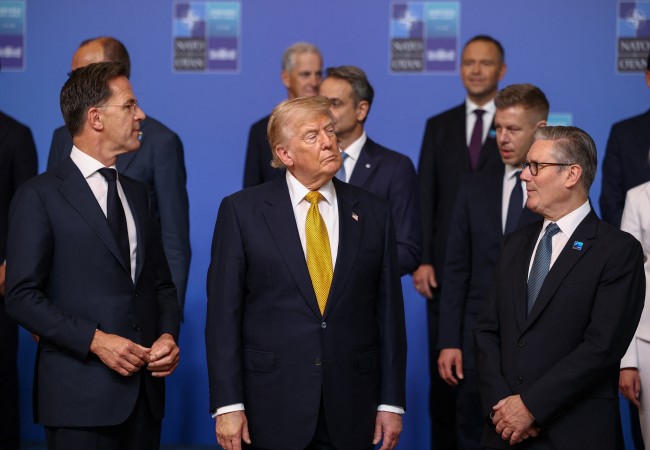
The NATO Summit opened in Ankara on Tuesday amid the Ukraine war and heightened tensions in West Asia, with leaders focusing on defence spending, military readiness and the alliance’s future security priorities.
The two-day gathering has brought together leaders of all 32 NATO member states, but much of the attention remains on US President Donald Trump. He was personally received at the airport by Turkish President Recep Tayyip Erdoğan, reflecting improving ties between Washington and Ankara following the easing of sanctions on Türkiye and renewed momentum over the proposed sale of F-35 fighter aircraft. Trump said he was attending the summit largely because it was being hosted by his “friend” Erdoğan.
Leaders are expected to push ahead with last year’s commitment to raise defence spending to five per cent of GDP as the alliance responds to the Ukraine conflict and instability in West Asia following the recent US-Israel strikes on Iran and the subsequent ceasefire.
Former ambassador Narinder Chauhan said Trump’s approach to NATO has remained unchanged.
“The US President Trump has been consistent in expressing his disappointment with NATO members and said he was attending the Türkiye Summit primarily because his ‘friend’ Türkiye President Erdogan was hosting it. This is in the backdrop of easing of sanctions on Turkey and firming up of sale of F35s to Türkiye. In a new found chemistry President Erdogan was at the airport to personally receive President Trump.”
She said the summit again underlined America’s dominant military position within the alliance.
“Though a NATO Summit, everyone saw that the red carpet was for President of USA which remains militarily the most powerful country in the world.”
According to Chauhan, the debate over burden-sharing has intensified since Russia’s invasion of Ukraine, with European countries increasing defence budgets while Washington insists it will no longer carry the primary responsibility for Europe’s security.
She also said Trump’s renewed comments on Greenland remained an underlying source of tension.
“The US threat to acquire Greenland was the elephant in the room though not as an agenda item which has the potential to unravel the Alliance itself.”
Chauhan said European members, despite drawing criticism from Washington for staying out of military action against Iran, had welcomed the ceasefire because West Asia has become an important source of oil after Europe reduced imports from Russia following the Ukraine war.
“Though having earned the disapprobation of the US for staying away from the Iran war, the European NATO members are much relieved at the ceasefire as the region had emerged a main source of oil supply after the EU boycott of Russian oil, post Ukraine. The timing, thus, of the NATO Summit was opportune.”
Alongside political discussions, NATO announced several capability-building measures. These include plans to jointly acquire up to 10 Saab GlobalEye airborne early warning aircraft to replace the ageing AWACS fleet, expand Airbus A400M military transport capability, induct another Airbus A330 Multi Role Tanker Transport aircraft later this year, and purchase five Triton intelligence, surveillance and reconnaissance drones.
NATO Secretary General Mark Rutte also announced new industrial partnerships between major American defence companies and European manufacturers to expand production and maintenance capacity in Europe. The cooperation will support platforms including Abrams tanks, AMRAAM and ATACMS missiles, Stinger air defence systems and other military equipment.
Dr Aparaajita Pandey, Assistant Professor at the Amity Institute of Defence and Strategic Studies, said the summit reflects NATO’s effort to redefine its role in an increasingly multipolar world. While Russia remains the alliance’s principal military challenge, she said the United States is placing greater emphasis on the Indo-Pacific and expects European allies to assume more responsibility for regional security.
Pandey said Türkiye’s role as summit host highlighted its growing importance within NATO. Its control of the Turkish Straits, location between Europe, West Asia and the Black Sea, and expanding indigenous defence industry have made Ankara an important member of the alliance despite periodic political disagreements with Western partners.
She also said NATO’s support for Ukraine is shifting from emergency wartime assistance to a longer-term framework centred on defence-industrial cooperation, sustained force generation and deterrence. Strengthening industrial capacity, she said, is becoming as important as increasing defence budgets.
Trump’s bilateral meetings are expected to draw close attention during the summit. He is scheduled to meet Ukrainian President Volodymyr Zelenskyy, who is expected to seek additional Patriot air defence systems as Russian missile and drone attacks intensify. Trump is also due to hold talks with Syrian President Ahmed al-Sharaa, reflecting the growing influence of developments in West Asia on NATO’s agenda.
The US President also reignited controversy by repeating that Greenland should come under American control, arguing that the Arctic territory holds significant strategic value. Denmark rejected the remarks, insisting Greenland’s sovereignty is not open to negotiation.
Despite continuing differences over defence spending, future US troop deployments and Trump’s criticism of European allies, NATO leaders are seeking to project unity as the alliance confronts security challenges stretching from Eastern Europe to West Asia.