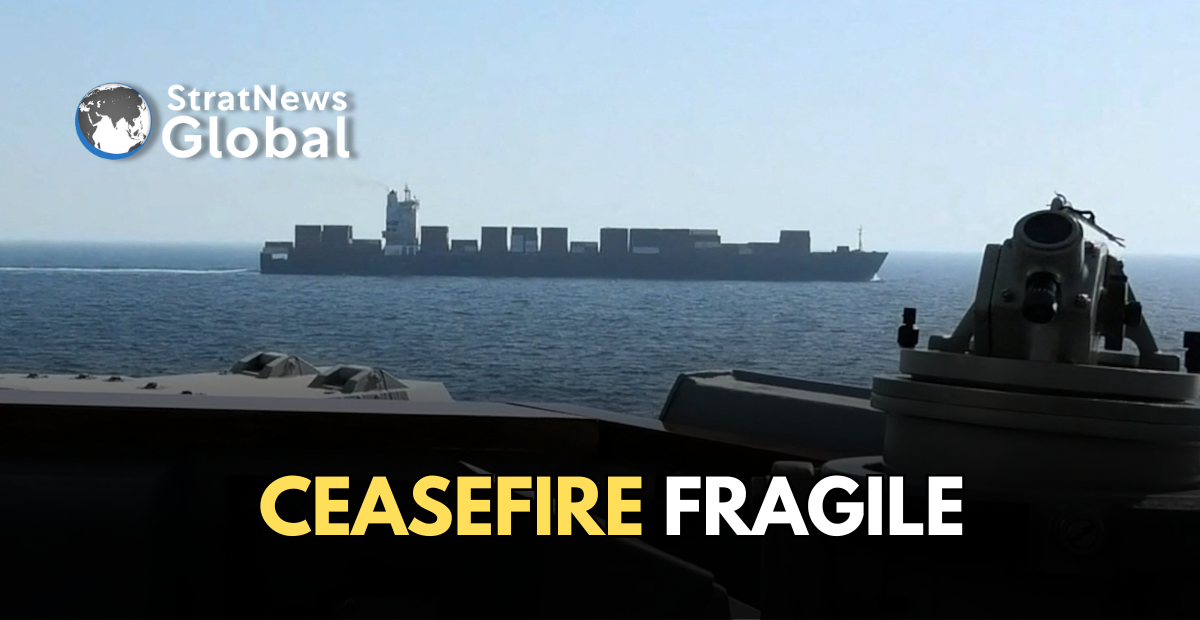
Concerns grew on Monday that the ceasefire between the United States and Iran might not hold after the U.S. said it had seized an Iranian cargo ship that tried to run its blockade and Iran vowed to retaliate.
Efforts to build a more lasting peace in the region likewise appeared to be on shaky ground, as Iran said it would not participate in a second round of negotiations that the U.S. had hoped to kick off before the ceasefire expires on Tuesday.
The U.S. has maintained a blockade of Iranian ports, while Iran has lifted and then reimposed its own blockade on marine traffic passing through the Strait of Hormuz, which typically handles roughly one-fifth of the world’s oil supply.
The U.S. military said Sunday it fired on an Iranian-flagged cargo ship as the vessel sailed toward Iran’s Bandar Abbas port. “We have full custody of their ship, and are seeing what’s on board!” President Trump wrote on social media.
Iran’s military said the ship had been travelling from China. “We warn that the armed forces of the Islamic Republic of Iran will soon respond and retaliate against this armed piracy by the U.S. military,” a military spokesperson said, according to state media.
Oil prices jumped, and stock markets wobbled, as traders pondered the prospect that traffic in and out of the Gulf would remain at a bare minimum.
Iran Rejects Peace Talks
Iranian state media reported that Tehran had rejected new peace talks, citing the ongoing blockade, threatening rhetoric, and Washington’s shifting positions and “excessive demands.”
“One cannot restrict Iran’s oil exports while expecting free security for others,” Iran’s First Vice President Mohammadreza Aref wrote on social media. “The choice is clear: either a free oil market for all, or the risk of significant costs for everyone.”
Trump earlier warned Iran that the U.S. would destroy every bridge and power plant in Iran if Tehran rejected his terms, continuing a recent pattern of such threats.
Iran has said that if the United States were to attack its civilian infrastructure, it would hit power stations and desalination plants of Gulf Arab neighbours.
Talks May Not Take Place
Trump said his envoys would arrive in Islamabad on Monday evening, one day before a two-week ceasefire ends.
A White House official told Reuters the U.S. delegation would be headed by Vice President JD Vance, who led the war’s first peace talks a week ago, and also include Trump’s envoy Steve Witkoff and son-in-law Jared Kushner. But Trump told ABC News and MS Now that Vance would not go.
Pakistan, which has served as the main mediator, appeared to be preparing for the talks. Two giant U.S. C-17 cargo planes landed at an air base on Sunday afternoon, carrying security equipment and vehicles in preparation for the U.S. delegation’s arrival, two Pakistani security sources said.
Municipal authorities in the Pakistani capital of Islamabad halted public transport and heavy-goods traffic through the city. Barbed wire was rolled out near the Serena Hotel, where last week’s talks were held. The hotel told all guests to leave.
(With inputs from Reuters)