Donald Trump’s push for more Muslim-majority countries to join the Abraham Accords has exposed a problem several governments have tried to avoid for years: their strategic interests increasingly favour engagement with Israel, while their political rhetoric still depends on opposing it.
No countries illustrate this contradiction better than Pakistan, Saudi Arabia, and Türkiye.
The Abraham Accords, signed in 2020 during Trump’s first term, normalised relations between Israel and the UAE, Bahrain, Morocco, and Sudan. Jordan did not sign the Accords, as it had already formally normalised diplomatic and economic relations with Israel in 1994.
The agreements effectively ended the old Arab position that Israel could not be recognised before the creation of a Palestinian state.
The message was simple: national interests now mattered more than ideological slogans.
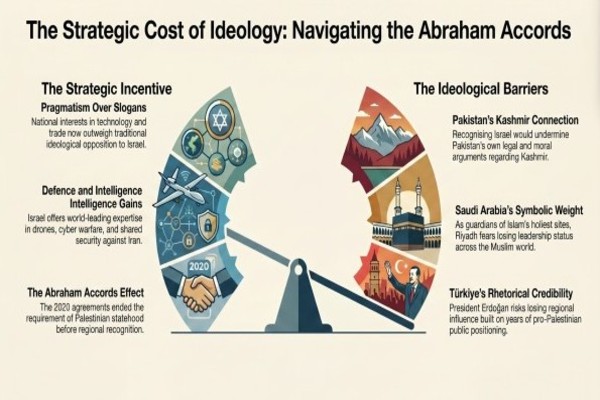
For the UAE and Bahrain, the calculation was straightforward. Israel offered technology, intelligence cooperation, trade, and a shared front against Iran. Public hostility toward Israel no longer made strategic sense.
Trump now wants more countries to follow.
But Pakistan, Saudi Arabia, and Türkiye face political constraints the Gulf monarchies largely avoided.
Pakistan’s problem is the deepest because opposition to Israel is tied directly to the ideological foundations of the Pakistani state.
Pakistan was created in 1947 as a homeland for Muslims during the partition of British India. Over time, support for Palestine became embedded in Pakistan’s national identity. Pakistani governments repeatedly linked Palestine with Kashmir, arguing both involved Muslim populations denied justice by occupying powers.
That comparison became central to Pakistan’s political narrative.
If Pakistan recognises Israel without a Palestinian state, it weakens its own arguments over Kashmir. India would immediately point out the contradiction. So would critics inside Pakistan.
The domestic risks are even greater.
Pakistan spent decades encouraging Islamist politics, especially during General Zia-ul-Haq’s Islamisation campaign in the 1980s. Anti-Israel rhetoric became deeply embedded in school textbooks, religious discourse, political speeches, and media narratives.
Support for Palestine stopped being just foreign policy. It became part of religious identity.
That creates a serious problem for Islamabad today. Any government openly joining the Abraham Accords could trigger protests, Islamist mobilisation, and accusations of betraying Islam itself.
Pakistan’s military establishment likely understands the strategic advantages of engaging Israel better than most politicians do. Israel’s expertise in drones, cyber warfare, missile defence, and intelligence is respected globally. There have long been rumours of quiet contacts between Pakistani and Israeli officials.
But quiet pragmatism is easier than public recognition.
Trump’s pressure makes the issue harder because it turns a gradual geopolitical shift into a public test of political loyalty. It also complicates Pakistan’s attempt to present itself as a mediator in the current West Asia crisis. Islamabad has tried to back the Palestinian cause while avoiding direct confrontation with Washington and Gulf states moving closer to Israel.
But once recognition of Israel becomes an explicit public issue, that balancing act weakens. Refusing makes Pakistan look isolated, while softening its stance risks domestic accusations that it is quietly abandoning the Palestinian cause altogether.
Saudi Arabia faces a different dilemma.
Riyadh is the biggest prize Trump wants. If Saudi Arabia formally recognises Israel, the symbolic impact would be enormous. Saudi Arabia is home to Islam’s holiest cities and remains one of the most influential Muslim countries.
Strategically, Saudi and Israeli interests already overlap heavily. Both see Iran as the primary regional threat. Israeli technology, intelligence capabilities, and security cooperation are attractive to Riyadh.
But Saudi Crown Prince Mohammed bin Salman also understands the political risks.
The Gaza war reignited public anger across the Arab world. Images from Gaza made open normalisation with Israel politically harder than it was in 2020. Saudi Arabia cannot appear to abandon the Palestinian cause entirely without risking damage to its standing across the Muslim world.
This leaves Riyadh balancing strategic interests against public optics.
Saudi leaders prefer gradual movement and quiet diplomacy, but Trump prefers public pressure and headline announcements.
Türkiye’s position is different again.
Unlike Pakistan or Saudi Arabia, Türkiye already recognises Israel and has done so since 1949. The two countries have maintained diplomatic relations, trade ties, tourism, and periods of military cooperation for decades.
Yet under Recep Tayyip Erdoğan, Türkiye became one of the Muslim world’s loudest critics of Israel.
Erdoğan built much of his regional image through pro-Palestinian rhetoric and public confrontations with Israeli leaders. Events like the 2010 Mavi Marmara raid strengthened his standing among Islamist audiences across the region.
But despite the rhetoric, Türkiye never fully broke relations with Israel.
Trade continued. Diplomatic channels survived. Economic ties remained significant even during periods of public hostility.
That exposed Erdoğan’s balancing act: public confrontation combined with private pragmatism.
The Abraham Accords complicate that strategy because they normalise open cooperation with Israel rather than quiet transactional ties. Erdoğan cannot openly support a Trump-backed normalisation process without undermining years of anti-Israel positioning.
For Türkiye, the issue is also about regional influence. Erdoğan wants Türkiye seen as a leading voice for Muslim causes. Openly embracing the accords would weaken that image and hand political ground to rivals like Iran.
That is why all three countries now look uncomfortable for different reasons.
- Pakistan fears ideological backlash.
- Saudi Arabia fears political fallout.
- Türkiye fears losing rhetorical credibility.
Yet all three also understand that regional politics have changed.
Many Muslim governments no longer see Israel as their primary enemy. Iran, economic competition, technology, and regional security concerns matter far more than old ideological positions.
The Abraham Accords simply exposed that reality publicly.
Trump believes pressure and public demands accelerate history. Sometimes they do. But in this case, his approach may slow the process by making normalisation politically toxic for governments that prefer ambiguity and gradual change.
Pakistan, Saudi Arabia, and Türkiye are not hesitating because engagement with Israel lacks strategic value.
They are hesitating because decades of political rhetoric trapped them.