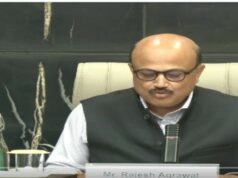
The bombing of Air India’s Kanishka in 1985, which killed 329 people on board (mostly Canadian citizens of Indian origin), needs to reach a logical conclusion even as it needs to be proven how that incident gave rise to “Khalistani terrorism” in India, said former High Commissioner of India to Canada, Sanjay K. Verma, who was declared persona non grata by Ottawa in October 2024.
Speaking exclusively on StrateNews Global, Verma said, “The Kanishka bombing issue needs to reach a conclusion. And in that conclusion, we would very much appreciate the names of those who were involved in the Kaniska bombing – dead or alive – are also released. How have they been able to drive Khalistani terrorism in Canada for such a long time, that should also be released.”
“And when it happens in Canada, the same Khalistani terrorists living in other countries also take a clue. So I will not treat it as only a Canadian episode. This episode influenced similar episodes, not bombing as such, but similar episodes of radicalisation elsewhere. So it’s a mother gravy, and I would like to spoil the mother gravy,” said Verma.
In October 2024, Canada declared Verma and five other diplomats persona non grata, expelling them in connection with the investigation into the 2023 assassination of Sikh separatist leader Hardeep Singh Nijjar, a prominent Khalistani leader, in Surrey, British Columbia.
Referring to the commission established by the Canadian government in 2006 on the Kanishka bombing, Verma said, Ottawa had “already realised that the entire investigation was botched up and therefore the closure was not reached.”
“Those who were responsible for this, whom the Khalistani terrorists celebrated in their posters and statements, were let off. Because there was not enough evidence. What I understand is that evidence was there, which was later on destroyed. So that’s my understanding. I would stand corrected if there’s anything new on that.”
The Kanishka bombing was a defining act of aviation terrorism, making it the worst mass murder in Canadian history. The attack, which involved a Boeing 747 on a Montreal-Delhi route, was linked to Canada-based Sikh militants in retaliation for Operation Blue Star.
Following a 2010 inquiry, the incident was described as a result of a “cascading series of errors” by Canadian authorities, including ignored warnings and destroyed wiretap evidence. The bombing was allegedly planned and executed in Canada.
In February 2025, the Narendra Modi government had informed the Rajya Sabha that the Canadian Security Intelligence Service (CSIS) had “ineffective” surveillance due to which the bombing happened.
‘Khalistan Biggest Concern’
According to Verma, the current Mark Carney dispensation in Ottawa is “not voicing Khalistani propaganda.”
“The Khalistan issue is the biggest concern in our ties… You have Canadian citizens in Canada trying to challenge India’s sovereignty and territorial integrity. Which country will like it? This is not only illegal in international law, it should have also been declared illegal in Canada.”
In October 2024, the Royal Canadian Mounted Police (RCMP) and the Canadian government officially designated Verma as a “person of interest” in the investigation into the Nijjar case. This designation was a primary catalyst for the most severe diplomatic breakdown between the two nations in decades.
However, earlier this month, the RCMP said, there are “no longer clandestine activities or transnational repression taking place in Canada” that are linked to the government of India. This came within days of the successful maiden visit to India by Canadian Prime Minister Carney.
The criminal case regarding the June 2023 killing of Hardeep Singh Nijjar in Surrey, B.C., is in the pre-trial phase in British Columbia courts, with four Indian nationals—Karan Brar, Kamalpreet Singh, Karanpreet Singh, and Amandeep Singh—charged with first-degree murder and conspiracy. The accused remains in custody as of early 2025, and the case has faced multiple adjournments.
“They are not Indian citizens. They have no right to decide the future or fate of India. Whether India will be divided into two countries or whether India’s political leadership should behave in a certain manner, they are no one to tell us. It is for Indian citizens, it is for the Indian electorates to talk about these issues, which are domestic to India and this is a domestic issue to India,” said Verma.
He added, “My biggest difficulty with this approach, which countries like Canada take on, is calling it freedom of speech. If your freedom of speech is impinging on my territorial integrity and my sovereignty, should I welcome that? What would happen if the same thing happened with other countries?”
“This is the largest political issue between the two countries. When the Khalistani terrorists talk of killing the Indian High Commissioner in Canada, maligning the image of India by showing the violence through which India’s former prime minister was killed, is it not hate speech? Is it not incitement to violence? And therefore it should be held as such under Canadian law. But what we found at that point in time was that even the (Canadian) government was hand in glove.”