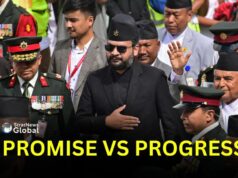
A veteran Bangladeshi diplomat, Mohammad Harun Al Rashid quit his ambassadorial post in Morocco after Prime Minister Sheikh Hasina was ousted in August 2024, denouncing what followed as an imposed and illegitimate transfer of power. The installation of Muhammad Yunus at the head of an interim government, he argues, was not a corrective transition but the opening act of a deliberate state capture—one that has allowed jihadist forces to move from the political margins into the centre of power under the cover of procedural legality.
From his base in Canada, Al Rashid dismisses the coming polls as a manufactured exercise designed to legitimise that capture rather than test popular will. With the Awami League barred from contesting, he says the election excludes roughly half the electorate while empowering actors fundamentally hostile to secular governance. For India, he warns, this is not an abstract democratic deficit but a direct security threat: a radicalised Bangladesh emerging through a sham electoral process would expose India’s eastern flank to sustained ideological, political, and militant pressure. “You cannot call this an election,” Al Rashid says, “when it is being used to install forces that endanger the region.”
What sets Al Rashid apart from many ex-officials is the bluntness of his critique. Dispensing with diplomatic restraint, he argues that Islamist groups in Bangladesh have long viewed elections not as instruments of accountability but as tactical entry points into the state. Once power is secured, he says, democratic norms are hollowed out rather than strengthened. Promises of moderation, women’s empowerment, or clean governance, he contends, are tools of mobilisation rather than binding commitments.
Al Rashid is equally dismissive of claims that India erred by concentrating its engagement on a single political force. The idea that New Delhi could have hedged across multiple “baskets,” he argues, reflects a fundamental misunderstanding of Bangladesh’s political landscape. In his assessment, the major alternatives are either ideologically aligned with Islamist politics or structurally dependent on them. For India, he insists, the choice was never between multiple friendly options, but between one imperfect partner and several adversarial outcomes.
His criticism extends to the international response. Al Rashid argues that Western governments have treated Bangladesh as strategically expendable, tolerating instability so long as short-term compliance is maintained. Limited scrutiny, he says, has emboldened radical actors while weakening the very institutions meant to contain them. The cost of that indulgence, he warns, will not be confined within Bangladesh’s borders.
For Al Rashid, the stakes are no longer about partisan politics or legacy. An election that confers legitimacy on jihadist power, he argues, marks a decisive break in Bangladesh’s post-1971 trajectory. Once institutionalised, such a shift will be difficult to reverse—and its consequences, he cautions, will be felt first and most sharply beyond Bangladesh itself.
Watch the full interview to get an insider’s candid and outspoken view of how the rise of radical Islam in Bangladesh could reshape and endanger not just India and the entire region, but perhaps even the world.