IAEA chief Rafael Grossi said North Korea has made major progress in nuclear weapons production, likely adding a new uranium enrichment facility and increasing activity at a key site.
Uranium enrichment offers a more effective route to weapons-grade material than reprocessing plutonium from reactors, experts say.
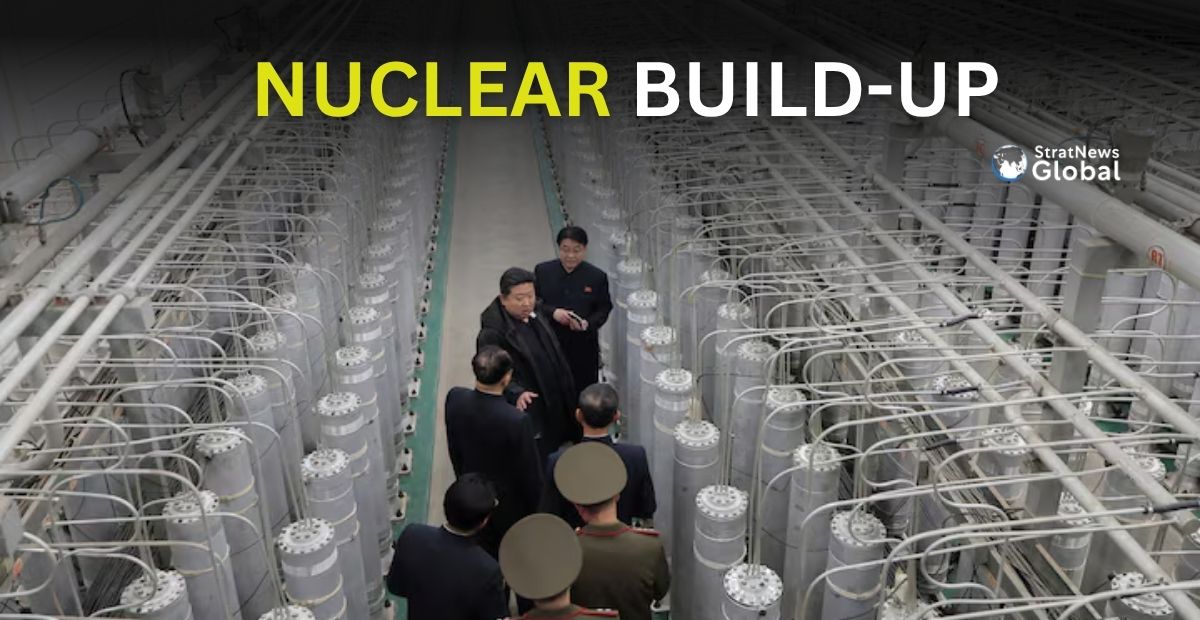
Speaking in Seoul, the head of the International Atomic Energy Agency (IAEA) confirmed a rapid rise in activity at the 5-megawatt reactor, the reprocessing unit, a light water reactor and other facilities at the North’s Yongbyon nuclear complex.
Few Dozen Warheads Estimated
North Korea’s nuclear programme was estimated at a few dozen warheads, he told a news conference, citing signs of activity such as the operation of a light water reactor and activation of other facilities besides Yongbyon.
The watchdog had observed construction of a new facility similar to Yongbyon’s uranium enrichment halls, he said, adding that analysis of external features showed a significant expansion of enrichment capacity.
Grossi told a meeting of the agency’s governors this month that it was monitoring a new building at Yongbyon with similarities to an enrichment facility at Kangson, another key nuclear site near the capital Pyongyang.
Satellite Imagery Supports IAEA Assessment
Satellite imagery from April supported the IAEA’s assessment, the U.S.-based Center for Strategic and International Studies said on Monday.
It indicated completion of a suspected uranium enrichment plant capable of producing weapons‑grade material, the centre said in a report.
On Wednesday, Grossi said the agency had not seen any evidence of Russian technology being used in North Korea’s nuclear weapons programme.
References in a cooperation pact both countries signed last year appeared to be limited to civilian nuclear projects, though it was too early to draw firm conclusions, he added.
South Korea’s Nuclear Submarine Plan
Turning to South Korea’s programme to build nuclear-powered submarines, Grossi said he invited Seoul to work closely with the agency to avert proliferation risks, with formal talks to begin on the matter.
Naval reactors pose special challenges as nuclear fuel on submarines can go uninspected for long periods during missions.
South Korean Foreign Minister Cho Hyun reaffirmed in a meeting with Grossi that the country will work with the IAEA with transparency on the nuclear submarine project as a party to the Non-Proliferation Treaty that has taken the highest degree of safeguard measures, the ministry said in a statement.
South Korea’s submarine ambitions advanced after President Lee Jae Myung and U.S. President Donald Trump finalised joint steps on trade and security last November, in which Washington approved its ally’s plan to build the nuclear-powered vehicles.
(With inputs from Reuters)