Part One of a Two-Part Series
Prime Minister Sanae Takaichi’s visit to New Delhi produced agreements spanning defence technology, artificial intelligence, semiconductors, critical minerals and energy security.
Yet one announcement deserves far more attention than it has received. Japan plans to deepen its engagement with West Bengal, Assam and the Northeast, signalling that it now sees eastern India as central to its long-term Indo-Pacific strategy. In fact, Takaichi was initially due to be hosted in Assam, but the programme was moved to New Delhi owing to her packed schedule and logistical considerations.
The shift in focus marks a new phase in the India-Japan relationship. Tokyo is no longer looking at India simply as a vast market or an investment destination. It increasingly sees India’s eastern seaboard as the point where trade, technology and geopolitics converge, linking South Asia with Southeast Asia through the Bay of Bengal.
The idea is not new. When Prime Minister Shinzo Abe addressed the Indian Parliament in 2007, he spoke of the “Confluence of the Two Seas”, arguing that the Indian and Pacific Oceans formed a single strategic space rather than separate regions. At the time, the concept seemed ambitious. Today, it underpins Japan’s Indo-Pacific policy, and nowhere is it more evident than in Tokyo’s growing interest in eastern India.
The choice of West Bengal, Assam and the Northeast is no accident. For decades, India’s economic outlook was directed westwards towards the Gulf and Europe. That is changing. West Bengal opens onto the Bay of Bengal, while Assam and the Northeast connect India with Bangladesh, Myanmar and Southeast Asia. As New Delhi pursues its Act East policy and companies seek alternatives to manufacturing concentrated in China, these states are becoming India’s gateway to the east rather than its distant frontier.
Japan wants to help build that gateway.
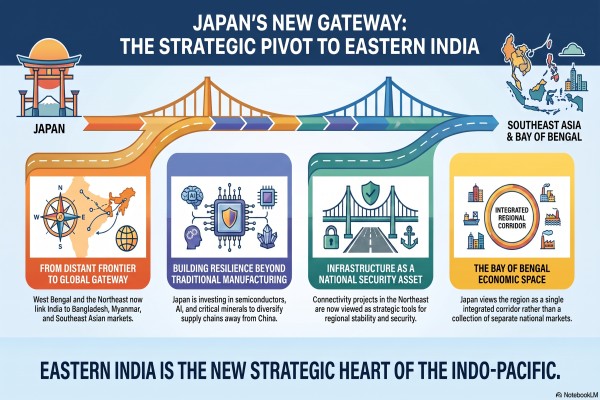
The agreements announced during Takaichi’s visit reflect that ambition. Japan will expand cooperation in industrial corridors, semiconductors, biofuels, logistics and skills development while supporting value chains linking the Northeast with the Bay of Bengal through BIMSTEC. Individually, these projects appear developmental. Collectively, they are designed to integrate eastern India more closely with regional production networks stretching across Southeast Asia.
The benefits extend beyond trade. Better roads, railways and logistics hubs strengthen one of India’s least-connected regions while improving access to its northeastern frontier, where economic development and national security increasingly reinforce one another. The experience of the 2020 border crisis demonstrated that infrastructure is no longer just an economic asset. It is also an important strategic capability.
Bangladesh gives this vision its practical shape. Better road, rail and river links shorten the distance between mainland India and the Northeast while opening faster routes into Myanmar and Thailand. Japan’s investments on both sides of the border suggest it increasingly views the Bay of Bengal as a single economic space rather than a collection of separate national markets. For India, that strengthens the Act East policy. For Japan, it reduces dependence on manufacturing and logistics networks concentrated in China.
That is also why the Bay of Bengal is attracting renewed attention. For years, discussion of the Indo-Pacific focused largely on the South China Sea and the western Pacific. The Bay of Bengal remained in the background despite linking South Asia with Southeast Asia. As companies diversify production and governments seek more secure supply chains, that is beginning to change. The region is emerging as one of Asia’s most important economic corridors, and Japan’s growing engagement with eastern India reflects that new geography rather than simply another overseas development programme.
China is scarcely mentioned in the summit documents, yet it shapes much of the thinking behind them. Rather than reduce economic ties with Beijing, India and Japan are trying to reduce strategic dependence on it. That explains the emphasis on semiconductors, critical minerals, economic security and more diversified supply chains. The objective is not confrontation but greater resilience, giving both countries and their industries more options in an increasingly uncertain global economy.
Another factor lies further east. Japan’s alliance with the United States remains the cornerstone of its security policy, but President Donald Trump’s return has revived concerns in Tokyo about the future direction of American policy. His first term raised difficult questions over tariffs, alliance burden-sharing and Washington’s increasingly transactional approach to its partners. Japan’s response has not been to distance itself from the United States, but to deepen ties with trusted partners that can strengthen its long-term strategic position. India has become one of the most important because it combines economic scale, technological ambition and growing regional influence without being bound by a formal alliance system.
This shift did not emerge overnight. Nearly a decade ago, a study by the US Institute for National Strategic Studies argued that India and Japan were natural partners because both sought a stable balance of power in Asia while sharing concerns about China’s growing influence. Much of that assessment has since been borne out. What began as a relationship centred on Japanese investment and development assistance has steadily expanded into cooperation on advanced technologies, energy security, critical minerals, resilient supply chains and regional security.
The transformation reflects a broader change in the nature of power itself. Japan was once seen primarily as one of India’s largest development partners, financing metro systems, industrial corridors and major infrastructure projects. Today, it is also working with India on semiconductors, artificial intelligence, clean energy and other technologies that are becoming central to both economic competitiveness and national security. The relationship is evolving from infrastructure to capability, mirroring the changing priorities of both countries.
That shift is perhaps most visible in eastern India. For decades, West Bengal and the Northeast were viewed largely through the lens of regional development. Japan now sees them differently. They sit at the intersection of India’s domestic transformation and the wider reordering of Asian trade and manufacturing. Better transport links, industrial investment and closer integration with Bangladesh and Southeast Asia could reshape commerce across the Bay of Bengal while giving India a stronger economic presence to its east.
The story of India-Japan relations is no longer centred solely on New Delhi and Tokyo. Increasingly, it is being written around Kolkata, Guwahati, Dhaka and the Bay of Bengal.
That may prove to be the most enduring legacy of Takaichi’s visit. The significance of the summit lies less in the agreements that were signed than in the geography they reveal. Japan is placing a long-term bet on eastern India because it believes the Bay of Bengal will become one of Asia’s defining economic and geopolitical corridors over the coming decades. For India, that brings investment, technology and stronger links with Southeast Asia. For Japan, it creates a trusted partner at the heart of a region that is becoming increasingly important to global trade, manufacturing and supply-chain resilience.
Japan is no longer investing only in India’s growth story. It is investing in the geography it believes will shape Asia’s future.
Next: The Quiet Security Axis Reshaping the Indo-Pacific
Japan’s investment in eastern India is only one part of the story. Equally important is the quiet transformation of India-Japan defence ties—from naval exercises and logistics agreements to advanced technology, maritime security and industrial cooperation. Tomorrow, we examine how two democracies are building one of the Indo-Pacific’s most consequential security partnerships.