History suggests that nations rarely diminish because they become weak. More often, they squander their strength through poor judgement.
Donald Trump’s latest proclamation on the Strait of Hormuz suggests the United States may be flirting with precisely that danger.
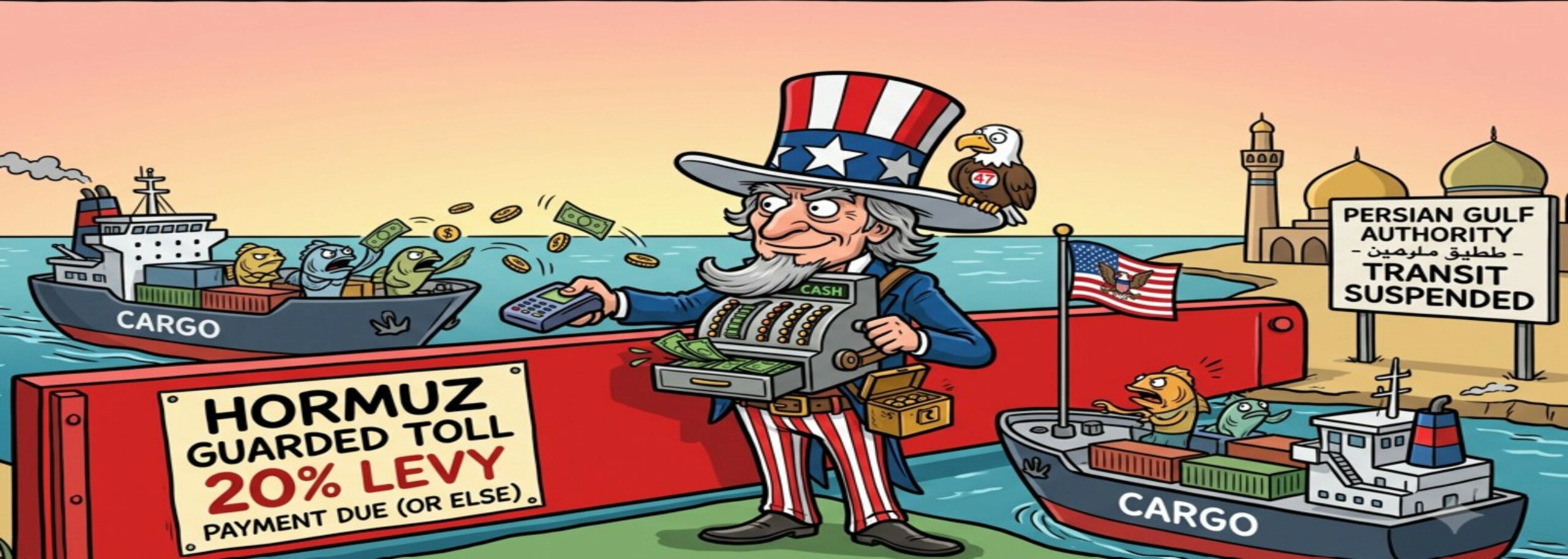
Declaring America the “Guardian of the Hormuz Strait”, Trump announced on Truth Social that the United States would keep the waterway open, blockade Iranian shipping and recover the costs by charging a 20 per cent levy on cargo transiting one of the world’s busiest maritime corridors.
— Rapid Response 47 (@RapidResponse47) July 13, 2026
It is difficult to think of another instance in modern diplomacy where the leader of a major power has proposed treating one of the world’s most important international waterways as though it were a privately managed toll road.
Nor is this an isolated flourish.
During the brief ceasefire with Iran in June, Trump suggested the United States could impose tolls on shipping through Hormuz if negotiations collapsed, describing America as the Gulf’s “Guardian Angel”. Days later, Secretary of State Marco Rubio publicly reaffirmed the long-standing American position that no country should levy tolls on an international waterway.
Less than a month later, the President appears to have abandoned that principle altogether.
That contradiction is more than an embarrassment. It reveals an Iran policy whose objectives seem to shift with events rather than shape them.
When Washington launched Operation Epic Fury on February 28, the mission appeared straightforward. The operation was presented as swift, decisive and limited. It would degrade Tehran’s nuclear programme, restore American deterrence and avoid dragging the United States into another prolonged conflict in West Asia.
Instead, Washington soon found itself confronting precisely the instability it had promised to avoid. Iran retaliated, regional tensions intensified, shipping companies reassessed risks, insurance costs climbed and energy markets turned volatile. The administration’s focus shifted from showcasing military success to containing escalation.
Since then, the stated objective has proved remarkably fluid. The mission has moved from degrading Iran’s nuclear capability to restoring deterrence, then to preventing regional escalation, preserving freedom of navigation and now, astonishingly, charging the users of that navigation. The destination seems to change every time events refuse to follow the original script.
Even as Trump declared Hormuz open, Iran’s newly established Persian Gulf Strait Authority, created only weeks ago as Tehran sought to tighten its control over the waterway, announced that passage through the Strait was “currently unfeasible” because of recent US military action and that transit permits would remain suspended until stability returned.
Two governments are once again issuing competing proclamations over one of the world’s most strategically important waterways, each asserting authority over who can pass and on what terms.
The irony, however, runs much deeper.
For decades, the United States portrayed itself as the principal defender of the global maritime order. Freedom of navigation was not a commercial service but a strategic principle. American naval power protected international sea lanes because they were meant to remain open to all, free from coercion, arbitrary restrictions and unilateral taxation.
Now Washington appears to be arguing that safeguarding those same sea lanes comes with an invoice.
Nearly a fifth of the world’s oil passes through the Strait of Hormuz. Even the perception of instability there reverberates through energy markets, insurance premiums and freight costs. Europe fears another energy shock. Asian economies worry about supply chains.
India, which depends heavily on crude oil shipped through Hormuz, has every reason to be concerned. Strategic confusion in Washington quickly becomes economic pain elsewhere.
America’s allies are left wondering which statement reflects settled policy. Its adversaries have learnt that patience can be an effective strategy when Washington keeps revising its own objectives.
Markets, meanwhile, have become accustomed to treating presidential social media posts as events capable of moving billions of dollars within minutes.
None of this reflects a shortage of American power. The United States remains the world’s foremost military and diplomatic power. But power rests as much on credibility as capability, and credibility depends on consistency.
For nearly eight decades, American influence has rested not only on unmatched military strength but also on the belief that Washington knew where it was going. That confidence is beginning to erode.
Trump’s latest Hormuz fantasy may never become policy. Like many dramatic presidential pronouncements, it may quietly disappear beneath the next announcement, the next crisis and the next attempt to regain the initiative.
But that is precisely the problem. When the world’s leading power keeps rewriting its objectives, uncertainty ceases to be a consequence of policy. It becomes the policy.
And the rest of the world is left paying the bill.