Two manifestos walk into Bangladesh’s 2026 election season.
One arrives with a 26-point master plan, sub-plans inside plans, and an unshakeable belief that CCTV cameras and digitisation can cure most human failings.
The other comes dressed in institutional nostalgia, insisting it has governed before, understands the machinery of the state, and merely needs the keys back.
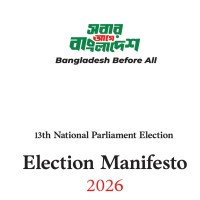
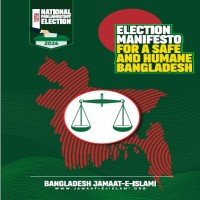
Together, the manifestos of the Bangladesh Jamaat-e-Islami and the Bangladesh Nationalist Party offer less a clash of ideas than a mirror held up to the country’s distorted political moment.
On paper, their diagnoses are almost identical. Corruption is entrenched. Youth unemployment is combustible. Institutions are hollowed out. Prices hurt. Democracy is fragile. Minorities need protection. Women need safety. Voters need dignity.
If manifestos were medical reports, both parties would describe the same critically ill patient. The difference lies not in what they see, but in how confidently each claims to be the cure.
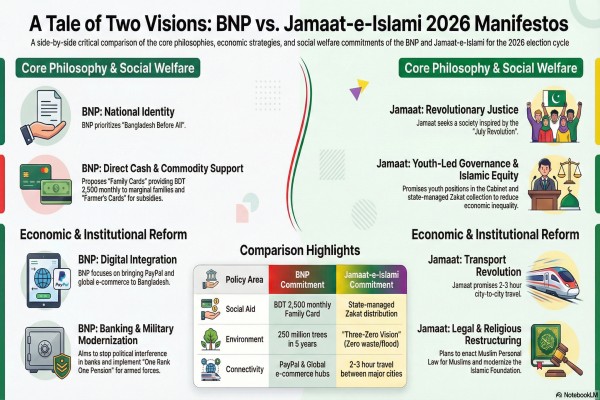
Jamaat’s manifesto reads like a comprehensive state redesign exercise. It promises “fundamental reform” of governance, parliament, elections, policing, courts, administration, media, local government, and the economy—often simultaneously.
There will be accountability councils, free government job applications, proportional representation, AI-driven public services, digitised grievance systems, and CCTV cameras in offices and institutions. The underlying faith is unmistakable: engineer the system tightly enough, and virtuous outcomes will follow.
BNP, by contrast, frames its promises as restoration rather than reinvention. It speaks of reviving parliamentary democracy, reasserting checks and balances, strengthening the Election Commission, restoring judicial independence, and returning politics to constitutional norms.
Where Jamaat sounds like it is installing Bangladesh 2.0, BNP promises to repair Bangladesh 1.0—patched, stabilised, and returned to something resembling factory settings.
Economically, both manifestos veer into confident excess.
Jamaat wants a USD 2 trillion economy by 2040, per capita income of USD 10,000, doubled remittances, lower corporate taxes, and a blue economy humming across the Bay of Bengal. BNP counters with trillion-dollar ambitions of its own, private-sector-led growth, export diversification, and financial reform.
Between them, Bangladesh is promised several trillion dollars’ worth of futures, with remarkably little attention paid to where the first trillion will come from.
Employment promises follow a similar pattern. Jamaat proposes a Ministry of Skills Development, district employment offices, employment insurance, and structured overseas labour pipelines. BNP emphasises vocational training, SMEs, rural industries, and overseas jobs. Everyone, it seems, will be employed—assuming the state can process the paperwork.
Yet treating these documents as routine democratic offerings misses the context entirely. This election unfolds amid ideological pressure, voter intimidation, and a shrinking space for dissent. The broader landscape includes a rise in ideologically driven violence and coercion directed at non-Muslim communities, quietly altering the practical meaning of equal citizenship. Participation, in such conditions, is not freely exercised; it is cautiously negotiated.
Most decisively, this is not a competitive election in the normal sense. One of Bangladesh’s principal political parties, the Awami League, has been banned. Whatever one’s judgement of its long and controversial record, its removal by decree fundamentally reshapes the electoral field. When a major party is excluded rather than defeated, manifestos stop functioning as alternatives and begin to resemble parallel monologues.
This reality sharpens how both documents read.
Jamaat’s emphasis on discipline, moral order, and systemic control acquires harder edges in a climate already marked by coercion. BNP’s language of democratic restoration sounds reassuring, but incomplete, when the democratic framework itself has already been narrowed. In this setting, manifestos compete less with each other than with public disbelief.
That is the central indictment of Bangladesh’s manifesto season. These documents overflow with promises of freedom, justice, accountability, and dignity, even as the political environment steadily erodes all four. The most extravagant promise on offer is not the trillion-dollar economy or the corruption-free state, but the insistence that this remains a normal democratic exercise.
And if the arithmetic produces a coalition, voters may discover that promises, like principles, are remarkably flexible once rivals are required to share a cabinet table.
What voters are ultimately offered is not a genuine choice between futures, but a carefully managed menu of permissible hopes. And no manifesto—however detailed, digitised, or nostalgic—can disguise the fact that democracy, here, is being asked to perform long after the stage has been fenced off.