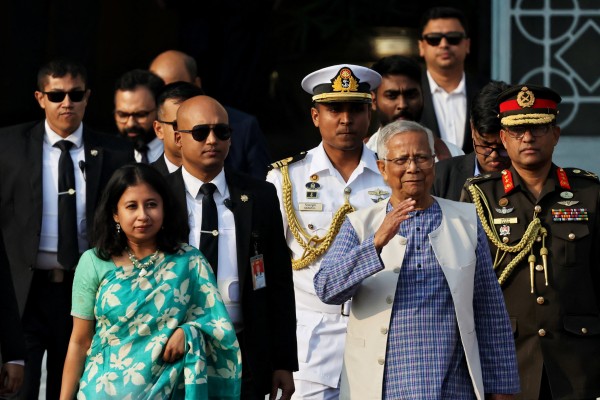
Bangladesh’s economic slide since the political upheaval of August 2024 has unfolded alongside the rise to power of Nobel laureate Muhammad Yunus.
While the country grapples with slowing growth, factory closures and rising poverty, critics say Yunus used his 18-month tenure as head of the interim government to clear legal troubles, expand the reach of the Grameen network he founded and secure personal privileges before leaving office.
For nearly fifteen years before the upheaval, Bangladesh had been one of Asia’s fastest-growing economies. Under former prime minister Sheikh Hasina and the Awami League government, GDP growth averaged above 6%, poverty declined sharply and the country was preparing to graduate from the UN’s Least Developed Country category in 2026.
The political collapse of August 2024 changed that trajectory. After mass protests forced Hasina from office, Yunus—best known internationally for founding microfinance—was installed as chief adviser to an interim administration meant to stabilise the country and oversee elections.
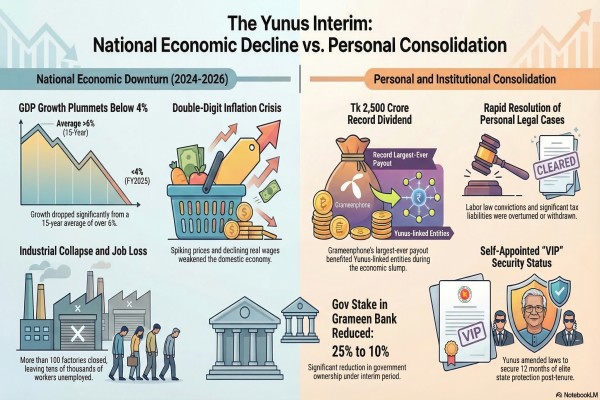
Instead, economic indicators deteriorated quickly. The Asian Development Bank estimated Bangladesh’s growth at below 4% in FY2025, among the weakest performances in decades. Inflation spiked to double digits, real wages declined and unemployment increased as factories shut down amid political uncertainty.
Economic analyses cited by development researchers suggest more than a 100 factories closed in the months following the interim government’s formation, leaving tens of thousands of workers unemployed. Private investment fell sharply as banks struggled with rising non-performing loans and businesses held back amid uncertainty.
Yet even as the broader economy weakened, Yunus moved rapidly to resolve legal cases against himself.
In August 2024, a Dhaka court overturned the conviction of Yunus and colleagues from Grameen Telecom in a labour law case involving profit-sharing payments to workers. Just months earlier, Yunus had been sentenced to six months in prison after prosecutors argued the company failed to establish a legally mandated workers’ welfare fund. Reuters had reported that labour authorities accused the organisation of failing to distribute benefits owed to employees.
Yunus insisted the case was politically motivated. Critics argue the timing of the reversal—days after he assumed control of the interim government—raised serious questions about institutional independence.
Tax disputes involving Yunus also began disappearing. Bangladeshi media reports said cases involving large tax liabilities linked to him were withdrawn or reassessed soon after the interim government took office. Critics say the pattern suggests Yunus used the extraordinary political moment of 2024 to remove legal threats that had long hung over him.
At the same time, regulatory decisions began benefiting institutions linked to the Grameen ecosystem—the network of social businesses and companies built around Yunus.
Among the most controversial was a change affecting Grameen Bank, the microfinance institution Yunus founded in the 1970s. Policy changes reportedly reduced the government’s stake in the bank from 25% to 10% while extending tax concessions to the institution.
Licences were also granted for new ventures tied to the Grameen network, including proposals for a university, a nursing institute and manpower export services. Financial-technology initiatives associated with the group received regulatory approval.
The most striking financial development came in February 2025 when Grameenphone declared what Bangladeshi media described as the largest dividend payout in its history—around Tk 2,500 crore. Because Yunus-linked Grameen Telecom holds a significant stake in the telecom company, critics say the payout channelled enormous financial gains into organisations within Yunus’s orbit.
The most controversial move came just before Yunus left office.
Two days before stepping down, Yunus issued a proclamation declaring himself a “Very Important Person” for the year following his departure from power. The notification—issued under the Special Security Forces Act on February 10, 2026 by the secretary of the Chief Adviser’s Office—guaranteed him elite state security protection for twelve months.
The move required amending a 2006 government order that limited such protection for former heads of government to three months. Legal experts quoted in Bangladeshi media said altering the rule to benefit Yunus himself raised serious constitutional concerns and violated the principle of equality before the law.
Controversy over Yunus’s conduct deepened further in February 2026 when President Mohammed Shahabuddin publicly accused him of constitutional breaches.
In an interview with the Bangla daily Kaler Kantho, Shahabuddin said Yunus repeatedly ignored constitutional protocol, issued ordinances without sufficient justification and attempted to marginalise the presidency during his tenure.
The president said Yunus travelled abroad “14 to 15 times” without briefing him upon return—an established protocol between the head of government and the head of state. Shahabuddin also alleged that elements within the interim administration tried to remove him from office during a volatile period in October 2024 but failed after the armed forces refused to support any unconstitutional move.
Recalling October 22, 2024, Shahabuddin described a “night of nightmare” when mobs surrounded the presidential residence at Bangabhaban amid political tensions. He said military leaders intervened to prevent the situation from escalating.
Yunus has strongly defended his record. In his farewell address he argued the interim government fulfilled its main objectives: institutional reforms, prosecution of alleged crimes linked to the 2024 uprising and the organisation of credible elections. In interviews with international outlets such as The Guardian, Yunus also insisted that earlier legal cases against him were politically motivated.
Even analysts who acknowledge some progress during the interim period say the record is mixed. Economist Debapriya Bhattacharya said macroeconomic stabilisation improved in some areas, while Transparency International Bangladesh executive director Iftekharuzzaman noted that reform commissions produced recommendations but implementation remained uneven.
For Yunus’s critics, however, the picture is clearer.
Bangladesh’s economy has slowed sharply. Investor confidence has weakened. And during the same period, the interim leader who promised reform cleared legal cases, strengthened the institutions tied to his personal network and rewrote government rules to secure special privileges for himself after leaving office.
All this means Prime Minister Tarique Rahman, the leader of the Bangladesh Nationalist Party (BNP) which won a landslide victory in the 13th national parliamentary election in February, has to work that much harder to fix the economy to fulfil the expectations of the people.