A leaked U.S. diplomatic recording has put Washington at the centre of fresh accusations over Bangladesh’s 2024 political upheaval, claims now voiced by figures linked to the Awami League.
The recording, published by The Washington Post January 22nd, captures a senior U.S. diplomat speaking candidly about engaging Bangladesh’s Islamist political forces and assessing the country’s post-Hasina political trajectory, triggering renewed scrutiny of Washington’s role in the transition.
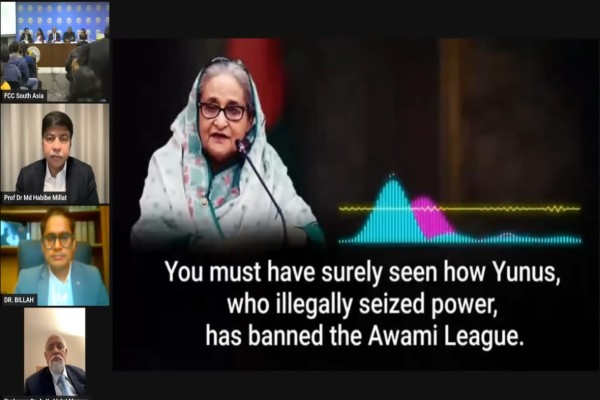
Speaking at an event organised by the Foreign Correspondents’ Club (FCC) of South Asia in New Delhi, former Bangladesh education minister Mohibul Hasan Chowdhury said the audio appeared to validate what the Awami League had long argued—that the fall of Sheikh Hasina was not an entirely organic process.
The FCC event also featured a recorded address by former Prime Minister and Awami League chief Sheikh Hasina, in which she attacked Yunus for running an unelected government and banning the Awami League from the elections slated for February. Hasina, who fled to India on August 5, 2024, after a student protest morphed into a violent uprising which her administration could not control, and has lived in Delhi since.
Pointing to the confidence with which the U.S. diplomat discussed future political outcomes in the leaked recording, Chowdhury argued that predicting electoral trajectories and claiming the ability to manage post-election governments before a vote had taken place suggested advance planning rather than detached analysis. He also warned that excluding major political forces like the Awami League would disenfranchise large sections of the electorate, producing a government with weak legitimacy and a limited public mandate.
While U.S. officials might say their engagement reflects standard diplomacy, the leaked recording raises uncomfortable questions not only about Washington’s dealings with Bangladesh’s Islamist parties but also about how the United States views the country’s political future after Hasina’s removal.
The recording of the December 1, 2025 conversation captures what it describes as a senior U.S. diplomat speaking candidly to Bangladeshi journalists about engaging Islamist political forces.
The assessment is blunt: Bangladesh, the diplomat says repeatedly, has “shifted Islamic.”
On that basis, Jamaat-e-Islami is expected to deliver its strongest electoral performance yet. Washington, by the diplomat’s own account, is not attempting to arrest this shift. Instead, it seeks early access, influence and outreach not only to Jamaat but also to its student wing, Islami Chhatra Shibir, and other conservative religious groups.
Bangladesh’s reliance on Western markets — particularly garment exports — is presented as a built-in restraint. If an Islamist-leaning government were to cross red lines on women’s rights, minority protections, or education, the U.S. and Europe could respond swiftly with tariffs and consumer pressure.
In this framework, ideology is assumed to have limits because the economy does.
This approach is not new.
In Egypt, U.S. support for the inclusion of the Muslim Brotherhood after the Arab Spring was based on the belief that electoral responsibility and economic exposure would moderate behaviour. Instead, polarisation deepened, and the experiment ended with a return to military rule.
In Afghanistan, prolonged engagement with the Taliban rested on similar assumptions about leverage and restraint, which proved ineffective once power was secured.
It is against this backdrop that the praise for Muhammad Yunus in the leaked transcript has drawn scrutiny. The U.S. diplomat speaks approvingly of Yunus’s political skill, his handling of rival parties, and his role in stabilising the country after Hasina’s fall. He is framed not simply as a neutral caretaker but as a capable manager of a transition Washington appears broadly comfortable with — one that accommodates Islamist participation while remaining responsive to Western pressure.
There might not be any hard evidence that Yunus was installed by the United States, but the tone of the endorsement matters.
Domestically, it complicates claims of neutrality. Strategically, it signals to Islamist actors that international legitimacy flows primarily through engagement with Washington. India, notably, does not feature in that equation.
This is clearly not an abstract concern for New Delhi. Islamist politics in Bangladesh intersects directly with India’s border security, internal stability in the eastern states, minority protection, and counter-radicalisation efforts.
And unlike Washington, India does not have the luxury of distance. Groups such as Jamaat-e-Islami and Islami Chhatra Shibir have historically been hostile to Indian interests and capable of mobilising street violence. Under Hasina, those forces were contained, forming the bedrock of India’s eastern security calculus.
What the leaked recording exposes might not be deliberate U.S. hostility toward India, but a widening divergence in priorities. Washington appears confident that markets restrain ideology, that access matters more than alignment, and that Islamist actors can be socialised through incentives and penalties.
India’s experience suggests otherwise.
Once normalised, ideological movements often respond more to identity and symbolism than to economic cost. Even limited shifts — in education, public rhetoric, or minority treatment — can have outsized regional consequences.
The United States can afford to test these assumptions and recalibrate if they fail. But India will have to bear the consequences.
An Awami League supporter at the Delhi event said the leaked audio “strips away the pretence” and shows Washington “talking openly about who should win, who should be marginalised, and how Bangladesh should be run.”
References to media framing, pressure on the BNP, assurances about Jamaat-e-Islami, and warnings linked to the garments trade amounted to “coercion dressed up as diplomacy”, he said, adding that the praise for Muhammad Yunus reinforced fears that the transition was being engineered to suit external interests rather than the will of Bangladeshi voters.
The Hasina years allowed New Delhi to equate stability with alignment. That equation no longer holds.
The leaked audio might not prove regime-change orchestration, but it does show Washington prioritising flexibility over partnership.
The U.S. wants options in Dhaka. India needs certainty on its doorstep.
Confusing the two would be the real strategic error.