Prime Minister Narendra Modi’s February 25, 2026 arrival in Israel—personally received at the airport by Prime Minister Benjamin Netanyahu and his wife—was more than ceremonial warmth.
The timing, amid speculation of a US-backed Israeli strike on Iran, invited accusations that New Delhi was abandoning its long-held balancing posture in West Asia. Such readings, however, risk oversimplifying what is in fact a calculated, interest-driven consolidation of a relationship that has been deepening for over three decades.
Since the resumption of full diplomatic ties in 1992, India–Israel relations have evolved into what can fairly be described as symbiotic. Both states inhabit hostile neighbourhoods, confront persistent terrorism, and prize hard security capabilities. Intelligence sharing, counter-terrorism coordination, border management technologies and high-end defence systems have formed the quiet backbone of this engagement. Crucially, Israel has respected India’s doctrine of strategic autonomy—an assurance that has allowed New Delhi to deepen cooperation without appearing subordinate to a bloc.
Diplomatically, the relationship carries layered utility. For Israel, India is a major Global South power capable of widening its diplomatic bandwidth beyond traditional Western allies. For India, Israel is a technologically advanced, politically supportive partner in West Asia that strengthens its regional balancing strategy without entangling it in formal alliances. The utility is mutual: diversification for Israel, calibrated leverage for India.
The symbolism of Modi’s address to the Knesset—the first ever by an Indian prime minister—reinforced this maturing confidence. Framing the partnership around democracy, pluralism and the rule of law, he invoked both Tikkun Olam and Vasudhaiva Kutumbakam, situating the bilateral relationship within shared civilisational vocabularies rather than transactional expediency. If 2017 broke taboos, 2026 normalised strategic candour.
The centrepiece of the visit was the elevation of ties to a “special strategic partnership”—a designation Israel reserves for key allies. This move codifies what had long existed informally: deep collaboration in defence, intelligence, high technology and crisis support. Importantly, it also signals a shift beyond a buyer–seller dynamic. Joint development, joint production and technology transfer now explicitly anchor the relationship, aligning with India’s Make in India and Atmanirbhar Bharat imperatives.
The November 2025 Defence Cooperation MoU—expanded during this visit—extends cooperation into artificial intelligence, cybersecurity, research, training and advanced weapons integration. Future collaboration is likely to fuse Israeli dual-use innovation with Indian manufacturing scale, embedding advanced technologies into command-and-control systems and surveillance architectures.
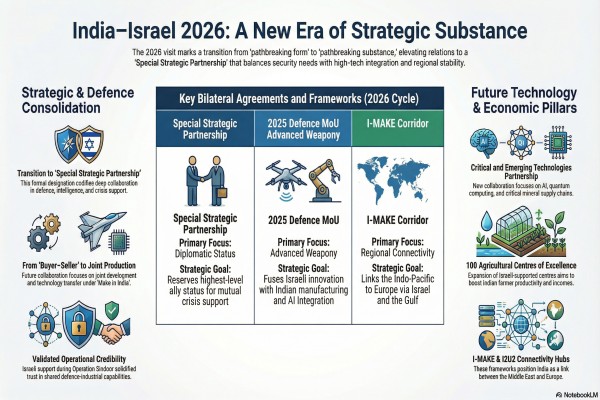
Operational credibility also played a role. During Operation Sindoor, Israeli diplomatic backing of India’s “right to self-defence” against Pakistan-based terror groups placed Tel Aviv among the earliest vocal supporters of New Delhi’s actions. The battlefield performance of Israeli and co-developed systems reinforced defence-industrial trust and validated long-term procurement and co-development bets.
Yet the visit was not solely about hard power. The joint statements reiterated an unequivocal stance against terrorism “in any form, in any manifestation”, affirming continued intelligence sharing and homeland security collaboration. At the same time, Modi underscored that India’s security is inseparable from peace and stability in West Asia. He reiterated support for dialogue and a peaceful resolution, including backing the Gaza Peace Plan.
This dual messaging—deepening strategic cooperation with Israel while affirming humanitarian and diplomatic commitments—illustrates India’s attempt to maintain equilibrium.
Prime Minister Narendra Modi departed Israel after a successful visit. 🇮🇱🇮🇳
Sara and I were glad to bid farewell to our friend. Thank you for your visit and your friendship – safe travels home.
True friendship. 🇮🇱🇮🇳@narendramodi pic.twitter.com/tE7iDKd7ig
— Benjamin Netanyahu – בנימין נתניהו (@netanyahu) February 26, 2026
Economic and technological cooperation formed the other pillar of the upgrade. A bilateral investment agreement signed last year, progress toward a free trade agreement, and the planned rollout of UPI – part of India’s digital stack – in Israel signal financial integration. The establishment of a Critical and Emerging Technologies Partnership covering AI, quantum computing and critical minerals reflects recognition that future power will be shaped as much by algorithms and supply chains as by missiles.
Agriculture remains a tangible example of applied cooperation. Israeli-supported Centres of Excellence in India are set to expand to 100, with “Villages of Excellence” aimed at boosting productivity and farmer incomes. An India–Israel Innovation Centre for Agriculture will co-develop next-generation solutions. Meanwhile, the 2023 Manpower Mobility Agreement—initially focused on construction and caregiving—is expanding into commerce and services, complemented by a proposed academic forum to connect researchers and youth.
Regionally, both sides recommitted to the India–Middle East–Europe Economic Corridor (I-MAKE) and the I2U2 grouping. These frameworks position India not as a peripheral actor but as a connective hub linking the Gulf, Israel, Europe and the Indo-Pacific.
Across Israeli media, the visit has been framed as a diplomatic success and an affirmation of a partnership that had matured quietly before being publicly elevated. But the geopolitical context gives the 2026 visit its sharper edge. With US–Iran tensions simmering and Israel facing international isolation over Gaza, India’s decision to visibly upgrade ties signals a higher risk appetite. The pathbreaking dimension lies less in first-time optics and more in substantive alignment.
Notably, Gulf Arab reactions have been cautious but measured. Their own evolving engagements with Israel, alongside expanding strategic and economic ties with India, temper confrontational responses. This provides New Delhi diplomatic space—but not immunity from future tensions.
Ultimately, Modi’s 2026 Israel visit represents strategic consolidation rather than rupture. It reflects a foreign policy increasingly guided by interests rather than ideological constraint. The success of this recalibration will depend on India’s ability to sustain parallel relationships—with Israel, with key Arab states, and with the Palestinian Authority—while maintaining credibility as a proponent of dialogue and just peace.
If 2017 was pathbreaking in form, 2026 is pathbreaking in substance.