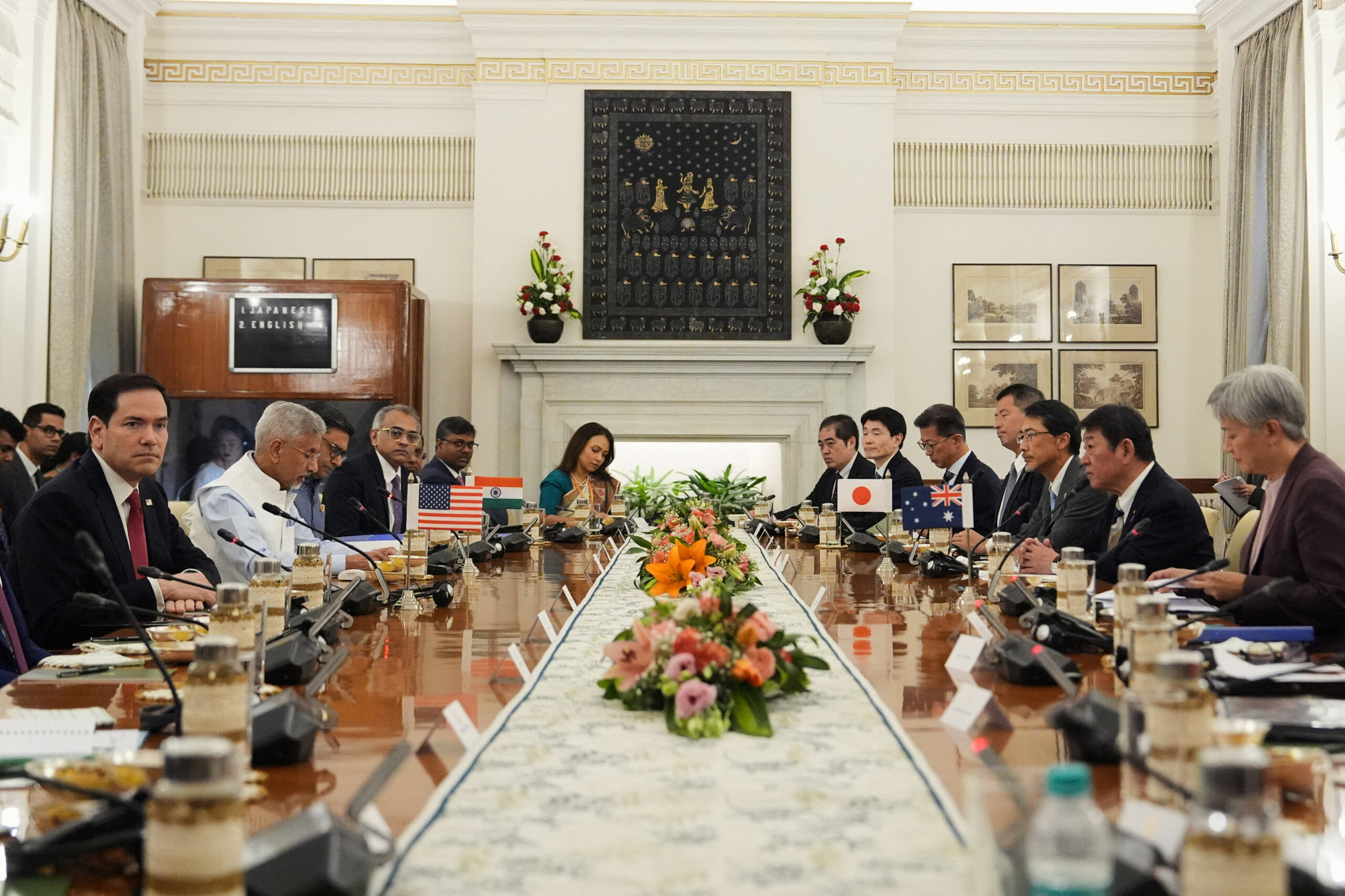
As India readies to host foreign ministers of the Quadrilateral Security Dialogue on Tuesday, diplomatic sources said it could lay the groundwork for the Quad Leaders’ Summit in India later this year.
It confirms the view among some US analysts that the Trump-Xi summit “produced modest stability but no grand deals for Southeast Asia and South Asia”, as the Council on Foreign Relations (CFR) noted in an analysis.
There was no progress in China’s lock hold over the supply of rare earths. There is also a growing concern that Trump’s “increasingly amenable approach to China will further embolden Beijing to militarize and dominate the South China Sea and other regional waters,” the CFR analysis said.
But let’s leave the leaders summit for now, the foreign ministers huddle is expected to focus on maritime security, resilient supply chains, critical technologies, and regional stability.
External Affairs Minister S. Jaishankar will host US Secretary of State Marco Rubio, Australian Foreign Minister Penny Wong, and Japanese Foreign Minister Toshimitsu Motegi. The meeting comes at a time when geopolitical fault lines are reshaping global diplomacy and economic priorities.
While the Quad was initially conceived as a strategic platform to promote a “Free and Open Indo-Pacific,” the coalition has steadily evolved into a broader mechanism addressing emerging security, economic and technological challenges across the region.
Discussions will focus heavily on maritime security, freedom of navigation, infrastructure connectivity, cyber resilience, and critical technologies. The ministers are also expected to review progress on initiatives launched during their previous meeting in Washington DC on July 1, 2025.
The Indo-Pacific remains fundamental to the Quad’s agenda as concerns grow over China’s expanding military footprint in the South China Sea and increasing naval deployments in the Indian Ocean Region.
Over the past few years, the Quad has intensified cooperation through joint naval exercises, maritime domain awareness initiatives, and coordination on infrastructure and connectivity projects.
The ministers will debate the ongoing crises in West Asia and the Russia-Ukraine war, both of which continue to disrupt global trade and economic stability.
The prolonged conflict in Ukraine has severely affected global grain exports, fertilizer supply chains, and energy markets, triggering inflationary pressures across both developed and developing economies.
The war in West Asia have also raised concerns regarding crude oil supplies and maritime shipping routes, particularly through strategic choke points. For energy-deficient countries like India, there are concerns about economic resilience and supply chain diversification.
Sources said the Quad may seek closer cooperation on energy security, semiconductor supply chains and alternative trade corridors to alleviate vulnerabilities from geopolitical conflicts.
The visit of Rubio assumes importance amid efforts by Washington to improve its ties with New Delhi and to deepen strategic ties across defence, technology, energy and trade.
Quad vs Squad
The New Delhi summit also arrives amid growing conversations around another emerging Indo-Pacific grouping, the so-called “Squad,” comprising the United States, Japan, Australia, and the Philippines.
The Squad has emerged in response to Beijing’s assertive territorial claims and aggressive maritime actions have alarmed the region. Unlike the Quad, which has a wider Indo-Pacific strategic outlook and includes India, the Squad is more narrowly focused on deterrence and maritime security in the Western Pacific.
The Philippines has supported closer coordination with India, especially as Manila strengthens defence partnerships to counter Chinese pressure in disputed waters. Philippine military officials have even suggested that India and South Korea could eventually become part of broader regional security arrangements.
While the Squad concentrates on immediate maritime tensions in the South China Sea, India’s strategic focus under the Quad extends from the Indian Ocean to the broader Indo-Pacific, including trade routes, connectivity, and regional development.
India’s growing strategic engagement with Southeast Asia, including defence cooperation with the Philippines and the export of BrahMos missile systems, demonstrates New Delhi’s expanding regional role without directly mirroring the Squad’s security posture.