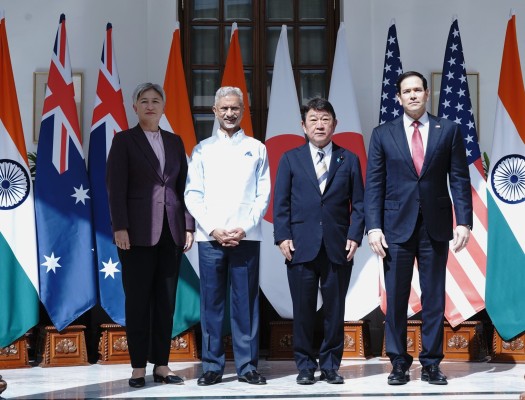
The Quad’s four foreign ministers are set to hold a closely watched meeting on the sidelines of the ASEAN Foreign Ministers’ Meetings in Manila this week, underlining the grouping’s growing role in shaping the Indo-Pacific security architecture amid mounting geopolitical uncertainty.
External Affairs Minister S. Jaishankar is expected to join US Secretary of State Marco Rubio, Australian Foreign Minister Penny Wong and Japanese Foreign Minister Toshimitsu Motegi for what will be the second Quad Foreign Ministers’ Meeting in just over two months.
The frequency of these consultations reflects the group’s increasing momentum and its evolution into a more institutionalised strategic forum.
The meeting comes at a time of heightened regional and global tensions. Alongside continuing maritime disputes in the South China Sea, concerns over supply chain resilience, critical technologies and economic security remain high.
The conflict in West Asia has added another layer of uncertainty, with implications for global energy markets, shipping routes and broader economic stability.
Diplomatic observers expect the ministers to review these interconnected challenges while reaffirming their commitment to a free, open and rules-based Indo-Pacific.
Although the Quad is not a military alliance, cooperation among its members has steadily broadened to include maritime domain awareness, cyber security, emerging technologies, critical minerals, resilient supply chains, disaster relief and humanitarian assistance.
The Manila engagement also reflects Washington’s renewed focus on the Indo-Pacific. Ahead of the ASEAN meetings, Secretary Rubio described ASEAN as America’s principal platform for engagement with Southeast Asia, highlighting opportunities for Quad and other strategic consultations.
US Ambassador to India Sergio Gor has similarly described the Quad as central to advancing a free and open Indo-Pacific.
The ministerial follows the 11th Quad Foreign Ministers’ Meeting held recently in New Delhi, where the four countries reaffirmed their commitment to regional peace, stability and prosperity. The regular pace of ministerial engagements is also seen as laying the groundwork for a Quad Leaders’ Summit later this year.
The diplomatic meeting coincides with another visible demonstration of cooperation among Quad partners.
The Indian Air Force has deployed Rafale fighter aircraft to Australia for Exercise Pitch Black 2026, one of the world’s largest multinational air combat exercises. While the exercise is not a Quad initiative, participation by India, Australia, Japan, the United States and several regional partners underscores the expanding defence interoperability among like-minded nations.
Together, the parallel diplomatic and military engagements highlight a broader trend: Quad cooperation is deepening across multiple domains even as the Indo-Pacific faces its most challenging security environment in years.