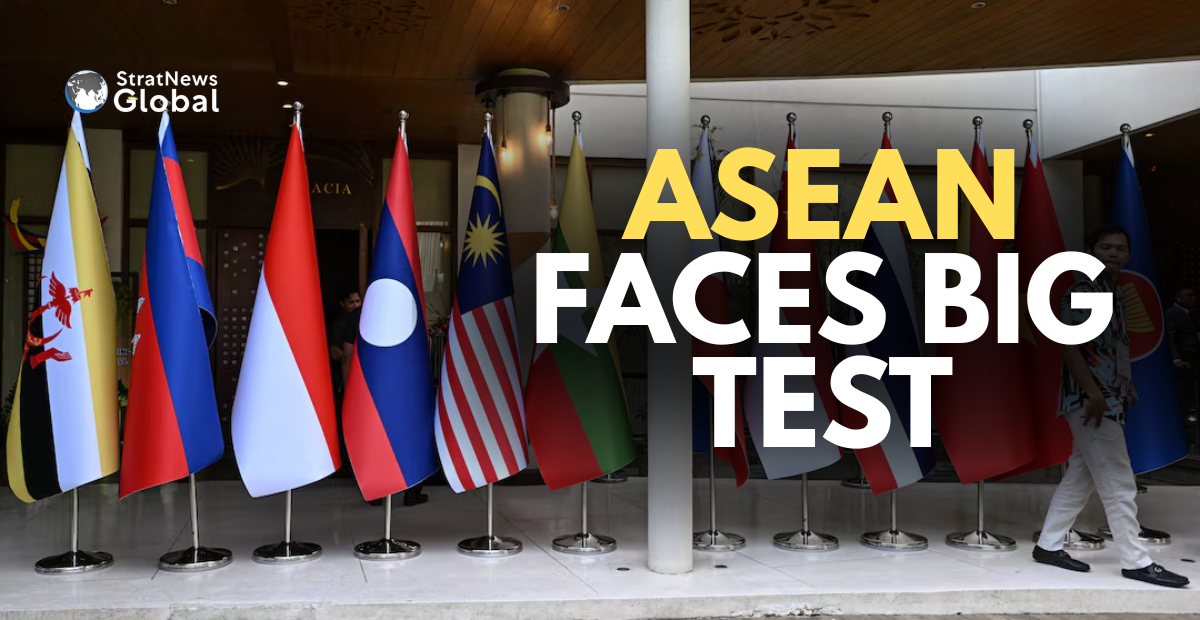
Foreign ministers from Southeast Asia and the world’s major powers are gathering in Manila this week as the region confronts a growing list of security challenges, ranging from renewed conflict between the United States and Iran to rising tensions in the South China Sea and Myanmar’s prolonged civil war.
The meetings, hosted by the Association of Southeast Asian Nations (ASEAN), bring together foreign ministers from the bloc’s 10 member states alongside key partners including the United States, China, India, Japan, Australia, South Korea, Russia, the United Kingdom and the European Union.
Iran Conflict Adds Global Uncertainty
The renewed confrontation between Washington and Tehran is expected to feature prominently during discussions, with regional leaders concerned about potential disruptions to global energy supplies passing through the Strait of Hormuz.
Philippine Foreign Ministry spokesperson Dominic Xavier Imperial said the issue would likely be discussed during several meetings, given its potential impact on inflation, global economic growth and energy security.
Myanmar Peace Process Remains Stalled
Closer to home, ASEAN foreign ministers will hold an informal consultation on Myanmar, where the bloc’s peace initiative continues to struggle nearly five years after the military seized power in a coup.
The conflict has evolved into a devastating civil war that has reportedly claimed around 100,000 lives, while ASEAN’s Five-Point Consensus has produced little tangible progress.
South China Sea Dispute Back in Focus
Maritime tensions are also expected to dominate discussions after the Philippines accused the China Coast Guard of assaulting one of its navy personnel near the disputed Second Thomas Shoal earlier this week.
According to Manila, Chinese personnel struck a Philippine sailor with a baton during the confrontation. Beijing rejected the allegation, calling the accusation “false.”
The incident has further heightened tensions in one of the world’s busiest waterways, where ASEAN and China have spent nearly a decade negotiating a Code of Conduct aimed at preventing confrontations at sea.
Rubio Sharpens Criticism of Beijing
Ahead of the meetings, U.S. Secretary of State Marco Rubio issued a strong warning over China’s growing maritime influence in an opinion article published in Philippine newspapers.
Without directly naming Beijing, Rubio said freedom of navigation in the Indo-Pacific could not be taken for granted.
“If those waters fall under the control of a power willing to use commerce as a geopolitical weapon, both the United States and the ASEAN states would face dire new threats to their sovereignty, security and economic futures,” he wrote.
Rubio also reaffirmed Washington’s support for the 2016 international arbitral ruling that invalidated China’s sweeping claims in the South China Sea, adding that the United States would honour its treaty commitments to the Philippines and other regional allies.
China continues to reject the ruling, insisting it has no legal validity.
Major Powers Gather in Manila
Rubio and Chinese Foreign Minister Wang Yi are both expected to participate in the ASEAN-led meetings and could also hold bilateral discussions on the sidelines.
The gathering is likely to serve as another important diplomatic platform for managing growing U.S.-China strategic competition across the Indo-Pacific.
Meanwhile, Australia announced an additional US$6.7 million package to strengthen the Philippine Coast Guard’s maritime surveillance capabilities, including long-range and underwater drones, as Canberra deepens defence cooperation with Manila amid growing regional security concerns.
(with inputs from Reuters)