India and the United States on Monday confirmed a trade understanding under which Washington has reduced “reciprocal” tariffs on Indian goods from 25% to 18%, offering relief to exporters after a year of elevated trade tensions, even as key elements of the agreement remain unclear.
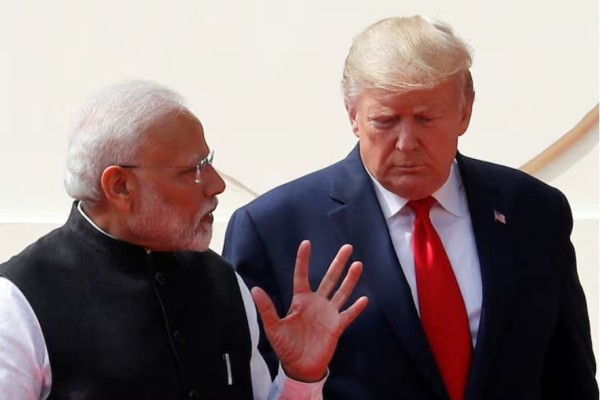
President Donald Trump announced the tariff cut following a telephone conversation with Prime Minister Narendra Modi.
Trump said the decision was taken “out of friendship and respect” for Modi, and linked the tariff reduction to expectations of greater market access for U.S. goods and changes in India’s energy sourcing. The Indian government, however, has not endorsed several of the conditions outlined by the U.S. President, and no detailed agreement text has been released by either side.
Relief for Exporters
The revised 18% tariff brings India closer to the U.S. baseline rate of 10% and improves its relative position compared with some regional competitors. Exporters in labour-intensive sectors such as apparel, textiles, leather goods, footwear, gems and jewellery, tea and coffee are expected to be the main beneficiaries.
Ajay Sahai, Director General and CEO of the Federation of Indian Export Organisations (FIEO), said the tariff cut would help restore competitiveness lost after last year’s increase, which had led to order deferments and cancellations.
“U.S. buyers are extremely sensitive to tariff differentials when finalising sourcing contracts. The reduction provides immediate certainty and should result in a revival of orders, particularly in labour-intensive sectors,” Sahai said.
Penalty Tariff Still Applies
Despite the relief, a separate 25% penalty tariff imposed by the U.S. over India’s continued imports of Russian crude oil remains in force. As a result, certain product categories may still face combined duties exceeding 40%.
Washington has linked removal of this penalty to India reducing its reliance on Russian energy. India has maintained that oil imports are guided by market conditions and energy security considerations, and have not confirmed any binding commitment on this issue.
Trump has said the deal includes India purchasing more than $500 billion worth of U.S. goods and significantly reducing tariff and non-tariff barriers. However, analysts have cautioned against taking these claims at face value.
Ajay Srivastava, founder of the Global Trade Research Initiative (GTRI), said India’s current annual imports from the U.S. are below $50 billion, indicating that the $500 billion figure is likely a long-term aspirational number rather than a near-term commitment.
“Such figures typically reflect cumulative trade or investment flows over many years. It would be premature to interpret this as an immediate or legally binding obligation,” Srivastava said, adding that across-the-board zero tariffs are unlikely in sensitive sectors such as agriculture and dairy.
Broad Trade Push
The India–U.S. announcement comes close on the heels of the conclusion of the India–European Union trade agreement last week, and amid expectations that New Delhi could announce progress on a trade arrangement with Canada as early as next month.
Trade officials say the sequence reflects India’s broader strategy of diversifying market access while navigating geopolitical pressures. The U.S. tariff cut is seen as providing short-term relief, while longer-term gains will depend on the scope and implementation of formal agreements.
While both governments have welcomed the tariff reduction, officials on the Indian side emphasised that further clarity is needed on product coverage, timelines and non-tariff measures. Until the fine print is released, exporters and investors are expected to treat the announcement as a positive but partial step rather than a comprehensive trade reset.