Intelligence Online with the tagline “Stay on top of the news about corporate and government intelligence in Europe, North America, the Middle East and Asia,” had a report on its site with a sensational claim:
“The (China’s) Ministry of State Security has ordered the immediate withdrawal of Chinese teams and interests from Afghanistan. Rather than a response to recent incidents in Tajikistan, the measure betrays Pakistan’s inability to protect Beijing’s interests. This strategic move is a costly setback for the CCP.”
More could not be accessed since it was behind a paywall. But the four lines above give the impression China was holding Pakistan responsible for the “security of its interests”. If the reference is to Tajikistan, would it be fair for Beijing to expect Islamabad to safeguard its interests there given they don’t even share a land border?
in the case of Afghanistan, China may have expected much since Pakistan played a crucial role in helping bring the Taliban to power in Aug 2021 But Kabul-Islamabad relations have deteriorated considerably since then and with the two now in a state of armed conflict, Pakistan has to safeguard its own interests first.
As for Chinese interests, Pakistan has had a problem securing them. Nineteen Chinese workers have died since July 2021 in attacks carried out from locations ranging from Karachi to Gwadar and Khyber Pakhtunkhwa.
The Baloch Liberation Army regularly targets China-funded projects in Balochistan saying they do not serve the interests of the people of the province.
Even in Khyber Pakhtunkhwa, Chinese workers on the Dasu hydroelectric project were attacked by a suicide bomber in March 2024 and five were killed.
An analysis by Priyanka Singh, Associate Fellow at the IDSA (Institute for Defence Studies & Analysis) in April 2024 noted “An intensification of the security threat to the Chinese nationals in Pakistan which is mired today in political problems alongside its raging tiff with the Afghan Taliban.”
Repeated attacks on Chinese nationals is seen as a major challenge to the CPEC with the Pakistan Army’s Inter-Services Public Relations warning that “Strategic projects and sensitive sites vital for Pakistan’s economic progress … are being targeted … to sow discord between Pakistan and its strategic allies … notably China.”
So much is fact. But does that mean, as Intelligence Online claims, that China’s Ministry of State Security (MSS) has ordered the withdrawal of its “teams and interests from Afghanistan.”
As China scholar Manoj Kewalramani of the Takshashila Institution asks, “Why would the MSS be ordering the teams and interests out? This is something the Chinese Foreign Ministry would be expected to carry out.”
The technicalities apart, Kewalramani notes that China does not like the current bloodletting between Afghanistan’s Taliban regime and Pakistan. But it is neither pulling out of Afghanistan nor Pakistan, and in the case of the latter, why when it has invested heavily, reportedly $65 billion, over the course of some decades.
Pakistan is also a key player in China’s goal to keep India “cribbed, cabined and confined” to the region. Witness their military-strategic collusion during Operation Sindoor last year, with the Chinese providing not only weapons and equipment but also real time satellite intelligence about India’s military moves.
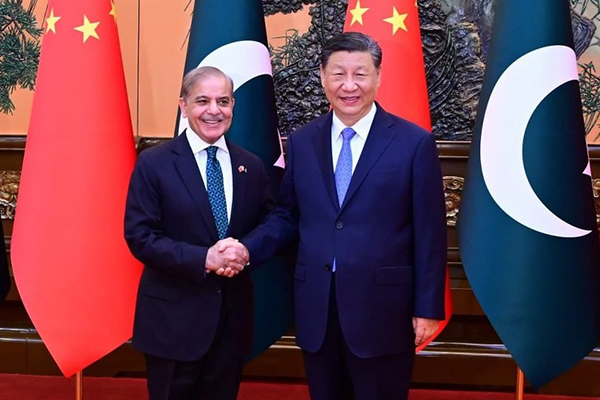
And only two days back, Pakistan’s Foreign Minister Ishaq Dar was in a “strategic call” with his Chinese counterpart Wang Yi. The conversation reportedly centered on the war in West Asia but it ended with this …
“Both sides also reaffirmed the enduring strength of the Pakistan-China All-Weather Strategic Cooperative Partnership, reiterated their shared commitment to further deepening bilateral cooperation, and agreed to remain in close contact.”
China remains committed to Pakistan despite the frustrations of dealing with a dysfunctional polity and a military that is unable to see beyond its narrow corporate interests. But more than that, Islamabad remains a useful ally against India, enough reason for Beijing not pulling the plug on its Iron Brother.