China’s Ministry of State Security (MSS) has warned that online historical content and popularised explainers on social media platforms are increasingly being used to shape public opinion, stir social conflict, and challenge China’s official historical narrative, placing such material within the country’s national security framework.
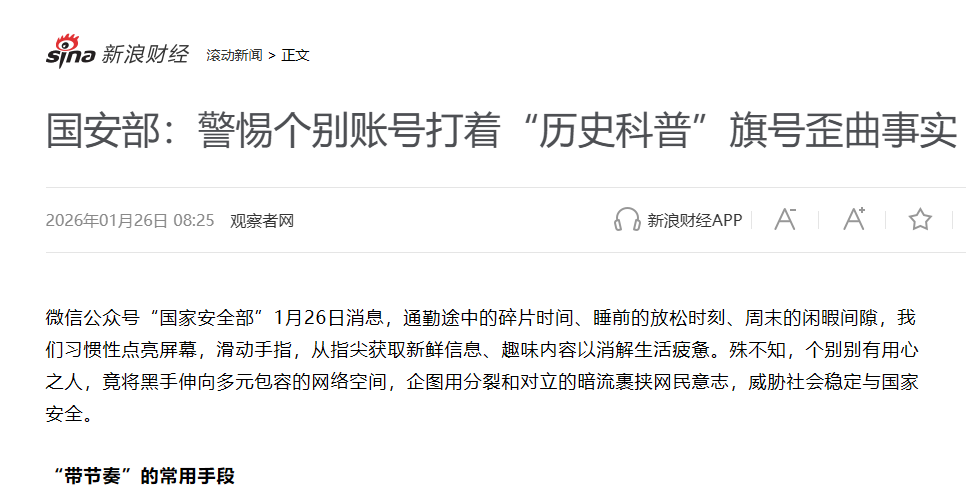
In a statement published on January 26, 2026 on its official WeChat account, the MSS said short videos, explainers, and lifestyle-style content on platforms such as Weibo, WeChat, and Bilibili are no longer merely entertainment formats, but tools that can be exploited to influence perceptions and weaken trust in public institutions.
The ministry said some online accounts deliberately play on social fault lines involving region, gender, profession, ethnicity, or class, using selectively edited material or unverified cases to suggest broader systemic problems. Such content, the MSS said, is designed to provoke anger and spreads rapidly through algorithm-driven recommendation systems.
Creating Conflict for Attention
The warning comes amid renewed scrutiny of historical material online. Last month, nostalgia-related content about the Cultural Revolution briefly circulated on Chinese social media before disappearing. A review video of the 2017 film Youth (Fanghua), set during the later years of the 1966–76 period, drew more than 35 million views on Bilibili, largely from younger users, before being taken down without explanation.
(StratNewsGlobal also reported on the brief surge and rapid removal of such content.) https://stratnewsglobal.com/world-news/cultural-revolution-nostalgia-surges-vanishes-fast/
The MSS said particular concern surrounds accounts that present themselves as “history explainers” while publishing unverified claims, conspiracy theories, or distorted interpretations of past events. According to the ministry, some such content attempts to rehabilitate controversial historical figures, downplay acts of aggression, or turn national suffering into entertainment.
Using History to Push Narratives
The statement also criticised the practice of drawing forced comparisons between historical events and present-day China to suggest inevitable decline or crisis, describing this as promoting “historical nihilism,” a term the MSS uses for narratives that deny the value or legitimacy of a country’s past.
The ministry further accused some creators of portraying life abroad as uniformly superior while presenting China in an excessively negative light, using carefully selected images and comparisons that highlight Western societies’ strengths while ignoring China’s development.
The MSS called on social media platforms to strengthen content review, improve monitoring, and adjust recommendation systems to limit the spread of misleading or harmful material. It also urged users to verify sources, rely on authoritative information channels, and report content that incites hostility, insults historical figures, or promotes division.
The statement said national security agencies will continue to treat ideological issues as a core security concern, confirming that online narratives, including the discussion of history, fall within China’s security agenda.