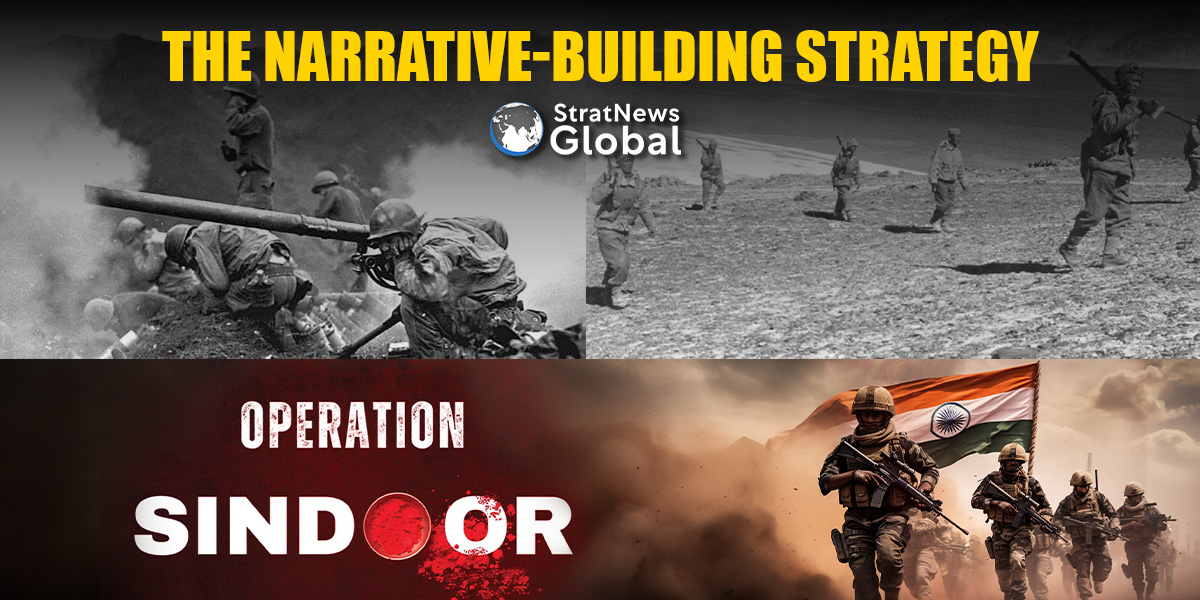
When Operation Sindoor captured national imagination last year, it did more than display military resolve. It brought national attention to something India has long underappreciated. It showed that battles are not only fought on the ground but also in the realm of public narratives. The operation was accompanied by clear messaging, coordinated communication and rapid dissemination of verified information. The result was a sense of confidence, coherence and ownership among citizens. India, perhaps for the first time in decades, appeared prepared not only to fight a battle but also to tell its story.
This renewed focus on narrative building has become a national priority. Senior officials highlight narrative as a strategic domain. Media commentary stresses the importance of controlling the interpretive space. Public expectations reflect a belief that the country must shape how the world sees its actions. This is a profound shift. For most of independent India’s history, narrative building was either ignored or surrendered to others. Nowhere was this neglect more evident than in the way the 1962 Sino-Indian conflict was understood, recorded and remembered.
How India Lost the Narrative In 1962
The military events of 1962 lasted only a few weeks but the story created around the conflict has lasted generations. The war is remembered almost entirely through the lens of sudden collapse and national humiliation. This is not accidental. It is the product of a narrative that developed rapidly during the conflict and was later reinforced by international media, diplomatic commentary and academic writing. India lost control of the story while the conflict was still unfolding.
During the war, the global press reported dramatic reverses in the Kameng region. Those reports overshadowed the fierce resistance offered in Aksai Chin and Walong. The surprise and speed of events created a vacuum in communication. India lacked both the institutional capacity and the culture of proactive information sharing. Into that vacuum stepped foreign correspondents, think tank analysts and governments with strategic interests in Asia.
The result was a one-dimensional portrayal of events. The complexity of operations, the bravery of units that held their ground and the limited territorial changes that actually occurred were all overshadowed. The narrative of complete collapse travelled faster than the facts. The story became more powerful than the battlefield realities.
This narrative, once formed, shaped everything that followed:
- Pushed Indian strategic thinking inward,
- Altered political debates, and
- Overshadowed subsequent military reforms.
It even affected how future crises were handled because the lesson drawn was one of inadequacy rather than one of mixed outcomes and success in certain defensive battles.
The Long Shadow Of The 1962 War
The narrative deficit did not end with media coverage. In the years after the war, academic interpretations began to play a larger role in shaping public understanding. Influential works argued that India had provoked the conflict with its flawed ‘Forward Policy’. These arguments travelled across policy communities and universities. They soon became reference points for global scholarship.
Since India did not publish its own operational history for decades and since archives remained inaccessible, counter-evidence never entered mainstream academic discussion. As a result, a version of history constructed outside India gained acceptance within India. The narrative became a form of inherited memory.
This loss of narrative control had three long-term consequences. First, it froze public understanding of the conflict in a narrow frame that emphasised national embarrassment. Second, it created assumptions about India’s strategic character that continued to influence policy thinking. Third, it allowed external powers to present their own involvement and interests without scrutiny.
In short, India became a victim of the story told about it.
Operation Sindoor Changed The Conversation
Operation Sindoor marked an inflection point because it showed what it looks like when India takes ownership of its own narrative. It combined speed, clarity and consistency in communication. Besides, it did not allow misinformation to fill the space. And it ensured that the world understood the purpose, legitimacy and execution of the operation. India did not wait for others to interpret events. It acted first.
The public response to the operation revealed something deeper. Citizens felt they were being treated as stakeholders. They felt better informed. They felt aligned with the direction of national policy. The clarity of communication became a source of unity. This was the opposite of the atmosphere in 1962, when confusion defined public perception and information scarcity magnified fear.
The contrast between these two moments highlights why narrative building is now seen as a matter of national importance. The state, civil society and the strategic community understand that narrative is not decoration. It is a form of power.
What Narrative Building Really Means
Narrative building is often misunderstood as propaganda or messaging but it is neither. Instead, it is the framework through which events are interpreted and is the story that gives meaning to facts. It shapes how societies understand crises, how allies evaluate partnerships and how adversaries assess resolve. Narrative building influences international opinion, diplomatic leverage and domestic cohesion.
A narrative does three things: selects what matters, explains why it matters and it connects individual events to larger ideas. The absence of a narrative does not create neutrality. It creates vulnerability because others will fill the interpretive space.
India’s experience in 1962 demonstrates this clearly. The loss of narrative control not only distorted global understanding but also distorted India’s own understanding.
Reinterpreting The 1962 War Through A Narrative Lens
If one revisits the 1962 conflict with a focus on narrative construction, a different picture emerges. The story that became dominant was built on selective visibility. It magnified early setbacks and overlooked tactical resilience in other sectors. Rather than operational detail, it emphasised emotion. It interpreted political decisions in isolation from geopolitical context.
At the same time, academic writing often adopted a simplified causal chain that blamed the conflict on Indian diplomatic misjudgements. This placed responsibility almost entirely on New Delhi and absolved broader Cold War dynamics. These interpretations were quickly institutionalised through publications, conferences and teaching material.
Such narratives do not merely describe events; they shape national psychology. Also influence how future conflicts are imagined. And determine whether a nation sees itself as capable or perpetually vulnerable.
The shift in Indian scholarship over the past decade, with new studies reassessing operations and challenging long-held assumptions, shows the importance of reclaiming interpretive space. Narrative building is not about creating new myths. It is about correcting inherited distortions and presenting evidence-based interpretations.
The New Era Of Narrative Power
The contemporary information environment is far more complex than it was in 1962. Digital platforms accelerate the formation of narratives. International media ecosystems influence each other. State and non-state actors compete for attention. In this environment, narrative is as strategic as deterrence, diplomacy or defence preparedness.
India’s growing attention to narrative building reflects an understanding that the country can no longer afford to surrender the interpretive domain. The lessons of 1962 demonstrate the cost of narrative neglect. The success of Operation Sindoor demonstrates the importance of narrative preparedness.
Narrative building is now a crucial component of national security, as it ensures that India’s story is told by India, rather than by others. It ensures that India’s actions are understood in their full context. It ensures that historical memory supports national confidence rather than undermines it.
Conclusion
The renewed emphasis on narrative building is not a passing trend. It is a structural change in how India approaches strategy and statecraft. From Operation Sindoor to the reassessment of the 1962 conflict, the country is recognising the centrality of narrative power. The story of 1962 shows what happens when a nation loses control of its narrative. The experience of Operation Sindoor demonstrates what happens when control is taken seriously.
For India, the narrative is no longer the afterthought. It is part of the strategy itself.
(The author is a research scholar who has extensively studied the 1962 Sino-Indian conflict and the Cold War dynamics. Views expressed in this article are personal.)