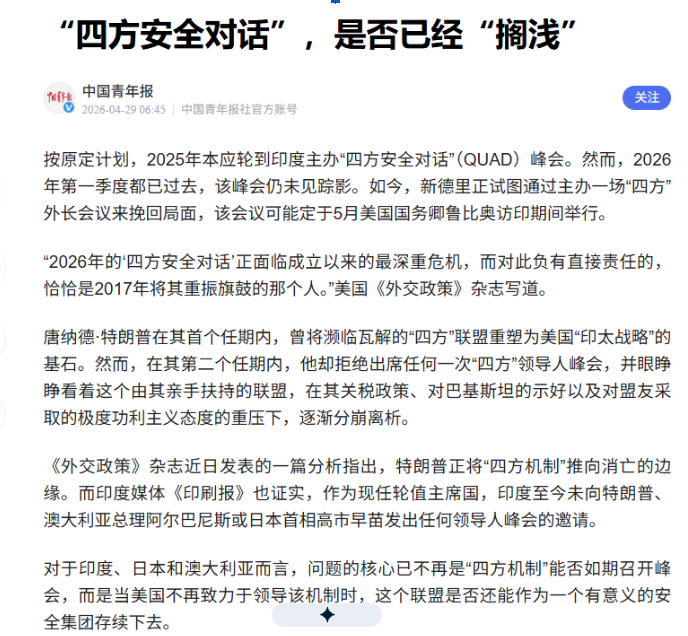
“Zombification” is a phrase that has now entered the Chinese lexicon with reference to the recent meeting of Quad foreign ministers in India. The term figured in an article in the China Youth Daily, the official newspaper of the Communist Youth League of China, so it reflects official thinking if not policy.
The article described the Quad as a “zombie mechanism” still functioning through meetings and working groups, but lacking political vitality, strategic unity, or summit-level momentum. Zombie, for the uninitiated, means something neither truly alive nor active although it may move minus strength or purpose
Rubio’s India visit.
On Weibo, verified accounts described the Quad meeting as anti-China in nature. One widely shared post claimed the QUAD was being “reactivated” to contain China, pointing to Marco Rubio’s contrasting diplomatic appearances first in China in a friendly setting alongside Donald Trump, and shortly afterwards in India at QUAD meetings announcing new areas of cooperation.
Another post pointed to the different strands of US diplomacy: friendly in Beijing, but more strategic in New Delhi. Others suggested that QUAD initiatives are increasingly viewed as anti-China, particularly due to their focus on critical minerals, energy security and maritime surveillance.
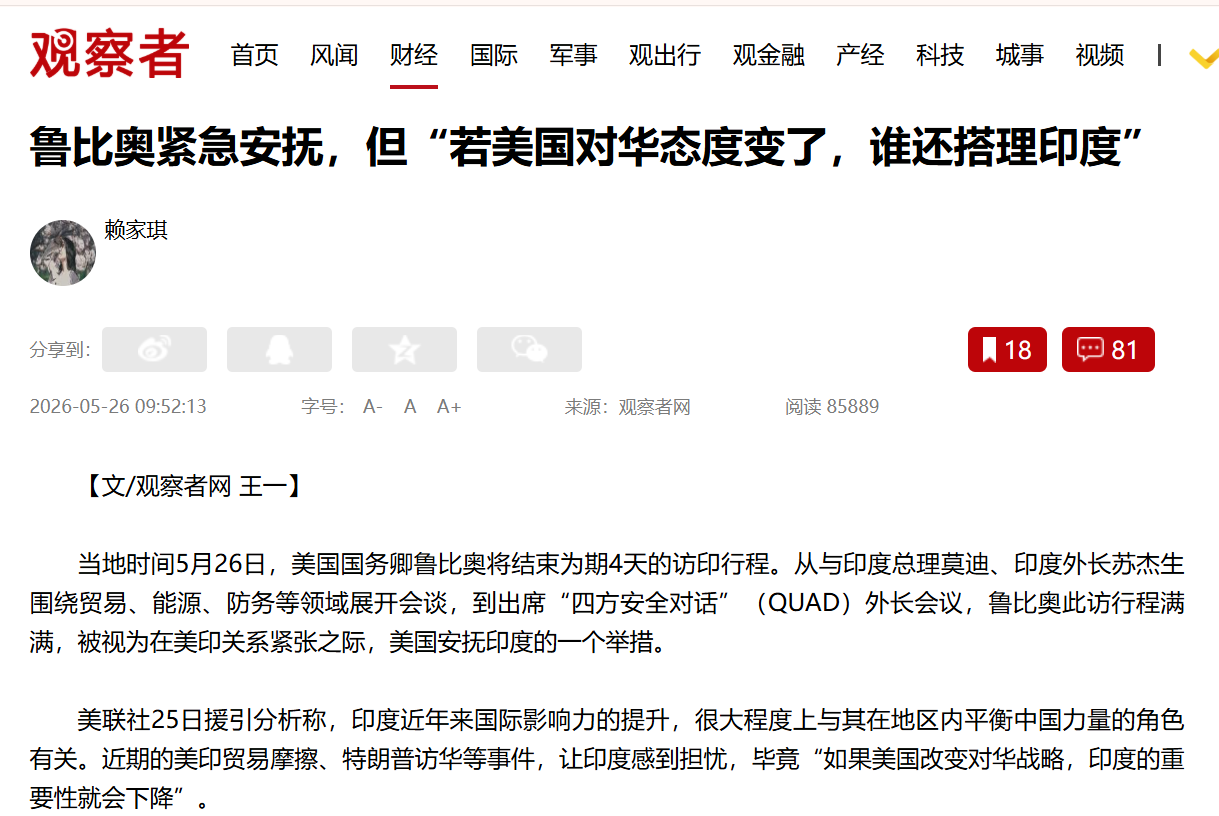
“If US strategy shifts, India’s importance declines”
Guancha.net, a Shanghai-based news site, argued that India’s strategic value to the United States is closely tied to Washington’s China policy. It warned that if the US softens its approach towards China, India’s geopolitical importance could decline. The article also suggested India is “cautiously exploring” more flexible engagement with Beijing.
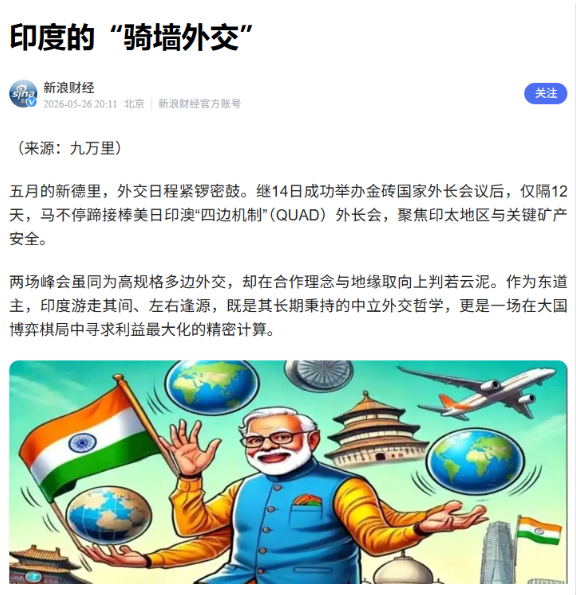
India as a “fence-sitter”
A Sina Finance commentary described India’s foreign policy as “balancing diplomacy” between global blocs. It noted India’s hosting of both BRICS and QUAD meetings in quick succession, clearly an effort underscoring its strategic autonomy.
It said BRICS strengthens ties with developing countries, while QUAD offers India access to technology, security cooperation and Indo-Pacific influence. However, it warned that India risks being seen as unreliable by Western partners while not fully satisfying expectations in the developing world.
Global Times: divisions beneath unity
The Global Times was even more forthright. In an analysis titled “Fanning ‘China-related concerns’, Quad mechanism struggles to hide divisions,” it said the QUAD members publicly stressed cooperation on security, energy and critical minerals, but such cooperation had an anti-China undercurrent.
It also argued that despite outward unity, the grouping faces internal differences over trade, regional priorities and strategic direction, claiming it could lead to “structural fragmentation.”
Weibo chatter: not a monolithic bloc
China’s social media also dwelt on the differences within the QUAD. Australia is portrayed as taking a more moderate stance, while Japan is seen as more security-focused. This reflects another view that the QUAD may not be an anti-China bloc but a coalition with differing priorities.
From “sea foam” to “zombification”
The scepticism is not new. Years earlier, Chinese Foreign Minister Wang Yi described the QUAD as “sea foam in the ocean” — temporary and unstable. The addition of “Zombification” seems to suggest that Beijing sees the group as lacking the cohesion required to become a durable alliance.
To sum up, Chinese commentary presents the QUAD as divided, India as balancing between powers, and US strategy as unstable but central. From “sea foam” to “zombification”, it consistently frames the QUAD as an anti-China grouping still evolving, but struggling to maintain unity in a shifting Indo-Pacific order.