Until very recently, the Baku Initiative Group (BIG) barely existed in the consciousness of international affairs watchers, let alone Indian strategic circles. It had no track record of serious scholarship, humanitarian work, or sustained civil-society engagement.
Its sudden emergence as host of an international conference attacking India therefore demands scrutiny, not indulgence. BIG did not stumble into South Asian politics by accident. It is a state-adjacent narrative platform that has learnt how effectively the language of human rights can be weaponised to serve geopolitical ends.
BIG first gained visibility by organising conferences denouncing France for alleged neo-colonialism, aligning neatly with Azerbaijan’s confrontation with Paris over Armenia. That trajectory matters. Baku has increasingly supplemented diplomacy with information warfare, outsourcing polemics to ostensibly independent civil-society fronts that provide plausible deniability while advancing state interests.
India entered BIG’s sights as New Delhi deepened strategic cooperation with France and Armenia. The Khalistan issue — emotive, externally marketable, and cultivated by Pakistan for decades — offered a ready-made pressure point.
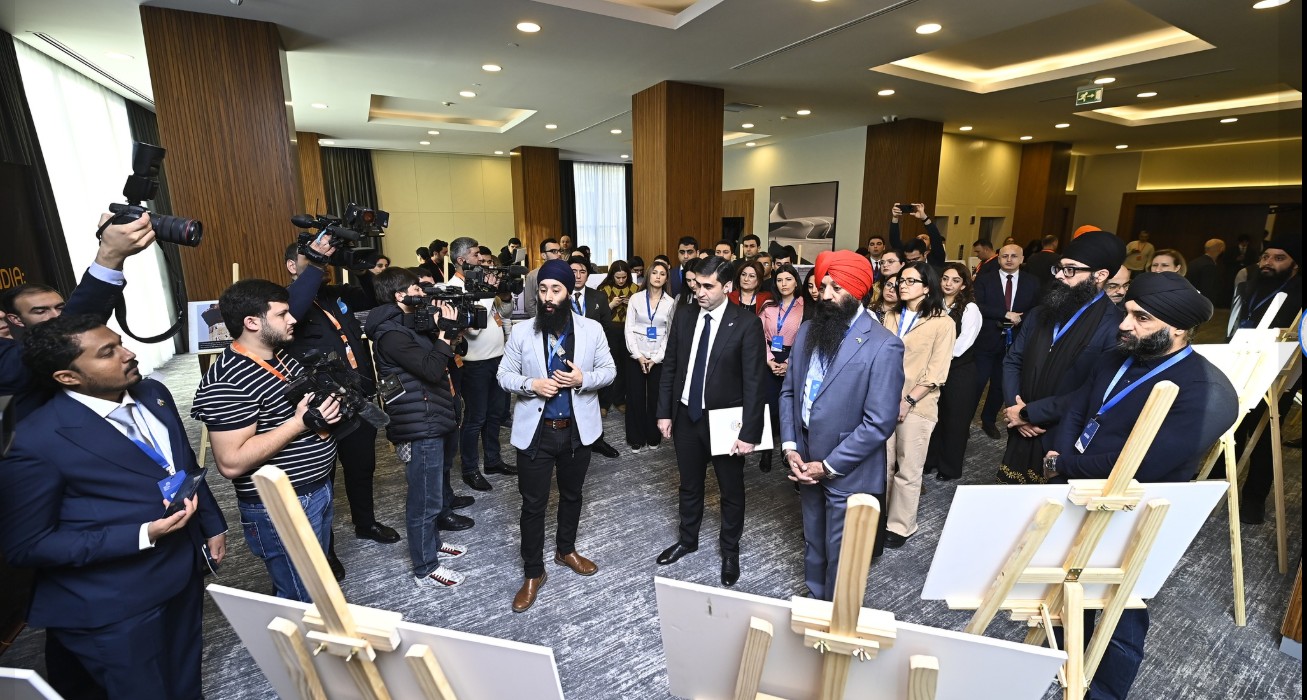
The International Conference titled “Racism and Violence Against Sikhs and Other Minorities in India: The Reality on the Ground”, which opened in Baku on January 16, must be read in this context.
Its symbolism was as revealing as its agenda. Proceedings began with a one-minute silence honouring Hardeep Singh Nijjar, assassinated in Canada in 2023, and “other members of the Khalistan movement who lost their lives.” This was not a neutral memorial gesture. It explicitly elevated Khalistan operatives—including figures India has formally identified as terrorists—into the status of martyrs, while erasing the victims of Khalistani violence altogether.
To an uninformed audience, the conference may have appeared as just another international human-rights forum. In reality, it marked a deliberate escalation: the relocation of a violent separatist movement, long defeated within India and sustained abroad only through diaspora activism, into a quasi-official international platform that confers legitimacy without accountability. This was not advocacy. It was narrative laundering.
What BIG and its Khalistani interlocutors seek to obscure is not a contested interpretation of history but the central fact of the movement itself.
Khalistan was not born as a civil-rights campaign that later “radicalised”. It emerged, matured, and collapsed as an explicitly violent insurgency sponsored and armed by Pakistan.
India has formally designated multiple Khalistani organisations as terrorist groups — including Babbar Khalsa International, the Khalistan Commando Force, the Khalistan Zindabad Force, and the International Sikh Youth Federation — for assassinations, bombings, targeted killings, and transnational conspiracies.
This record is statutory and judicial, not rhetorical. The violence was neither symbolic nor incidental. It included the assassination of elected leaders, mass-casualty bombings, systematic intimidation of civilians, and one of the deadliest acts of aviation terrorism in history.
The movement’s defeat came not through censorship but through the dismantling of an armed campaign that had lost all legitimacy among the Sikh population it claimed to represent. Punjab today is not a silenced conflict zone; it is a state whose electorate has repeatedly and decisively rejected separatism.
Overseas, however, fragments of the Khalistan ecosystem survived by mutating. As arms pipelines and training routes were disrupted, the movement migrated into referendums without voters, protests without constituencies, and conferences without facts.
Groups such as Sikhs for Justice, banned in India, rebranded extremism as “self-determination” while continuing to glorify convicted terrorists and issue open threats against Indian diplomats and public officials. Indian agencies have consistently documented overseas handlers directing financing, radicalisation, and targeted violence from safe havens abroad.
This is where BIG’s role becomes more than incidental. Terrorist movements in decline depend on legitimacy transfer — the process by which violence is sanitised through NGOs, academic panels, and international conferences until the distinction between grievance and gunfire is deliberately blurred. By hosting figures associated with proscribed Khalistani outfits, honouring slain operatives as martyrs, and recycling allegations without evidentiary scrutiny, BIG performs precisely this function. It does not merely provide a venue; it provides cover.
Defenders of BIG will argue that conferences do not kill and that discussion itself cannot be criminalised.
But modern counter-terrorism doctrine recognises that extremist ecosystems are sustained not only by weapons but by narratives — through fundraising, recruitment, glorification, and the international laundering of violent causes into respectable spaces. When an organisation knowingly amplifies actors linked to terrorism while erasing their record of violence, it ceases to be neutral. It becomes an enabler.
The geopolitical alignment is equally transparent. Pakistani politicians and media outlets openly celebrated the Baku conference as evidence that the Khalistan narrative is being “internationalised”. Azerbaijani pro-government platforms amplified claims of “systematic repression” in India while selectively omitting both the insurgency’s crimes and Pakistan’s historical sponsorship of Khalistani militancy.
India’s Sikh community occupies the highest levels of political, military, and economic life. Sikhs lead major political parties, command elite military formations, and dominate key sectors of agriculture and industry. To portray this reality as one of systemic persecution requires not evidence but ideological commitment. BIG supplies the stage on which that commitment can masquerade as concern.
The test for the Baku Initiative Group is therefore simple. Will it disavow designated terrorist organisations, exclude speakers with documented links to violence, and subject its claims to independent verification? Or will it continue to function as a laundering mechanism where insurgency is repackaged as rights discourse? Its conduct so far answers the question.
States are ultimately judged not by the slogans they host but by the company they keep.
On Khalistan, Baku has chosen to keep company with a movement whose history is written in blood. Dressing that record in the language of conferences and civil society does not change that fact.