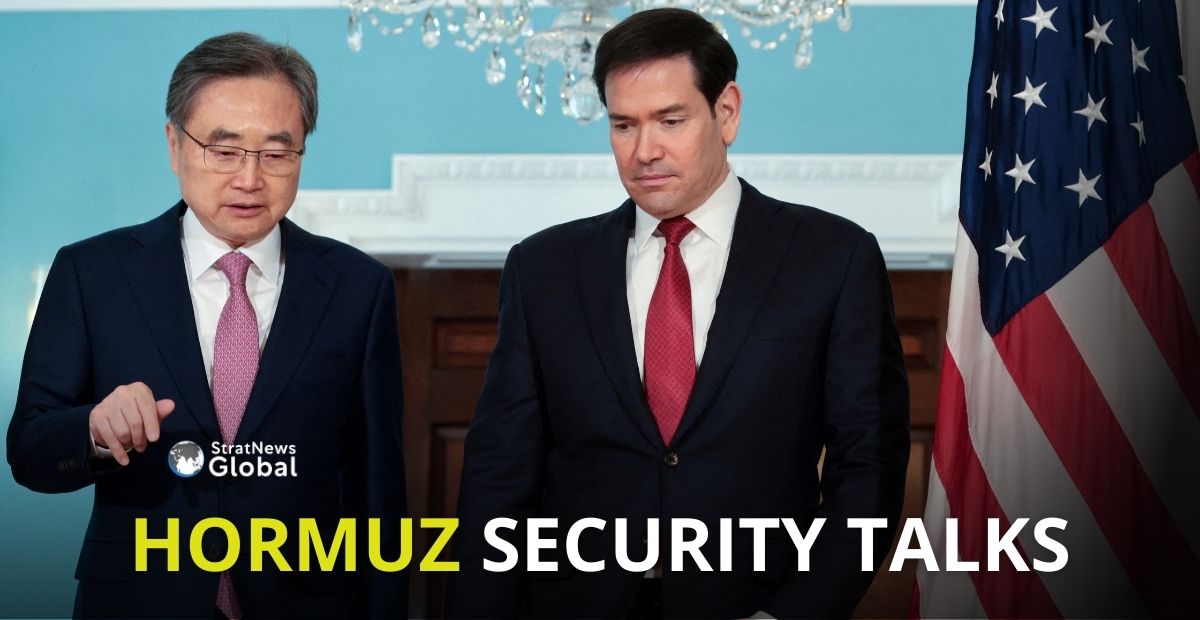
U.S. Secretary of State Marco Rubio said in a phone call with South Korea’s Foreign Minister Cho Hyun that cooperation among countries to secure the Strait of Hormuz is more important than ever to stabilise the global economy and oil prices, Seoul said.
Cho later refused to disclose whether Washington had asked South Korea to deploy a naval ship to the strait, despite intense questioning by members of parliament, some of whom suggested such a move could breach domestic laws.
“The question of how we’re going to respond to an ally’s demand is a very important one,” Cho said. “As we make a decision, I assure you we will act according to the constitution and the law,” he told a parliament committee hearing.
No Request to Deploy Warships
U.S. President Donald Trump has accused Western allies of ingratitude after several countries rebuffed his demand for help securing the Strait of Hormuz by deploying warships to escort oil tankers.
South Korea said that it will carefully consider Trump’s call for countries, which in Asia include South Korea, Japan and China, to deploy naval ships to West Asia to form a coalition to ensure safe passage through the waterway.
The country relies almost entirely on imports for its energy, buying about 70% of its oil and 20% of its liquefied natural gas (LNG) from West Asia, according to data from the Korea International Trade Association.
On Tuesday, South Korea’s Defence Ministry said it had not received a request to deploy naval ships or troops to the Strait of Hormuz.
South Korea has already deployed some forces in West Asia after deploying the Cheonghae unit in 2009 to escort its merchant vessels sailing near the Somali coast in anti-piracy operations, and has since sent a rotation of destroyers with an attack helicopter and about 260 crew members.
In his call with Rubio, Cho agreed on the importance of freedom of navigation in the strait for the security and economies of South Korea and other countries, and he suggested the allies continue discussions, stated South Korea’s foreign ministry.
The vital waterway has effectively closed for most of the world’s tanker traffic since the U.S. and Israel struck Iran on February 28th.
(With inputs from Reuters)