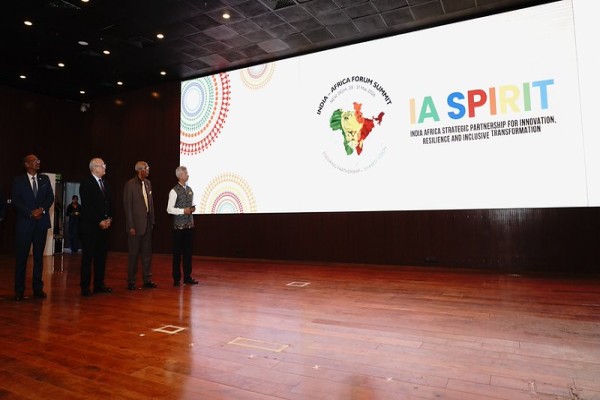
The Fourth India-Africa Forum Summit (IAFS-IV) scheduled for May 31, 2026 in Delhi underlines both the strength and the strain in India’s Africa policy.
India still has goodwill. It built that over decades through training programmes, low-cost healthcare, education exchanges, and small but visible development projects.
Indian companies operate in telecom, pharmaceuticals, and agriculture. Digital public goods such as identity systems and payment platforms are areas where India offers practical solutions that many African countries can adopt quickly and cheaply.
This creates a clear advantage. India is seen as relatable. It does not carry the baggage of being a former colonial power in Africa. It also avoids overt political conditions. That makes engagement easier.
But the gap between intent and delivery is becoming harder to ignore. Projects often move slowly. Funding is limited. Execution is uneven. African governments are now comparing partners.
They see China building large projects quickly. They see the United States bringing finance and market access. India’s model looks modest in comparison.
This is the core tension. India’s approach is politically comfortable but economically constrained. The summit matters because it forces a shift. India needs to move from goodwill to scale. It needs to focus on fewer sectors and deliver faster results.
There are clear areas where India can compete. Healthcare is one. Indian pharmaceutical firms already supply affordable medicines across Africa. Expanding local manufacturing would deepen this link.
Digital infrastructure is another. India’s experience with large-scale digital systems can be adapted for governance, banking, and welfare delivery. Skill development is a third. Africa’s young population needs training, and India has experience in low-cost education models.
There is also a strategic layer. Africa is rich in critical minerals such as cobalt, lithium, and rare earths. These are essential for energy transition and technology. India cannot rely only on imports routed through others. Direct engagement with African producers is becoming necessary.
Energy security is another driver. Several African countries are emerging as key oil and gas suppliers.
Diplomatically, Africa matters in multilateral forums. A large number of votes in global institutions come from African countries. Support here strengthens India’s global position.
Yet even as India recalibrates, it is entering a space that is already crowded.
China set the pace. It is Africa’s largest trading partner and its most visible builder. Chinese finance has built highways, railways, ports, and power plants across the continent. The appeal is speed and scale. Projects move quickly. Funding is large. Conditions are fewer.
But China’s role is evolving. It is now combining economic reach with strategic depth. Military cooperation has expanded. Its base in Djibouti signals long-term intent.
It is also more willing to use pressure. Its stance towards Eswatini shows this clearly. Eswatini remains one of the few countries that recognises Taiwan. China has applied steady diplomatic pressure to change that position.
This reflects a broader pattern. Economic engagement is backed by political expectations.
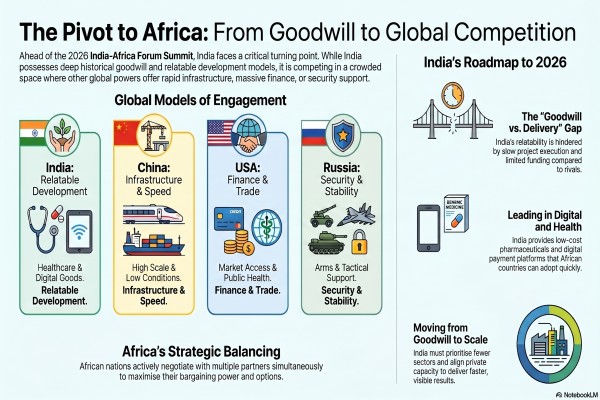
The United States is trying to respond to this shift. After a period of limited focus, it is re-engaging with Africa. It offers investment, trade access, and strong public health programmes. Its work on HIV has had a deep impact across the continent.
But US policy is also shaped by competition. It wants to secure supply chains for critical minerals and limit the influence of China and Russia. This creates a more transactional approach.
In Zambia, reports suggest that access to support, including HIV-related assistance, has been linked to cooperation on mineral access and broader alignment. This reflects a clear carrot-and-stick method. Benefits are offered, but they are tied to expectations.
Russia operates differently. It does not compete on infrastructure or trade. It focuses on security. It provides arms, training, and direct support to governments facing instability. Its appeal lies in speed and the absence of political conditions.
The role of the Wagner Group is central here. It has operated in countries such as Mali and the Central African Republic. These engagements provide immediate security support, but they also give Russia influence over political and economic decisions. In return, Russia gains access to resources and strategic footholds.
What links all these approaches is a mix of incentives and pressure. China offers infrastructure but expects alignment. The United States provides aid but ties it to strategic goals. Russia delivers security but seeks influence in return. The methods differ, but the logic is similar.
Africa, however, is not a passive space in this competition. It is actively shaping outcomes.
Many African countries are practising strategic balance. They engage with all major powers at once. They accept Chinese investment, American trade access, Russian security support, and Indian development cooperation.
This approach increases bargaining power. Governments can negotiate better deals. They can compare offers and push for improved terms. They are less dependent on any single partner.
There are, of course, risks. Debt burdens are rising in some countries. External pressure can influence domestic decisions. In fragile states, foreign involvement can deepen conflict. But there is also opportunity. Competition creates options, and options create leverage.
This is visible in the growing role of Africa in global groupings such as BRICS. The inclusion of countries like Egypt and Ethiopia reflects a shift towards a more distributed global order.
In this setting, the India–Africa Summit is not just another diplomatic event. It is a test of whether India can adapt to a sharper, more competitive environment.
India does not need to match China’s scale or the United States’ financial power. But it does need clarity. It must choose sectors where it can lead and deliver results quickly. It must align its public sector efforts with private sector capacity. It must also ensure that commitments are implemented on time.
The larger story is not just about why India, China, the United States, and Russia are focusing on Africa. That answer is straightforward. Africa offers resources, markets, and strategic reach.
The deeper story is about how Africa is using this attention. The continent is no longer on the margins of global politics. It is at the centre of a new competition.
The outcome will depend on two things. Whether external powers can balance ambition with respect, and whether African countries can convert competition into long-term gain.
Right now, Africa is not just being pursued. It is choosing how to be engaged.
That is what makes this moment different.