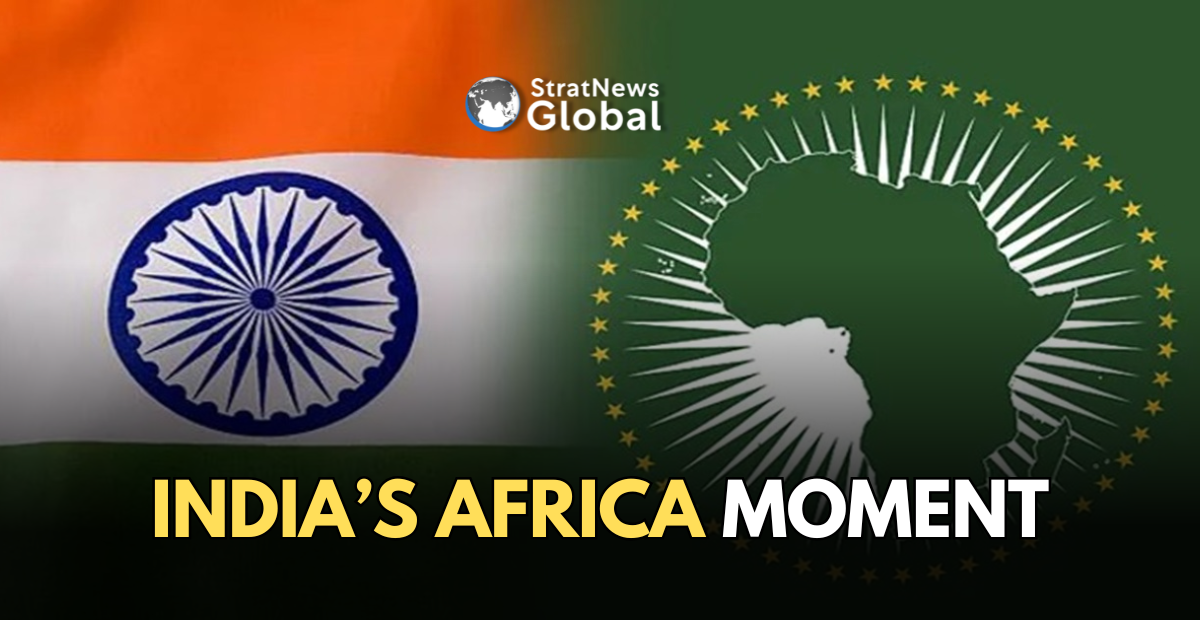
It’s been 11 years since the last India-Africa summit, and the one scheduled for this year had to be cancelled owing to the Ebola crisis. Why the long gap is not clear, but India and Africa have a bilateral trade of around $100 billion, which could easily go up to $200 billion with a little effort.
On that note of optimism, scholars and diplomats got together for a seminar on “India-Africa Relations in a New World Order,” organised by the India Foundation. Moderator Alok Bansal argued that if the 21st century has gone to Asia, the 22nd will belong to Africa: the fastest-growing continent, a young and diverse population, vast untapped resources.
India, he reminded the room, was among the first to raise its voice against apartheid, set up the Africa Fund, and back the African Union’s inclusion in the G20. Yet the world stays apathetic, till date, to the continent’s crises, from Sudan to Congo to the Sahel.
Manju Seth, former envoy to Madagascar and Comoros, said the West had approached the continent through extraction and exploitation, mining minerals and rare earths and even trying to control their economies, adding little value locally even after independence, whereas India’s approach was built on co-development and mutual benefit.
China recalibrated around 2012–13, once African nations realised that huge infrastructure built by Chinese workers brought them few jobs, contributed little to local economies, and at times pushed countries into ‘Debt Trap’. India must stay nimble footed, drop the one-size-fits-all template across 54 countries, and carry its private sector along through joint ventures and partnerships in fintech, pharmaceuticals and scalable, low-cost technology. The space for India is narrowing, she warned, but it still exists.
Bansal added that India had a head start and lost it, its presence traditionally confined to three hubs: Kenya in the east, Nigeria and Ghana in the west, South Africa in the south. Mauritius, bound to India by treaty and part of the African Union, and Egypt’s special economic zone offering access across Europe, Russia and Africa, remain useful bridgeheads, and Indian products like Tata Motors are still in demand there.
His sharper point was that money power is not why India fell behind: countries with far less of it have done better in Africa. India, he said, has its own historical legacy to its advantage and both the private sector and Indian foreign policy needed to shed their conservative approach by taking more risks.
Aditya Ghosh, who heads CII’s Africa Desk, has watched the continent for 22 years. The relationship, he argued, has moved beyond development assistance into a strategic and economic partnership. With $80 billion invested over the last decade. India now has over 47 missions in Africa, 18 added recently, and CII has taken some 30 business delegations across the continent in two years, with South Africa, Egypt, Nigeria, Kenya, Ghana, Tanzania, Mozambique, Congo and Ethiopia emerging as key partners.
Africa, he noted, holds all 118 elements of the periodic table, and the answer is not to take resources and run but to invest in technology transfer, capacity building, ports, railways and industrial parks. He flagged ‘Trilateral Partnerships’, with Spanish, Japanese, and other European firms keen to enter Africa via India: a model, he said, that offers a feasible alternative to China’s all-encompassing services approach.
Dr Nivedita Ray, Director (Research) at ICWA and an Africa specialist, focused on what is missing: ‘People’ and ‘People Centric Enablers.’ She traced the relationship from the ideological solidarity of the 1960s to today’s polycentric world, where assertive African states have more choices and the language has shifted to co-development. Ordinary people on both sides, she said, still see each other through a Western perspective, and her answer was the ‘Creative Economy.’
She wanted collaboration, co-production and co-platform in cinema, digital content, music, and AVGC (Animation, Visual Effects, Gaming, and Comics) sector between India and Africa, for instance Nigeria’s ‘Nollywood,’ to build a south-south narrative long dominated by the West.
Sustainable textiles linking Indian design institutes to fashion clusters in Lagos and Johannesburg, and a shift in gems and jewellery from mere extraction to value retention, with cutting hubs and training academies set up within Africa.
Each idea, she stressed, was meant to create jobs for women and youth at the grassroots, since the creative economy is democratic, not top-down, resting only on individual imagination and aspirations.
The questions were pointed. The first turned on perception: how Africans are seen in India and the treatment of African students, and feasibility of geologists in embassies. The panel’s answer was narrative-building, more interaction between people through various means, better care for students by universities, and closer involvement of embassies and the MEA. On geologist, Amb. Seth replied the appointment requires interests, needs, and collaboration between both sides.
The second round drew out solar and space cooperation, with ISRO and only five African agencies in deeper collaboration, and growing involvement of companies in solar, India’s 15 think-tank MoUs that go largely unreciprocated, and the reminder that India’s single largest contribution has been capacity building, education and technology.
It also turned to harder questions: India’s bandwidth to mediate in Africa’s conflict zones, where Bansal was candid about India’s reluctance since Somalia and the IPKF years in Sri Lanka, and agriculture, where he flagged land transfer-a sensitive issue and day-to-day security as the real obstacles.
It was medical tourism that brought the session back to where it began. Bansal argued that Indian firms should not simply bring Africans to India for treatment but set up hospitals on the continent itself, as they have in West Asia. Closing the seminar much as it opened: India’s case for itself in Africa rests on showing it cares about African health and its futures, not only Africa’s rare earths.