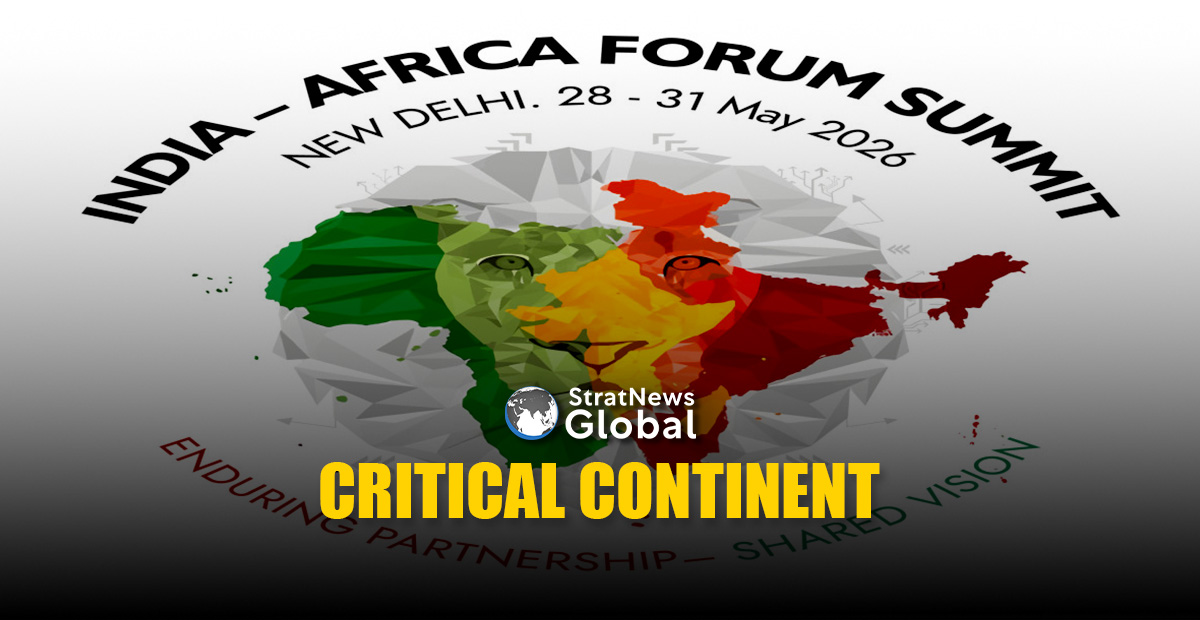
One of the most important issues expected to come up at the forthcoming 4th India–Africa Forum Summit is access to critical minerals and rare earth elements.
India is pushing aggressively into electric vehicles, renewable energy, and electronics manufacturing. All of these depend on minerals like lithium, cobalt, nickel, and rare earths. But India does not have enough of them.
As a result, it remains dependent on imports, often from a limited set of countries, which makes supply both uncertain and strategically risky.
China’s strong hold over the processing of rare earth elements has made many countries uneasy. The pandemic further exposed how easily supply disruptions can ripple across industries. For India, which is trying to scale up EV production and renewable capacity at the same time, any disruption in mineral supply can slow down entire sectors.
That is where Africa enters the picture. The Democratic Republic of the Congo produces most of the world’s cobalt. Zimbabwe and Namibia are emerging as lithium sources. South Africa dominates platinum group metals, which are important for future technologies like hydrogen energy. There are also deposits of rare earth elements in Tanzania.
Initiatives like Khanij Bidesh India Limited (KABIL) show intent, trying to secure mineral assets abroad instead of relying only on imports. But securing mines is only one part of the equation. Processing, logistics, and long-term agreements matter just as much.
Instead of simply extracting and exporting raw minerals, there is growing emphasis on setting up processing units within Africa itself. That allows African countries to retain more value, while India gets more stable and predictable supplies.
There is also scope for India to invest in infrastructure, rail lines, ports, storage, which are often the real bottlenecks in mining projects. Skill development and technology transfer can also become part of the partnership, rather than an afterthought.
At the same time, there is increasing pressure to ensure mining is done responsibly. Issues like unsafe working conditions and child labour, especially in cobalt mining, cannot be ignored anymore, both for ethical and reputational reasons.
India is not entering an empty space. China has had a long presence in Africa’s mining sector. The US and European Union are now actively trying to secure alternative supply chains. This means India has to move carefully, it cannot compete only on money.
What may work in India’s favour is a more development-oriented approach, projects that create local jobs, build capacity, and avoid the perception of exploitation.
The potential is clear, but the constraints are equally real. Infrastructure gaps in several African countries increase project costs. Political instability in some regions adds uncertainty. Regulatory systems are not always consistent.
On India’s side, engagement with Africa has sometimes lacked continuity, with long gaps between high-level interactions like the India–Africa Forum Summit. These are not small issues, they will directly affect how quickly any agreements translate into actual supply.