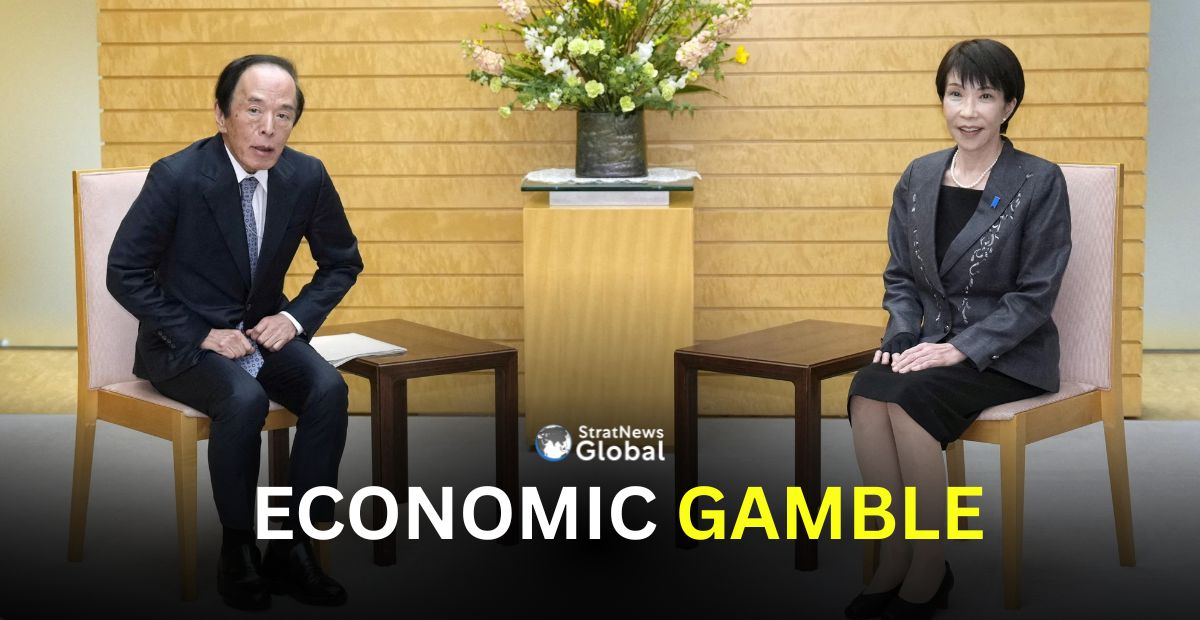
Japan’s Prime Minister Sanae Takaichi on Tuesday unveiled her first economic policy blueprint, pledging to increase investment in key growth sectors. However, the announcement was overshadowed by rising government bond yields, which reflected investor concerns that her administration could interfere with monetary policy.
Takaichi’s government has struggled to dispel market concerns that it may expand fiscal spending while pressuring the Bank of Japan (BOJ) to delay further interest rate hikes, raising worries about the long-term cost of financing Japan’s already massive public debt.
As government bond yields crept up to multi-decade highs since June, the administration was forced to tweak the blueprint’s language on monetary policy several times.
A phrase in an early draft calling for monetary policy “that bolsters private demand” disappeared as long-term rates rose.
Revisions Made To Clarify BOJ Sets Policy
A revised version of the blueprint clarified that the Bank of Japan independently sets monetary policy to achieve stable inflation after an earlier draft unsettled markets by linking policy more closely to the government’s growth agenda.
The final document still called for policy coordination between the government and the BOJ but added a footnote reaffirming the central bank’s legal independence. Japan’s law grants the BOJ autonomy over monetary policy while requiring close coordination with the government’s economic strategy.
Vows To Boost Investment
Prime Minister Sanae Takaichi’s blueprint reflects her support for “Abenomics,” pledging greater public and private investment in strategic industries, with combined spending expected to exceed 370 trillion yen ($2.28 trillion) by fiscal 2040. It also shifts away from previous commitments to fiscal consolidation, instead emphasizing a balance between economic growth and fiscal sustainability.
Since taking office in October, Takaichi has advocated higher government spending and expressed caution over the Bank of Japan’s rate hikes, fuelling market concerns about rising debt and inflation. Although the 10-year government bond yield eased to 2.73% on Tuesday from a three-decade high of 2.9% earlier this month, analysts said the revised wording in the blueprint is unlikely to ease concerns that the government favors low interest rates to support increased borrowing.
Meanwhile, the BOJ has continued tightening policy since ending its stimulus program in 2024, raising its benchmark rate to 1%.
(With inputs from Reuters)