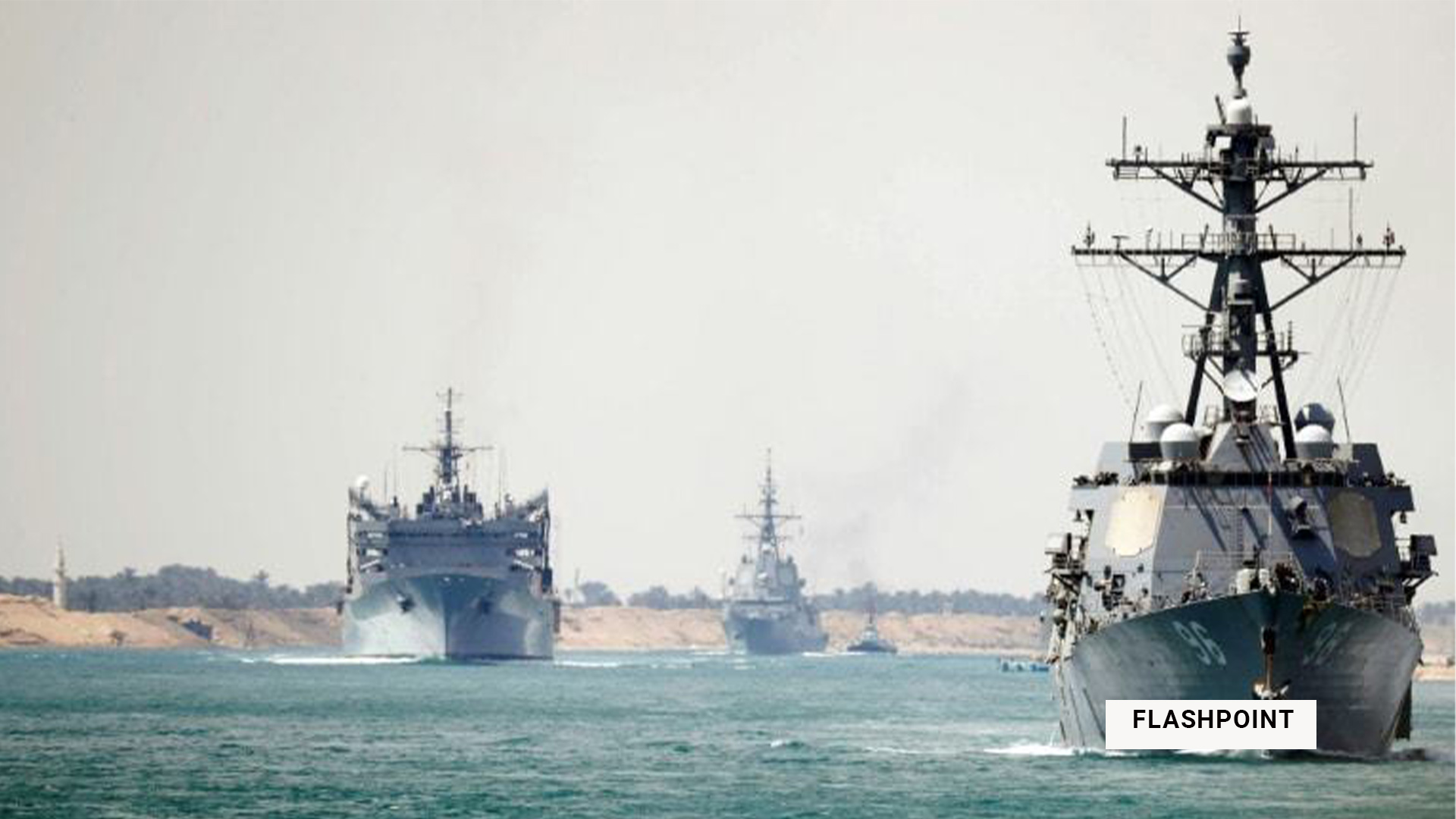
The U.S. Navy’s imposition of a blockade on the Strait of Hormuz, backed by explicit threats of punitive action against any vessel that defies it, marks a radical departure from modern maritime norms.
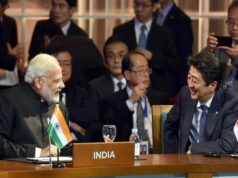
This aggressive pivot was laid bare during a recent diplomatic exchange, where U.S. Secretary of State Marco Rubio bluntly warned India’s External Affairs Minister, S. Jaishankar, that “all commercial vessels must comply with orders from US forces in the Strait of Hormuz.”
While dressed in the language of regional security, this threat to global commercial shipping is fundamentally designed to strangle Asian trade, turning a vital international choke point into a weapon of economic coercion.
US Navy’s Paranoia
To understand why the world’s sole superpower has resorted to such drastic, blockade-running tactics, one must look at the sheer, multi-layered paranoia gripping U.S. naval circles. For decades, the US Navy operated from a near-sanctuary position of unchallenged dominance. Today, that dominance is numerically eroding.
China has morphed into the world’s foremost maritime power, boasting over 400 warships backed by a merchant fleet consisting of 6000 vessels. In sharp contrast, U.S. Navy force levels are stagnant at around 350 ships, and its domestic merchant marine has withered to fewer than 200 vessels flying the American flag.
Yet, the paranoia is not solely related to the stupendous growth of the Chinese Navy. More immediately, it is fueled by a reality on the ground: a tiny power, in comparison to the U.S., like Iran is standing up in defiance to the mighty US Navy fleet.
Iran’s asymmetric tactics have effectively prevented the U.S. carrier-based navy from entering the Strait of Hormuz. Faced with a conventional fleet that cannot physically breach the strait, Washington is lashing out by weaponizing the waters and holding global commercial traffic hostage.
Unable to close the numerical gap with China through shipbuilding due to lack of industrial capacity and unable to project conventional carrier dominance against Iranian asymmetric warfare, the viability of the century-old American naval strategy is collapsing.
Since the eras of Alfred Thayer Mahan and Julian Corbett, the core doctrine of the U.S. Navy has been maintaining order at sea and protecting the sea lanes of communication (SLOCs) to allow global trade to flourish.
Strategy Of The Weak
Now, a revisionist thought process is taking hold, replacing the strategy of the strong with a “strategy of the weak.” Historically, commerce-raiding was the tactic of choice for nations that could not field a grand armada to achieve “command of the sea.”
Unable to win decisive fleet-on-fleet battles, weaker navies deployed frigates and privateers not to conquer the ocean, but to deny it to the enemy—hunting down merchant ships to bleed the adversary’s economy dry.
In a historical irony, the U.S. Navy is now adopting this exact inferior-party tactic. By turning the Strait of Hormuz into a lethal no-go zone for commercial vessels, the U.S. is effectively becoming the very maritime menace it was originally built to suppress.
This current panic is not a sudden development; it is the delayed execution of a blueprint drawn up when the writing was first spotted on the wall. Back in the April 2020 issue of Proceedings, the U.S. Naval Institute’s flagship magazine, the intellectual groundwork for exactly this kind of desperation was laid.
Unleashing The Privateers
In a joint article titled “Unleash the Privateers!” Brandon Schwartz and Mark Cancian, both senior advisers at the Center for Strategic and International Studies (CSIS), warned that the U.S. could not counter China’s maritime mass by building traditional warships.
Four years later, with carrier groups locked out of Hormuz and the Chinese fleet numerically superior, their once-fringe proposal has become the logical, if terrifying, fallback.
They argued that Congress must use its constitutional mandate to issue Letters of Marque to civilian ship-owners—privately armed vessels legally empowered to capture, destroy, and loot Chinese merchant ships on the high seas, bringing the booty home to share with the government.
While this remains a proposal rather than enacted policy, the theoretical panic of 2020 has since seeped into the halls of Congress, setting a troubling institutional precedent.
In February 2025, Representative Tim Burchett introduced the “Cartel Marque and Reprisal Authorization Act of 2025.” Co-led by Rep. Mark Messmer, this legislation explicitly invokes Article 1, Section 8 of the U.S. Constitution to authorize the President to commission privately armed actors to seize the persons and property of designated enemies.
While currently framed around land-based cartels, the deeper danger of this bill lies not in its immediate target, but in the precedent it sets: it actively normalizes the delegation of state-sanctioned violence to private, profit-motivated actors, and revives a constitutional mechanism that has lain dormant for over two centuries.
If this bill passes, the institutional and political barrier to shifting its application from the southern border to the high seas—to hunt the merchant vessels of a rival state—would be significantly lowered.
To further pave the ideological road, in the 2020 Proceedings companion piece, “U.S. Privateering Is Legal,” Schwartz attempted to construct an international legal shield for this 18th-century tactic.
He argued that under the 1977 Additional Protocol I (AP I) of the Geneva Conventions, privateers cannot be labeled “mercenaries” so long as they are U.S. nationals, pointing to a geopolitical loophole: the International Convention against the Recruitment, Use, Financing and Training of Mercenaries (2001) has been ratified by only 35 countries, deliberately excluding the U.S., the UK, Russia, and China.
In reality, there is hardly a distinction between a privateer and a mercenary; both are driven to indulge in hostilities by the desire for private gain. Issuing a Letter of Marque to strangle rival economies remains a gross violation of customary international law, specifically the 1977 UN Security Council resolution outrightly rejecting the use of mercenaries against member states.
However, this remains a flimsy legal gambit. In reality, there is hardly a moral or functional distinction between a privateer and a mercenary; both are driven to indulge in hostilities by the desire for private gain.
More critically, even if the U.S. could successfully argue the technical “mercenary” exemption, issuing Letters of Marque to strangle a rival economy would still collide head-on with the fundamental principles of customary international law—specifically, the freedom of navigation and the prohibition against unregulated attacks on civilian merchant vessels. The legal path is not clear; it is a high-stakes gamble.
Identifying Hostile Zones
Crucially, as the 2020 Proceedings authors noted, this doctrinal shift toward privateering does not necessarily require a formal declaration of war. It only requires that a particular part of the ocean be declared a “hostile zone.”
The U.S. Navy’s current blockade of the Strait of Hormuz—enforced by Rubio’s zero-tolerance threats to commercial vessels—is effectively Washington’s attempt to manufacture that operational and political precondition.
By turning the Persian Gulf into a de facto war zone to choke off Beijing’s energy supplies, the US Navy is setting the exact precedent needed to justify, in the future, unleashing licensed privateers against the thousands of Chinese merchant vessels navigating the rest of the global commons
The theoretical panic of 2020 has now manifested as kinetic policy and legislative reality. By weaponizing choke points and dusting off Letters of Marque, the U.S. Navy is abandoning its role as the guarantor of global maritime security.
Driven by numerical inferiority to China and tactical humiliation by Iran, the world’s premier navy is regressing, replacing international maritime law with the law of the jungle. It seems the naval establishment is perfectly content to hum an old 1970s Peter Allen and Carole Bayer Sager tune as it casts off the rules-based order:
And don’t throw the past away,
You might need it some other rainy day,
Dreams can come true again,
When everything old is new again
Lt. Cdr.Atul Bhardwaj (Retd) is Deputy Director, Centre for Military History & Conflict Studies, USI, New Delhi