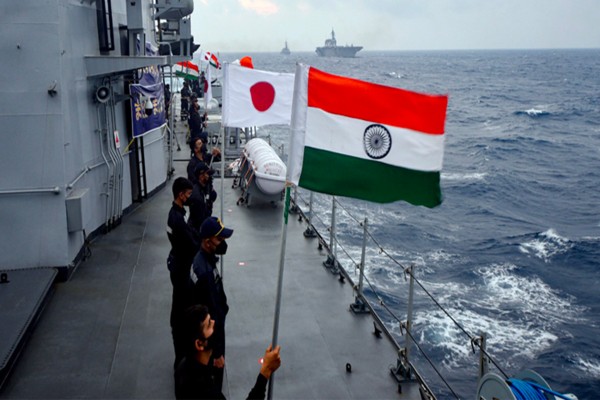
Concluding part of a two-part series on the India-Japan relationship
Part I:Why Japan Is Looking East in India
India and Japan are quietly building a new model of security cooperation where defence, technology and industrial capability matter as much as military alliances.
If Japan’s growing investment in eastern India reflects a new economic geography, its expanding defence relationship with India points to an equally important shift in Asia’s security landscape.
The partnership has moved well beyond diplomatic exchanges and naval exercises. It now spans defence manufacturing, emerging technologies, maritime security and institutional cooperation, creating one of the Indo-Pacific’s most consequential strategic relationships without the framework of a formal military alliance.
The transformation has been gradual rather than dramatic. Over the past decade, New Delhi and Tokyo have built an institutional architecture that now drives cooperation throughout the year.
The annual summit is reinforced by the 2+2 Foreign and Defence Ministers’ Dialogue, regular Defence Ministerial meetings, a Defence Policy Dialogue, staff talks between the armed forces and expanding cooperation between the two coast guards.
Defence ties no longer depend solely on the chemistry between political leaders. They have become embedded within the institutions of both governments.
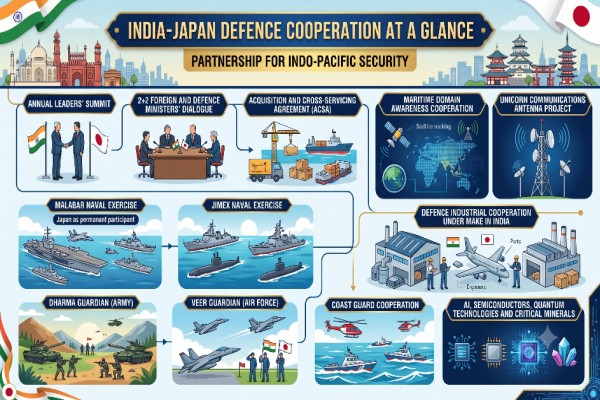
That institutional foundation has steadily produced practical cooperation. Japan is now a permanent participant in the Malabar naval exercise alongside India, the United States and Australia.
The Acquisition and Cross-Servicing Agreement (ACSA) allows the armed forces of both countries to use each other’s facilities for logistics, fuel and maintenance, making cooperation during exercises and humanitarian missions significantly easier.
Bilateral engagement has also expanded through JIMEX at sea, Dharma Guardian between the two armies and Veer Guardian between their air forces. Individually, these exercises may appear routine. Collectively, they have built familiarity, trust and the ability to operate together when circumstances demand.
The next phase of the relationship is likely to prove even more significant because it shifts the emphasis from exercises to capability. Japan’s decision to ease restrictions on defence exports has opened opportunities that scarcely existed a decade ago.
The conversation is no longer limited to buying military equipment. It increasingly centres on co-development, technology transfer and joint manufacturing. The proposed UNICORN communications antenna project, cooperation in maintenance, repair and overhaul, and collaboration under India’s Make in India programme all point towards a future in which the two countries develop defence capability together rather than simply conduct military exercises.
Maritime security provides the strongest strategic logic for this partnership. Japan depends on sea lanes stretching from the Gulf through the Indian Ocean and the Strait of Malacca for much of its energy and trade. India sits astride those routes.
As Chinese naval deployments become more frequent across the Indo-Pacific, New Delhi and Tokyo have expanded cooperation in maritime domain awareness, anti-submarine warfare, logistics and information sharing. Their objective is not to dominate these waters but to ensure they remain open, secure and governed by international law.
This shared maritime outlook reflects a broader reality. Japan’s security interests no longer end in the western Pacific, just as India’s extend well beyond the Indian Ocean. Energy supplies, commercial shipping and naval deployments now connect both regions into a single strategic theatre.
Shinzo Abe recognised this transformation when he described the Indian and Pacific Oceans as the “Confluence of the Two Seas” in 2007. What was once an ambitious strategic vision has since become the organising principle of Japan’s Indo-Pacific policy and a defining feature of its relationship with India.
The meaning of security is also changing. Military strength is no longer measured only by the number of ships, aircraft or soldiers a country possesses. It increasingly depends on access to semiconductors, critical minerals, artificial intelligence, quantum technologies and secure digital networks.
These technologies underpin modern weapons systems, communications and intelligence capabilities while driving economic competitiveness. That explains why the latest India-Japan summit devoted as much attention to emerging technologies as it did to conventional defence cooperation. Technology has become an essential pillar of national security.
Japan’s own transformation has reinforced this shift. For decades after the Second World War, Tokyo maintained a deliberately restrained defence posture, relying heavily on its alliance with the United States.
Over the past decade, however, Japan has increased defence spending, adopted a more proactive National Security Strategy, relaxed restrictions on defence exports and invested in capabilities that would once have been politically difficult to contemplate. Closer defence cooperation with partners such as India has become a natural extension of that evolution.
The Quad reflects the same logic, although it is often misunderstood. It is not an Asian NATO, nor was it designed to become one. Its strength lies in its flexibility. India, Japan, Australia and the United States cooperate where their interests converge, whether on maritime security, disaster relief, critical technologies or resilient supply chains, without binding treaty obligations.
That arrangement suits both New Delhi and Tokyo. It allows deeper cooperation while preserving the strategic autonomy that each values.
The return of President Donald Trump has added another layer to Japan’s calculations. Tokyo’s alliance with Washington remains the cornerstone of its security policy, but recent years have underlined the importance of strengthening partnerships beyond the United States.
Questions over tariffs, alliance burden-sharing and the increasingly transactional nature of American policy have encouraged Japan to diversify its strategic relationships.
India occupies a unique place in that approach. It combines military capability, technological ambition, industrial scale and an independent foreign policy that complements rather than competes with Japan’s alliance with Washington.
China, meanwhile, remains the unspoken factor behind much of this cooperation.
Neither India nor Japan seeks confrontation or containment. Both continue to maintain substantial economic ties with Beijing. Their objective is to ensure that China’s growing military and economic influence leaves them with more choices, not fewer.
Stronger defence industries, secure supply chains, closer maritime coordination and technological cooperation all contribute to that goal without creating new military blocs.
Viewed together, these developments reveal how profoundly the relationship has changed. A decade ago, India and Japan were primarily linked through development finance, infrastructure projects and political dialogue.
Those foundations remain important, but they are now being reinforced by defence production, military interoperability, advanced technologies and shared maritime interests. The relationship has moved steadily from consultation to coordination and increasingly towards building capability together.
In the first part of this series, we argued that Japan’s growing investment in eastern India reflects a new economic geography centred on the Bay of Bengal. Defence and technology are becoming the second pillar of that strategy. Together they reveal a partnership that has evolved well beyond trade, development assistance or summit diplomacy.
India and Japan are not constructing an Asian NATO. They are shaping a different model of security cooperation, one built on trusted institutions, industrial capability, technological innovation and secure sea lanes rather than formal military alliances.
It has developed quietly, without dramatic announcements or treaty commitments. Yet as Asia’s balance of power continues to evolve, this partnership may prove to be one of the region’s most enduring sources of stability.
The India-Japan relationship is no longer simply adapting to the Indo-Pacific’s changing security landscape. Increasingly, it is helping shape it.
Part One: Why Japan Is Looking East in India