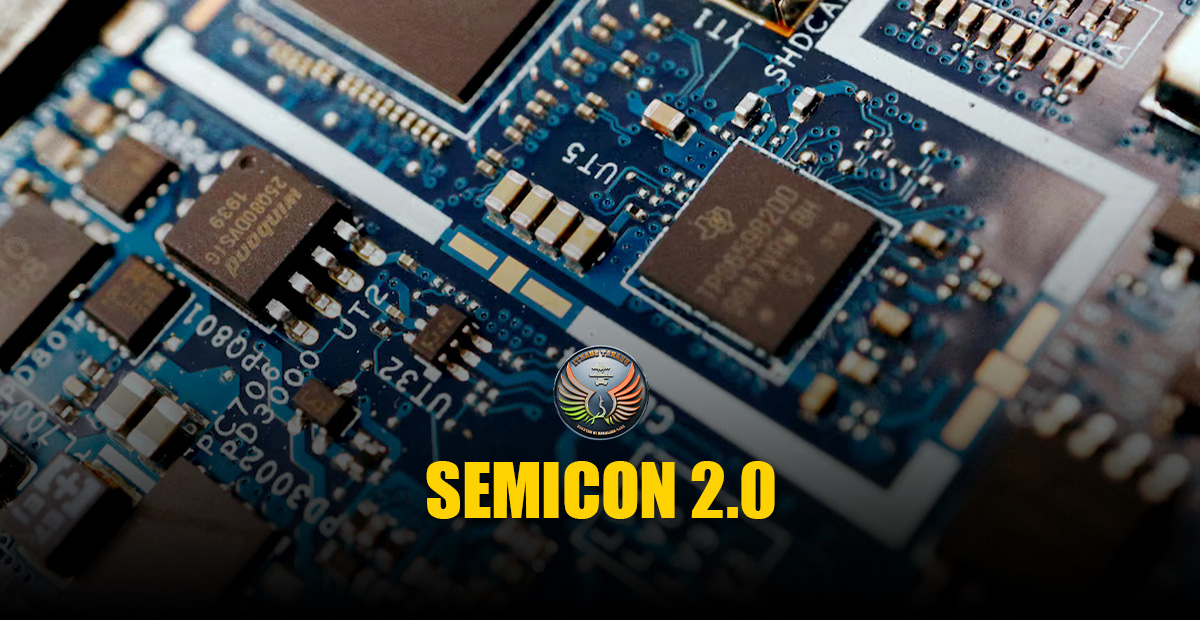
Five years and nearly $10 billion invested, India is now ready to embark on the second phase of its ambitious semiconductor mission with a budget of Rs 1,27,500 crore or over $13 billion.
Five key areas of focus have been identified that are expected to build the semiconductor ecosysterm in the country in terms of chip design, machines and materials, more fabs, strengthening the ATMP-OSAT (Assembly, Testing, Marking, Packaging – Outsourced Semiconductor Assembly & Testing), and of course R&D.
“Under Semicon 2.0, the chips required for all our strategic needs will be designed in India, and by the end of this semiconductor programme, the country will become self-reliant in chip design,” is the promise by Ashwini Vaishnav, Information Minister.
The first semiconductor chip assembled in India rolled out of the assembly lines of CG Semi’s OSAT facility in Sanand, Gujarat last year. Tata Electronics JV with Taiwan’s Powerchip Semiconductor is expected to rollout its first “Made in India” chip of 28 nanometre by the end of this year.
It will feed into two huge sectors, consumer durables and defence.
“Everything is becoming smart,” an industry watcher said, “so chipsets made in India would not only be customised to our requirements, it will also free India from the conditions imposed by other chip-producing and exporting nations.”
He noted that Semicon 1.0 “is a decent success given that Indian biggies like the Tatas and the Murugappa Group and Micron from the US have invested. These include 12 manufacturing units and 24 semiconductor design projects.”
This is nothing to be sneezed at given that India had nothing of that kind five years back. India made chips will help the country cut down, to a certain degree, imports from other countries. It may not matter even if the chip is made by an American as long as it is in India.
Reports suggest that minus Semicon 1.0, India would have ended up paying a staggering $240 billion for imported chips by 2035. Now made in India chips will not only bring down costs, it frees or limits key sectors of Indian industry from geopolitical shocks and global disruptions.
Besides, manufacturing chips locally ensures strategic autonomy, secures critical infrastructure and safeguards military electronics from external dependencies. India’s fast expanding industry for drones, for instance, is expected to be a major customer for the 28-nanometre chip.
The same chip would not go into a mobile phone, since such instruments require 3 to 5 nanometre chips. Those will continue to be imported until a time comes when they could end up being made in India.
Mobile phone exports are around $30 billion with much of them going to the US. The main exporters are Foxconn, Tata Electronics, Pegatron and Samsung.