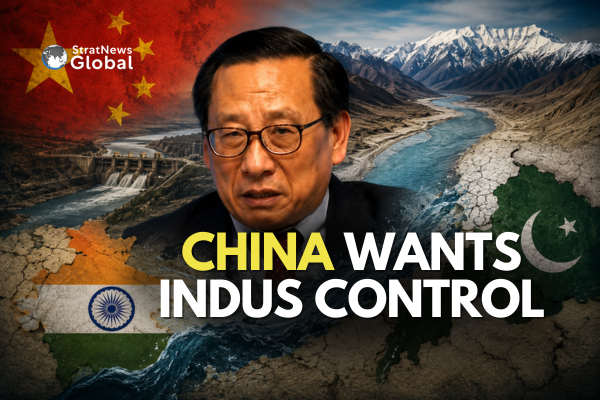
Victor Gao, vice-president of the Beijing-based Center for China and Globalization, is an incorrigible India-baiter. Witness his latest comments targeting India at a high-profile seminar on the Indus Waters Treaty (IWT) in Islamabad, Pakistan.
“Don’t do unto others what you don’t want others do unto you,” he said invoking an ancient Chinese proverb attributed to the sage Confucius. He was hinting that India is hardly an “upstream” country, meaning that the headwaters of major rivers don’t originate in India.
Calls for China to Join Indus Framework
In fact, the Indus flows down from Tibet giving China control over the river. He warned that by putting the IWT in abeyance, India was committing a “crime against humanity” and demanded a say for China in the IWT.
“To deal with the violation of the IWT should be fully exposed and should be stopped as much as we can. In this sense, in my personal capacity I want to fully support the positions taken by many of the Pakistani speakers.”
“China and Pakistan, fully respecting each other, can really do many things together to make sure the IWT clauses should be strictly abided by,” he said and then proposed a trilateral agreement.
“Theoretically speaking, we could also start to think about a trilateral agreement involving China, India and Pakistan… to make sure that the flow of the water should not be interrupted and should be better managed.”
Push for Wider Regional Water Rules
Gao then broadened the discussion beyond the Indus basin, saying that around 18 countries depend on rivers originating from Tibet and argued that the Indus issue should be viewed as part of a much larger regional water framework.
“I counted on my fingers, actually there are about altogether 18 countries which depend on the water flowing from rivers originating from what we call Qinghai-Tibetan Plateau,” he said.
He claimed there is currently no regional or international framework governing these shared water resources and called for one to be established.
“I hope all these countries together should think about and work together to come up with a framework so that common standards, common rules, regulations and the best code of conduct should be introduced.”
According to Gao, such a framework should eventually be endorsed by the United Nations and cover not only the Indian subcontinent but also countries in Southeast Asia and Central Asia that rely on rivers originating from the Tibetan Plateau.
How much of what Gao said has the approval of the Beijing establishment is not clear. China has refused to negotiate or even discuss water sharing treaties either with India or any country in southeast Asia.
The Mekong for instance also has its headwaters in Tibet but China went and built 11 dams on the Upper Mekong ensuring water and energy for its people but disrupting agriculture and fisheries downstream in Myanmar, Laos, Thailand, Cambodia and Vietnam.
China’s Own Water Record Under Scrutiny
Critics warn that China’s reservoir filling and manipulation of water flows downstream have left these countries vulnerable. Experts at the Stimson Center in Washington DC said in an interview to the online boell.org in 2023 that “China’s dams can reduce natural flow by up to 70% in the wet season and cause downstream river levels to be four times more than what is normal for the Mekong environment.”
China has also shown its contempt for international treaties, for example by not accepting the UN Conference on the Laws of the Seas even though it has signed it.
The Permanent Court of Arbitration at The Hague had dismissed China’s “9-Dash-Line” which claimed historical rights over the South China Sea, but Beijing continues to claim all of it and uses its muscle against the Philippines and others to enforce its claim.
Gao’s comments should be seen in the context of close Beijing-Islamabad ties and the need to show support at a time when concern over what further steps India could take to stop the flow of Indus waters into Pakistan are growing.