By trying to buy Donald Trump’s goodwill through billion-dollar crypto deals and commercial promises after Operation Sindoor, Pakistan may have secured short-term political dividends.
Whether it has secured its future is another question altogether.
Donald Trump has never hidden his belief that everything is negotiable. Foreign policy, trade, diplomacy, even geopolitics can become transactions if the price is right. Pakistan appears to have understood that before anyone else.
Following Operation Sindoor, Islamabad found itself diplomatically cornered. India had demonstrated both military resolve and political confidence. Washington’s traditional balancing act looked increasingly tilted towards New Delhi.
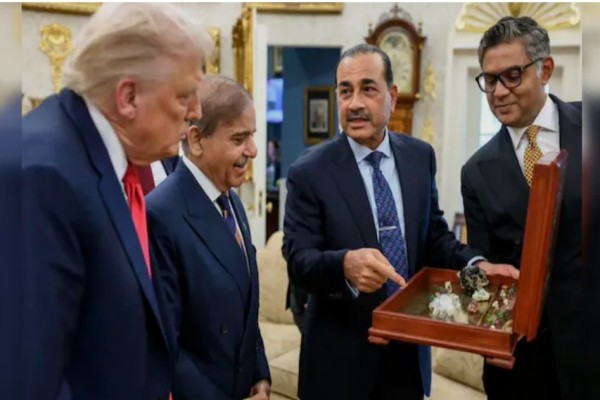
Pakistan, led by Army chief Asim Munir, who promoted himself to Field Marshal and de facto ruler of Pakistan soon after the clash with India, needed a reset. But instead of relying on strategic arguments, Munir and lame-duck Prime Minister Shahbaz Sharif began with business.
And the centrepiece was cryptocurrency.
Trump’s latest financial disclosures show that his crypto ventures generated at least $1.4 billion in 2025. A significant part of this empire revolves around World Liberty Financial, the Trump family-controlled digital finance company that signed an agreement with Pakistan’s newly created Pakistan Crypto Council to promote blockchain infrastructure and the USD1 Stablecoin in Pakistan.
The deal immediately raised conflict-of-interest questions and Congressional investigations in Washington, because the sitting US President stood to benefit financially from policies that could directly aid one of America’s foreign partners.
Crypto, however, was only the opening act.
Pakistan followed it with offers of cooperation in critical minerals, energy, artificial intelligence, digital infrastructure and investment. It showcased rare earth deposits to Trump, courted American investors and signed trade and mining agreements that perfectly matched Trump’s transactional approach to diplomacy.
Then came the flattery.
Islamabad enthusiastically backed Trump’s claim that he had brokered the India-Pakistan ceasefire after Operation Sindoor, even nominating him for the Nobel Peace Prize. Soon afterwards came an extraordinary White House welcome for Field Marshal Asim Munir, the first such meeting in fifteen years.
The contrast with Trump’s first presidency could hardly have been sharper.
This was the same Trump who had once accused Pakistan of giving America “nothing but lies and deceit” while cutting security assistance. Now Pakistan was suddenly back in favour.
India watched this transformation with increasing discomfort.
Trump repeatedly claimed he had mediated between India and Pakistan despite New Delhi’s categorical rejection of any third-party role. He repeatedly referred to Indian aircraft having been shot down, echoing Pakistan’s preferred narrative instead of India’s official position. Simultaneously, India faced punitive tariffs while Pakistan secured one of the most favourable trade arrangements in South Asia.
Taken together, they create an uncomfortable pattern.
Former US National Security Adviser Jake Sullivan perhaps put it most bluntly when he argued that Trump’s willingness to pursue business with Pakistan had effectively pushed the India relationship aside. Whether one agrees with Sullivan or not, the perception itself is damaging.
For decades, India believed the United States viewed the relationship through the prism of shared strategic interests — China, the Indo-Pacific, technology, defence and democratic values.
Trump’s second presidency has often suggested something different. Relationships appear increasingly measured by immediate commercial opportunity. Pakistan exploited this to the hilt.
Yet there is another side to this story.
Pakistan may have won Trump’s attention, but it has not solved Pakistan’s problems. Far from it.
The country’s crypto ambitions rest on remarkably weak foundations. Pakistan continues to struggle with chronic fiscal instability, repeated IMF bailouts, low tax collection, external debt, persistent balance-of-payments pressures and severe electricity shortages.
It has even proposed allocating 2,000 megawatts of electricity for Bitcoin mining despite regularly suffering power deficits that affect ordinary consumers and industry alike.
Cryptocurrency cannot fix any of those structural weaknesses.
If anything, it could make them worse.
An assessment by the Bengaluru-based Takshashila Institution is sobering. It concludes that serious crypto adoption is likely to be a net negative for Pakistan’s economy while simultaneously increasing risks for India’s national security.
Crypto’s volatility makes it unsuitable as a strategic reserve. Wider adoption could weaken Pakistan’s currency, reduce the central bank’s control over monetary policy, encourage capital flight and shrink already inadequate tax revenues.
Even more worrying are the security implications.
The same characteristics that make cryptocurrencies attractive for legitimate cross-border payments also make them attractive for sanctions evasion, money laundering and terrorist financing.
The report warns that Pakistan’s military establishment could eventually dominate the country’s crypto ecosystem, creating new avenues for financing cross-border terrorism through blockchain-enabled hawala networks that are far harder for intelligence agencies to monitor.
If that happens, Pakistan risks not only renewed international scrutiny but also the possibility of finding itself back under FATF pressure. Ironically, in trying to attract global investment through crypto, Pakistan could simultaneously create conditions that discourage legitimate investors.
Nor is Trump emerging unscathed.
His family’s crypto empire has become the subject of growing scrutiny in Washington. Congressional investigators are examining whether foreign governments have effectively gained privileged access through investments in Trump-linked crypto ventures.
Critics argue that his administration’s pro-crypto regulatory changes, weaker enforcement and Stablecoin policies have directly benefited businesses in which his family retains substantial financial interests.
Even if no legal wrongdoing is established, the optics are deeply troubling.
Every major foreign commercial agreement involving Trump-linked companies now invites the same uncomfortable question: Is America pursuing national interest or private interest?
That question weakens Washington’s credibility far beyond South Asia.
Recognising that Trump’s diplomacy is fundamentally transactional and that complaining about it changes nothing, Delhi’s response has been measured and practical.
Resisting the temptation to imitate Pakistan’s approach, New Delhi continues to engage not merely with the White House but with Congress, the Pentagon, the State Department and American industry, institutions that provide continuity long after individual presidents leave office.
Second, India’s financial intelligence agencies are stepping up preparations to counter blockchain-enabled terror financing, money laundering and crypto-based hawala networks emerging from Pakistan.
Third, New Delhi continues to highlight genuine conflicts of interest whenever they arise, not as political attacks but as questions of transparency that concern every democracy.
Pakistan may have discovered the quickest route to Donald Trump’s attention and gained some favours, but whether it has discovered a sustainable foreign policy is another matter entirely.
Crypto may have bought Islamabad access, but it has not bought credibility.
And when political fortunes, crypto prices and presidential preferences all change with astonishing speed, Pakistan may discover that betting its diplomacy on one man’s balance sheet could lead to unexpected and unpleasant blowback.