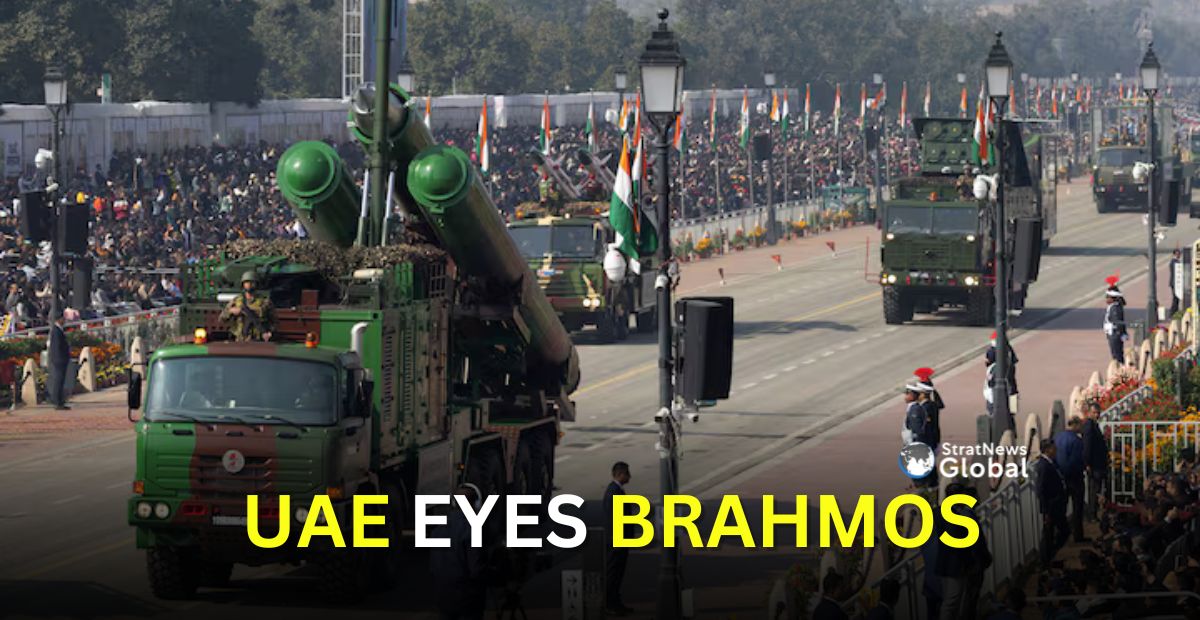
India and the UAE are in talks over the potential sale of key Indian defence platforms, including the BrahMos supersonic cruise missile, as Abu Dhabi seeks to bolster its military capabilities following the war in the Middle East, four Indian sources said.
The UAE is considering buying defence equipment from India and other sources after the Gulf nation was heavily attacked by Iran during the war and as it enhances its ability to respond to emerging threats. It also needs to protect the Strait of Hormuz, a crucial conduit for its energy exports.
Earlier this year, the UAE signed a memorandum of understanding with South Korea to promote defence cooperation that would be worth more than $35 billion.
According to data from the Stockholm International Peace Research Institute (SIPRI), the U.S. was the biggest exporter of arms to the Middle East between 2021 and 2025, supplying 54% of imports, followed by Italy at 12% and France at 11%.
Before clinching any BrahMos sale to the UAE, India would require Russia’s approval, as the 290-km (180-mile) range missile is jointly developed. One source said this is unlikely to pose a hurdle given Moscow’s close ties with Abu Dhabi.
Tighter Ties Between India, UAE
The UAE already has the U.S. MGM-168 ATACMS ballistic missile, according to the International Institute for Strategic Studies, which has a maximum range of 300 km. For air defence, it has the sophisticated U.S. THAAD and Patriot systems.
Akashteer would help knit together information from other devices to combat an air threat, defence experts said.
Closer ties between India and the UAE in recent years have led to a flurry of deals on trade and energy and a pact to jointly develop military hardware.
India’s Defence Exports Surging
Previously, India has signed deals to sell the BrahMos to Vietnam and Indonesia. It has also received interest from Thailand, South Africa, Brazil and Chile, the two sources said.
The only previous sale of the BrahMos was to the Philippines in 2022.
India’s defence exports surged to over $4 billion in the year ending March 2026, from just $7.26 million in 2013-14, according to the Indian government.
(With inputs from Reuters)