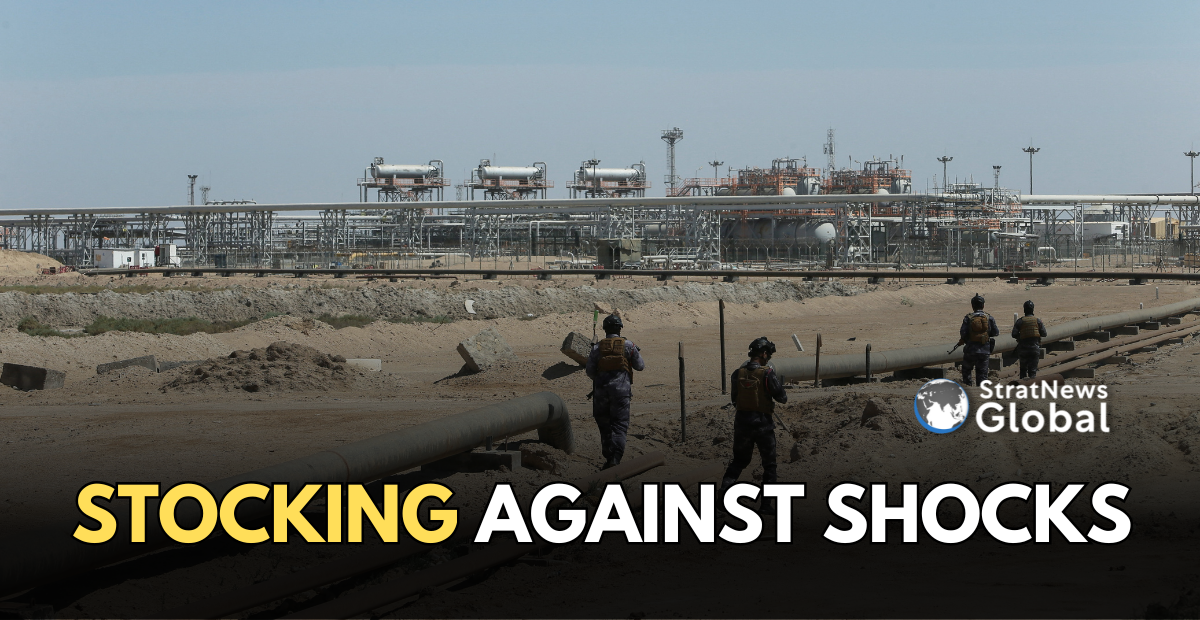
Vulnerable countries that paid a high economic price during the Iran war are seeking to build domestic oil and gas storage buffers against future shocks, a drive that could bring roughly half a billion barrels of additional demand down the pike.
While the near-total closure of the Strait of Hormuz near Iran cut off a fifth of global oil and liquefied natural gas supplies for over three months, boosting Brent crude to nearly $120 a barrel, it could have been far worse. One key stabilizing force was the world’s ability to tap emergency reserves. Early in the conflict, all 32 members of the International Energy Agency agreed to a record 400 million-barrel release from strategic petroleum reserves, with the U.S. contributing the largest share, the sixth such drawdown since the agency’s creation, validating a strategy forged after the 1973 Arab Oil Embargo.
China’s Rainy Day Fund
China offered a second lesson. Though not a full IEA member, China has spent years building what is believed to be the world’s largest strategic reserve, holding more than a billion barrels. This buffer let the world’s largest energy importer cut crude purchases by more than a third during the war, saving Beijing billions and insulating it from the distress seen elsewhere in Asia, which relies on the Middle East for roughly 60% of energy imports.
The pain was particularly acute in India, Pakistan, Thailand and other economies with limited reserves, where governments turned to subsidies, fuel curbs and austerity measures.
The Rush For Strategic Reserves
India, the world’s third-largest oil importer, is not a full IEA member and did not join the coordinated release. Its reserve covers just eight days of imports; meeting the IEA’s 90-day standard would require over 400 million additional barrels, costing roughly $28 billion. New Delhi has asked Oil and Natural Gas Corporation to build a nearly 13 million-barrel reserve.
Pakistan, which relied on the Middle East for about 90% of its imports, would need around 35 million additional barrels to meet the same standard.
Australia, the only IEA member that consistently missed its SPR requirement, has announced plans to spend $7 billion to hold at least 50 days of fuel.
Singapore is also weighing expanded storage, while Europe may build more government-controlled gas storage given its growing reliance on U.S. LNG.
Even Gulf producers like Saudi Aramco are seeking more storage abroad to preserve export flexibility.
Implications For Oil Prices
Together, these plans could require around 500 million barrels of crude and refined products. Add roughly 400 million barrels already drawn from global stocks since the war began, and total additional demand could reach roughly 1 billion barrels. Even spread over years, that would offer meaningful price support, though the IEA expects supply to surge next year as Middle East production recovers, potentially outstripping demand by more than 4 million barrels per day, which could offset the impact unless Gulf supply recovers more slowly than expected.
The longer-term lesson is that a world with larger strategic reserves may prove more resilient to shocks, anchoring prices over time as countries reduce purchases during tight supply, much as China did.
(with input from Reuters)