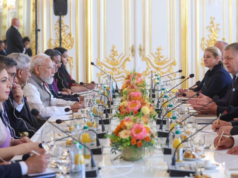
Pakistan’s former National Security Adviser Moeed Yusuf has argued that improving relations with India is essential if Pakistan is to overcome its economic and strategic challenges and secure long-term development.
In a paper published by the Harvard Kennedy School titled In the Eye of the Storm: Pakistan’s Balancing Act in the Evolving Geopolitical Order, Yusuf warns that Pakistan can no longer afford to follow policies that have left it isolated and economically vulnerable. He contends that Islamabad’s strained relationship with India remains one of the biggest obstacles to its regional integration and growth.
The paper examines Pakistan’s prospects in four key areas—regional connectivity, climate change, security partnerships, and emerging technologies—and concludes that better ties with India could help unlock economic opportunities across the region. Yusuf argues that decades of rivalry with New Delhi have limited Pakistan’s ability to participate in broader Asian economic and strategic frameworks.
He notes that Pakistan’s foreign and security policies have long been shaped by its perception of India as an existential threat, leading to high defence spending and persistent regional tensions. According to Yusuf, a more stable relationship with India would strengthen regional connectivity and improve Pakistan’s economic prospects.
The former NSA also calls on major powers, particularly the United States and China, to support Pakistan through increased trade and investment rather than financial bailouts. He recommends that international partners encourage economic reforms while helping stimulate growth through greater commercial engagement.
However, Yusuf’s proposals face significant challenges. His suggestion that Western countries encourage dialogue between India and Pakistan overlooks New Delhi’s long-standing opposition to third-party involvement in bilateral disputes. Relations between the two countries have deteriorated sharply in recent years, with disputes extending from security concerns to trade and water-sharing arrangements.
While Yusuf’s paper is notable for acknowledging the importance of stable India-Pakistan ties, it offers few concrete recommendations on how Islamabad can translate that objective into policy. The paper ultimately serves as a critique of Pakistan’s past strategic choices while highlighting the need for a more pragmatic approach to regional engagement.