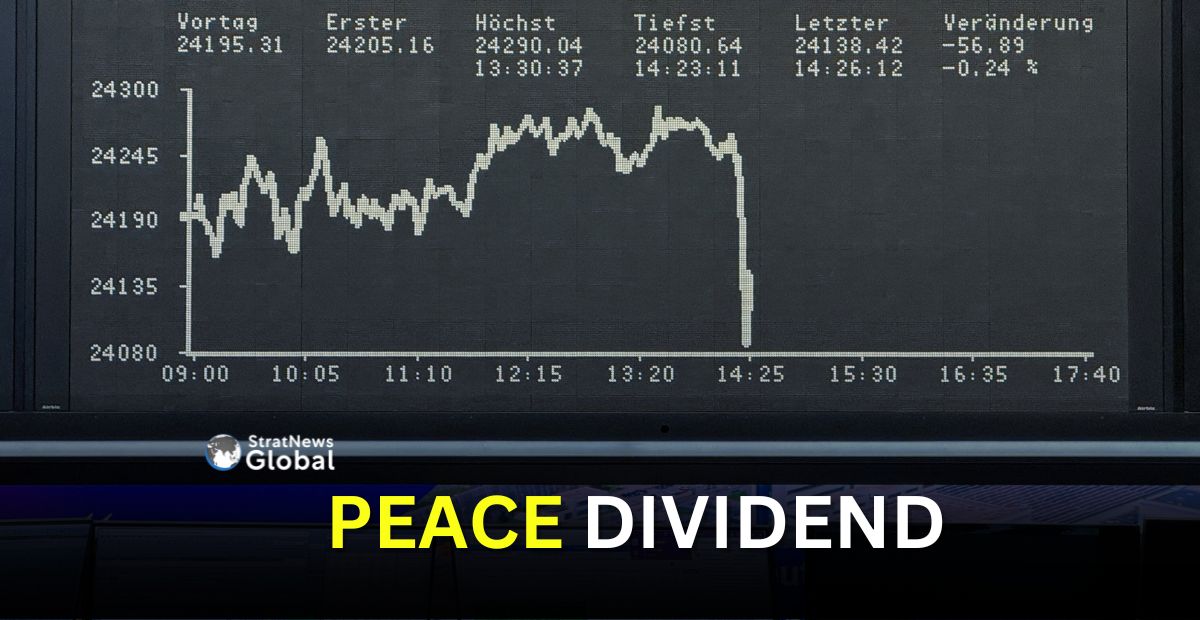
Global markets rallied and oil prices tumbled on Monday after the United States and Iran agreed to a framework peace deal that eased concerns over energy supplies and reduced fears of a wider economic shock.
The agreement, announced after weeks of negotiations, includes the reopening of the strategically vital Strait of Hormuz, through which a significant share of the world’s oil trade passes. While Iran said traffic through the waterway would be regulated jointly with Oman, investors largely welcomed the prospect of uninterrupted energy flows.
Markets Surge On Peace News
The market response was swift. Brent crude fell 5% to around $83 a barrel, extending a retreat from the highs reached during the conflict and raising hopes that inflationary pressures could ease globally. Equity markets across Asia surged, with Japan’s Nikkei gaining 5%, South Korea’s benchmark index rising more than 5%, and Chinese blue chips posting solid gains. European stocks also climbed to record levels, while Wall Street futures pointed to a strong opening.
Analysts said the combination of lower oil prices and reduced geopolitical risk offered a powerful boost to investor sentiment.
“The peace deal is about as supportive as you can get for markets,” said John Hardy, head of macro strategy at Saxo Bank.
Relief For Central Banks
The decline in energy prices is likely to be closely watched by central banks meeting this week across major economies, including the United States, Britain and Japan. Cheaper oil could ease inflation concerns and reduce pressure on policymakers to keep interest rates elevated.
Bond markets reflected that expectation, with government yields falling as investors bet the inflation outlook had improved. The dollar weakened against major currencies, while gold and bitcoin also advanced.
Uncertainty Lingers
Despite the optimism, some uncertainty remains. Iran’s insistence on regulating traffic through the Strait of Hormuz has raised questions about future shipping arrangements, while analysts caution that damage to regional energy infrastructure could continue to affect supply and prices.
For now, however, investors appear to be betting that the peace agreement marks the beginning of a more stable period for global markets, with lower energy costs providing an immediate economic dividend.
(with input from Reuters)