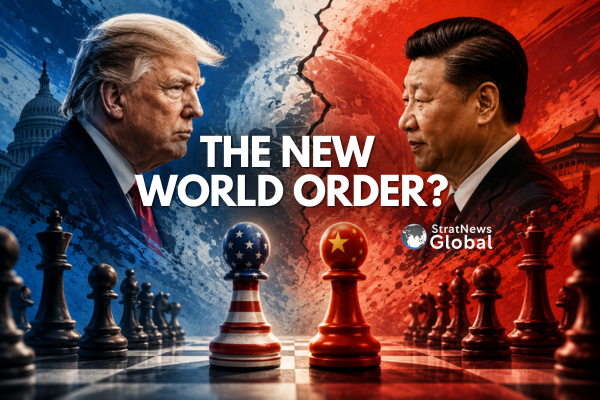
US President Donald Trump’s summit with Xi Jinping in Beijing was a masterclass in restraint, argued former diplomat and ambassador to Greece Dilip Sinha.
At a discussion organised by the Observer Research Foundation (ORF) in New Delhi, he noted that Trump did not directly challenge China’s “red lines” on Taiwan, human rights, governance and technology.
In his view, Washington and Beijing may move towards greater cooperation, with the former seeking the latter’s help on issues such as Iran. Beijing in turn, could use that leverage to secure concessions on matters it considers core interests.
Antara Ghosal, China Expert at ORF
But Antara Ghosal, China Expert at ORF warned that its important to assess how China read the summit.
“In the Chinese media and strategic thinkers’ circles, the summit has been widely considered a sign of a broader shift in the global balance of power,” Ghosal said. Chinese scholars increasingly contend that China has become a co-author of international order, not just a rule-taker.
This reading was an implicit American recognition of China’s rise and growing importance at the summit. That confidence is evident in Beijing’s drive for what Chinese experts call “constructive strategic stability” – a concept not intended to destroy competition but to ensure that rivalry stays predictable, controlled and short of violence.
Manoj Kewalramani of the Takshashila Institution
Manoj Kewalramani of the Takshashila Institution pointed to a crucial development in the US-China relationship: both sides appear to be in agreement that competition will be the defining characteristic of their ties for the foreseeable future. The focus has moved from trying to overcome rivalry to designing measures that prevent it from turning into confrontation.
China may have left the summit feeling secure, but he wondered if Beijing really wants a “G2” agreement with Washington. That would force China to take on greater duties in administering the international system and supplying international public goods.
He indicated that Beijing’s priorities remain more closely related to national rejuvenation, technical progress, economic growth and territorial goals. This helps other countries that would rather not have to pick between the US and China.
A stable but competitive US-China relationship would give countries more room to engage both powers while pursuing their own interests. The biggest test of that stability, however, remains Taiwan.
Professor Wei Mei Chuan
Professor Wei Mei Chuan of Taiwan’s National Chengchi University argued that Taiwan remains the most important and sensitive issue in US-China relations. It would be premature to assume that a single summit could fundamentally alter US policy towards Taiwan, she said.
US support for Taiwan is rooted in long-standing legislation, congressional backing and broader strategic interests in the Indo-Pacific. At the same time, Taiwan’s future cannot be understood solely through Washington-Beijing dynamics. Taipei remains a critical actor in its own right, and most Taiwanese continue to favour maintaining the status quo preserving peace and stability while protecting the island’s democratic system and self-governing status.
According to Wei, stability across the Taiwan Strait will ultimately depend on careful management by all three parties—Washington, Beijing and Taipei as miscalculations or abrupt policy shifts could quickly escalate tensions.