India does not qualify as a great power.
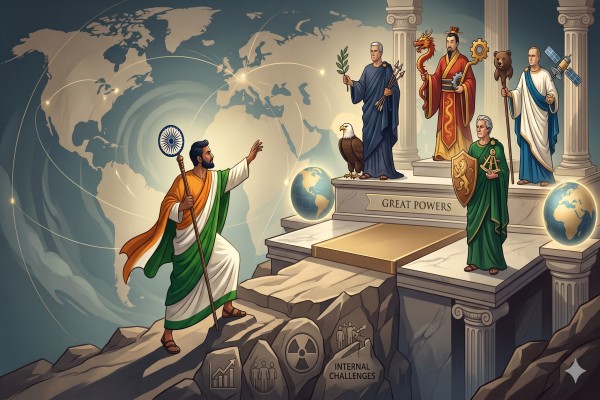
That is the blunt conclusion of a recent column in Foreign Affairs, which argues that despite its nuclear arsenal, vast population and status as one of the world’s largest economies, India fails to meet the criteria required for entry into the top tier of global powers.
Instead, the article identifies only four countries as genuine great powers today: the United States, China, Russia and, somewhat controversially, the United Kingdom.
The author, Brendan Simms, director of the Centre for Geopolitics at the University of Cambridge and author of The Return of the Great Powers, builds his case around four criteria: resources, reach, reputation and resilience.
A true great power, he argues, must possess not only military and economic strength, but also global influence, international recognition and the ability to absorb shocks and recover from adversity. Judged by these standards, Simms concludes that India falls short.
The first thing to acknowledge is that Simms deserves credit for attempting a rigorous definition of “great power”. Too often the term is used loosely, reduced to GDP rankings or population size. His framework forces readers to think beyond economics and ask harder questions about military reach, diplomatic influence and strategic endurance.
Yet the argument begins to wobble when applied consistently.
The most striking aspect of Simms’ list is not India’s exclusion. It is Britain’s inclusion.
The United Kingdom undoubtedly retains impressive assets: a nuclear deterrent, intelligence capabilities, a permanent seat on the UN Security Council, a professional military and deep diplomatic networks.
But Britain today has neither the economic weight nor the military scale of China, the United States or even India. It spends a fraction of what the major powers spend on defence and relies heavily on alliances, particularly with Washington, for strategic influence.
Simms appears to compensate for Britain’s shrinking material power by placing extraordinary emphasis on historical legacy, reputation and resilience.
Yet these are subjective measures. If reputation and historical continuity can elevate Britain into the first rank, why should India’s rapidly expanding diplomatic profile and growing geopolitical relevance count for so little?
His treatment of India is particularly debatable.
Simms argues that India’s military reach remains largely regional. That is true if measured against America’s global network of bases or China’s expanding overseas footprint.
But reach is not a static concept. India today operates across the Indian Ocean, conducts regular naval deployments from the Gulf to Southeast Asia, participates in major multinational exercises, and increasingly serves as a security provider in its neighbourhood.
It may not yet possess global military reach comparable to Washington, but neither does Britain.
The article also dismisses India’s claim to global influence by describing its self-image as a “world teacher” in non-great-power terms. This overlooks India’s growing role in shaping international agendas. Whether through the G20 presidency, the International Solar Alliance, digital public infrastructure initiatives, vaccine diplomacy, or its position as a leading voice of the Global South, India has demonstrated an ability to shape debates well beyond South Asia.
Simms’ assessment of resilience is even more contentious. He points to terrorism, communal tensions and persistent poverty as indicators of vulnerability.
Those challenges are real. But resilience can also be measured by a state’s capacity to endure and adapt despite them.
By that standard, India presents a stronger case than Simms allows. It has remained a functioning democracy through wars, insurgencies, political upheavals, economic crises and profound social diversity.
The survival and consolidation of the Indian state over nearly eight decades may itself be evidence of resilience rather than fragility.
There is also a broader conceptual problem. Simms appears to define great-power status partly through existing recognition by other great powers.
This risks turning the concept into a self-reinforcing club. Countries are great powers because other great powers treat them as such. But history suggests that rising powers are often recognised only after their ascent becomes impossible to ignore.
Where Simms is strongest is in reminding readers that economic growth alone does not create great-power status. His scepticism toward countries such as Germany, Japan, Brazil and Indonesia is rooted in a long-standing geopolitical reality: wealth and influence do not automatically translate into strategic power. On that point, his argument is persuasive.
But his final conclusion feels less like a snapshot of the emerging international order and more like a defence of an older one.
The article’s four-power world would have been familiar to observers of the late nineteenth century, and Simms explicitly celebrates that continuity. Yet international politics is rarely so static. China’s rise has already transformed the global balance. India’s trajectory suggests another major shift may be underway.
The real question is not whether India meets every criterion for great-power status today. It is whether a framework that comfortably includes Britain while excluding India is measuring contemporary realities or preserving historical hierarchies.
That debate, perhaps more than Simms’ list itself, is what makes the article worth reading