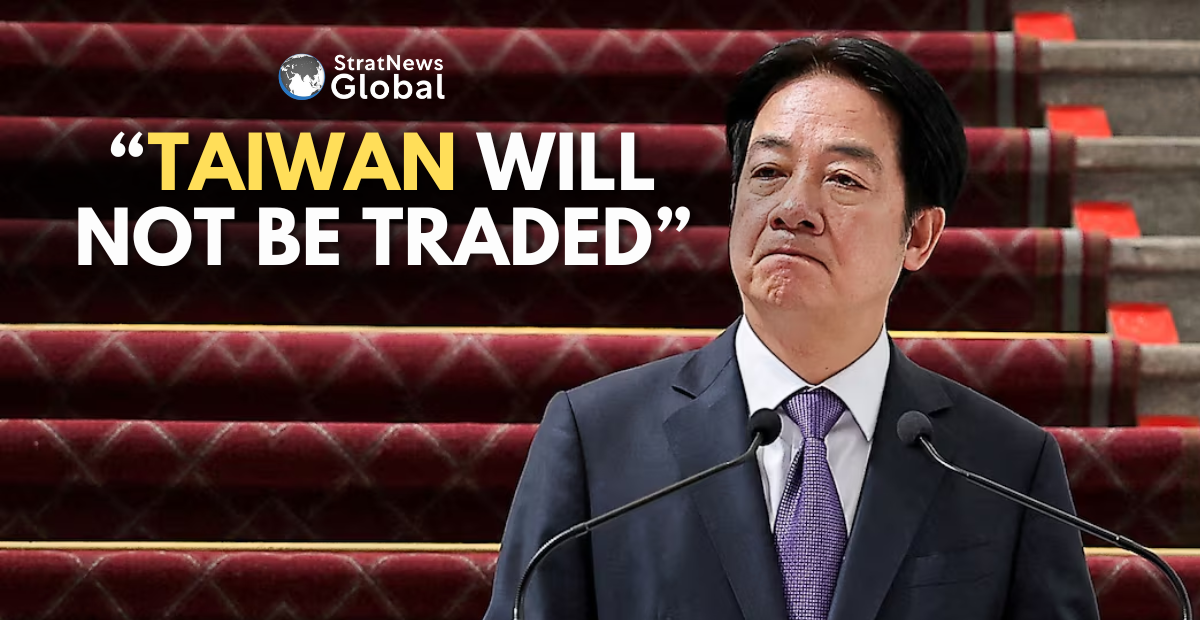
Taiwan President Lai Ching-te on Sunday pushed back strongly against concerns raised after last week’s Trump–Xi summit in Beijing, declaring that Taiwan “will not be sacrificed or traded” and would not abandon its democratic way of life under pressure from China.
In his first direct response to the summit between U.S. President Donald Trump and Chinese President Xi Jinping, Lai sought to reassure the Taiwanese public amid growing debate over whether Washington could soften its support for Taipei as part of broader negotiations with Beijing.
Writing on Facebook, Lai said many people in Taiwan were “very concerned” about discussions surrounding the island during the high-level China-US talks. However, he thanked the United States for continuing to support peace and stability across the Taiwan Strait and for maintaining its security commitments to Taiwan.
“But we will also not give up our national sovereignty and dignity, or our democratic and free way of life, under pressure,” Lai wrote.
His remarks came after Trump signalled he was still considering whether to approve a new package of arms sales to Taiwan. Trump also stated that the United States was “not looking to have somebody say, ‘Let’s go independent because the United States is backing us’.”
The comments triggered concern in Taiwan, where many closely monitor signs of Washington’s long-term commitment to the island’s security.
Lai argued that ensuring peace and stability in the Taiwan Strait remains a shared interest between Taiwan, the United States and democratic partners around the world.
“Taiwan will absolutely not be sacrificed or traded,” he said.
He also defended continued US weapons sales to Taiwan, saying they are based on the Taiwan Relations Act, the 1979 American law that forms the foundation of unofficial ties between Washington and Taipei.
“This is not only a US security commitment to Taiwan, but also the most important deterrent force over the years against actions that undermine regional peace and stability,” Lai said.
The Trump administration approved an $11 billion arms package for Taiwan in December, while another reported $14 billion package is still awaiting final approval.
Lai also reiterated his long-standing position that the Republic of China — Taiwan’s official name — is already a “sovereign, independent, democratic country.”
He said Taiwan’s future can only be decided by its own people and rejected Beijing’s repeated claims that the island is part of China.
“There is no so-called ‘Taiwan independence’ issue,” Lai said, arguing that Taiwan’s current democratic system and self-rule already represent the status quo the island seeks to preserve.
China has never renounced the use of force to bring Taiwan under its control and has increased military pressure around the island in recent years through near-daily air and naval activity.
Taiwan’s government, however, continues to reject Beijing’s sovereignty claims, insisting that only Taiwan’s people have the right to decide their future.
(with inputs from Reuters)