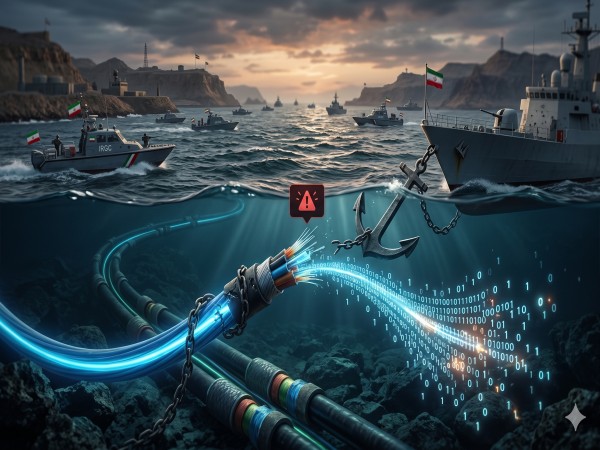
Tehran’s implicit threat over undersea fibre-optic cables in the Strait of Hormuz marks a dangerous escalation in the weaponisation of geography.
Its demand that foreign operators obtain Iranian permits, pay licensing charges and submit to exclusive Iranian control over maintenance operations is an attempt to convert physical geography into geopolitical leverage over the digital economy.
The implications stretch far beyond the Gulf.
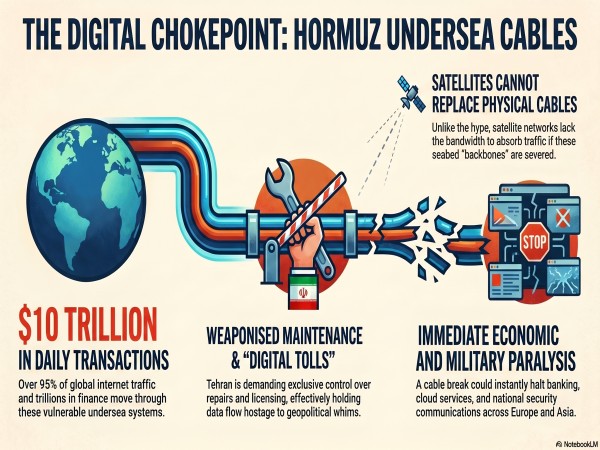
Undersea cables are the backbone of the modern world. More than 95 per cent of global internet traffic moves through these fibre-optic systems.
The cables running through the Strait of Hormuz connect the digital economies of Europe, Asia and the Gulf states and carry an estimated $10 trillion in financial transactions every single day.
That makes them strategically more important than many military assets.
The Iranian argument is framed around sovereignty. Tehran claims that, under the UN Convention on the Law of the Sea, it has authority over sections of the seabed and therefore the right to regulate cable operations passing through its waters. Its state-linked narratives increasingly present foreign-owned cables as infrastructure operating within Iran’s sovereign domain.
But the language emerging from the Iranian Revolutionary Guard Corps goes far beyond routine regulation. The demand for licensing fees, “protection payments” and exclusive control over repairs resembles coercive leverage more than normal maritime governance.
This matters because the global internet depends not only on cables existing but also on them remaining rapidly repairable.
Undersea cable systems are enormously expensive. Individual transoceanic systems can cost between $300 million and $1 billion to deploy. Once laid, they require specialised deep-sea maintenance vessels capable of responding quickly to breaks, anchor damage or technical failures.
Iran’s proposed restrictions would effectively allow Tehran to decide who can repair damaged cables and when. Repair ships may need explicit Iranian permission to enter the area.
In a crisis, delays measured in hours could have massive consequences for banking systems, stock exchanges, cloud computing networks and military communications across several continents.
This creates a dangerous precedent.
For years, analysts worried about states weaponising energy routes. Russia used gas pipelines as political leverage over Europe. China’s dominance over rare earth minerals raised concerns about strategic dependency.
Now, Iran is signalling that digital connectivity itself can become hostage to geopolitical pressure.
The Strait of Hormuz is already one of the world’s most militarised waterways. Naval stand-offs, drone incidents, tanker seizures and proxy confrontations occur regularly.
In such an environment, undersea cables become highly vulnerable. Most cable breaks globally are accidental, often caused by fishing trawlers or anchors. But military conflict dramatically raises the danger. A disabled ship drifting after an attack could drag its anchor across the seabed and sever multiple cables simultaneously.
Sabotage is another possibility.
The consequences would be immediate.
India, the UAE and other data-heavy economies could face severe financial paralysis within minutes if major cable systems were disrupted. Cloud infrastructure, payment systems, financial trading platforms and logistics networks all rely on uninterrupted connectivity.
The modern economy functions because digital transactions move invisibly and continuously across oceans. Interrupt the cables, and the illusion of seamless globalisation disappears very quickly.
Satellite internet cannot replace these systems.
Despite the hype surrounding Low-Earth Orbit constellations such as SpaceX’s Starlink, satellites do not possess the bandwidth necessary to absorb the traffic handled by major subsea cable networks. That means the world remains deeply dependent on physical seabed infrastructure concentrated in a handful of vulnerable maritime chokepoints.
The Strait of Hormuz now joins a growing list of regions where digital infrastructure has become entangled with geopolitical confrontation.
The Baltic Sea has witnessed repeated incidents involving damaged cables and pipelines. The Red Sea faces threats from Houthi attacks. Taiwan’s undersea connectivity remains vulnerable to Chinese pressure.
For India, the issue is especially serious.
India’s digital economy depends heavily on stable international connectivity through Gulf routes. Financial services, outsourcing operations, cloud computing, AI infrastructure and e-commerce all require uninterrupted high-capacity data flows.
Any sustained disruption in Hormuz would ripple through India’s banking system, stock markets and technology sector almost immediately.
There is also a military dimension.
Modern armed forces rely heavily on secure digital communications, cloud-linked intelligence systems and real-time data exchange. Undersea cable vulnerabilities, therefore, affect not only commerce but also national security planning. In any future regional conflict involving Iran, Gulf states or Western navies, digital infrastructure could become both a target and a bargaining chip.
The companies affected are not small players. Major global firms such as Amazon, Meta and Microsoft depend on these networks for cloud services, data transfers and regional connectivity. If Tehran succeeds in imposing recurring fees or regulatory control, other states may follow the same model.
That would fundamentally alter how the internet operates.
The internet was built on the assumption that connectivity infrastructure would remain largely neutral and internationally accessible. Iran’s approach challenges that assumption directly. It suggests a future where states increasingly treat data routes like toll roads, extracting political and financial concessions from the global digital economy.
There is another danger here: normalisation.
If the international community quietly accepts Iranian demands, it may encourage similar assertions elsewhere. Countries controlling strategic maritime corridors could begin imposing fees, inspections or restrictions on digital infrastructure passing through their waters.
The result would be a fragmented, politicised internet shaped by coercive geography rather than open connectivity.
That would mark the end of the internet as a truly global commons.
Which means major economies need to accelerate diversification of cable routes, invest in redundancy and improve rapid repair capabilities. Strategic digital infrastructure must now be treated with the same seriousness as energy security or naval defence.
The world spent decades worrying about who controls oil chokepoints.
It is now entering an era where control over data chokepoints may matter even more.