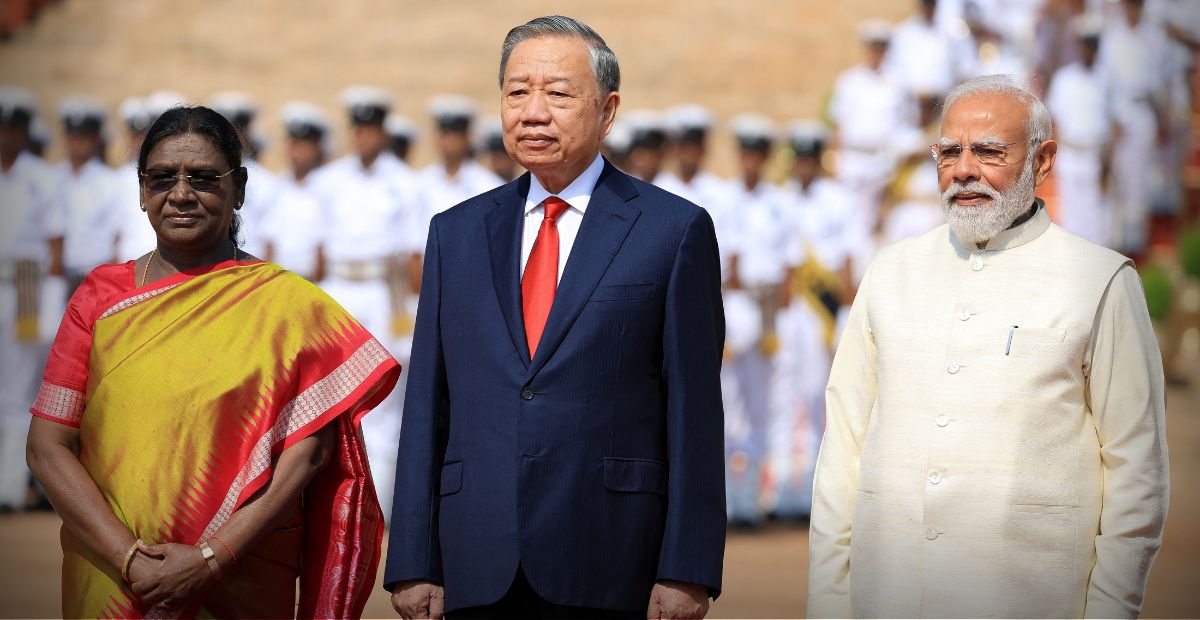
India and Vietnam have set a $25 billion bilateral trade target for 2030, as both countries upgraded their relationship to an Enhanced Comprehensive Strategic Partnership during the state visit of Vietnamese President To Lam.
At the end of talks with Prime Minister Narendra Modi, 18 key outcomes including 13 MoUs covering digital technology, finance, culture, trade facilitation and institutional cooperation.
During a meeting with NSA Ajit Doval, the two sides are expected to take forward cooperation in security and artificial intelligence.
At a special briefing, senior diplomat P. Kumaran, said the two sides recognised that the partnership had “expanded significantly in the last ten years” and agreed that the new upgraded structure would help “give greater ambition and direction” to future cooperation.
Economic, Digital
A significant set of agreements focused on strengthening economic and financial linkages. Cooperation in digital technologies, payment systems, financial innovation and cross-border digital infrastructure was advanced through multiple MoUs.
These include frameworks linking payment systems between the two countries to support smoother digital transactions and greater financial connectivity.
Kumaran said both sides agreed to expand cooperation in emerging areas such as rare earth elements research and new-age technologies.
Trade facilitation measures were also highlighted, including expanded agricultural market access, with exports of select Indian fruits to Vietnam and Vietnamese agricultural products to India.
At a joint press briefing Modi said “Today, we made several key decisions to reach that goal. Very soon, Vietnam will enjoy India’s grapes and pomegranates, while India will enjoy Vietnam’s Durian and Pomelo.”
Bilateral trade has doubled to about $16 billion over the past decade. These steps are expected to support more balanced and diversified bilateral trade.
Accompanied by a high level ministerial and official delegation as well as a large delegation of businessmen, this is Lam’s second overseas trip since securing the presidency last month.
Lam said both nations agreed to “continue to further deepen political trust, step up high-level engagement and increase the effectiveness of existing cooperation mechanisms.”
The two sides will also elevate defence and security cooperation to “contribute to strengthening an environment of peace and stability,” he added.
The visit also saw a strong push towards institutional and people-to-people engagement. New MoUs were signed between academic institutions to establish chairs for Indian studies in Vietnamese universities and to strengthen long-term educational collaboration.
Cultural cooperation was significantly expanded through a 2026–2030 cultural exchange programme, aimed at deepening civilisational linkages and increasing exchanges in arts, heritage and tourism.
Urban cooperation was also strengthened through a new partnership between Mumbai and Ho Chi Minh City, focused on sharing expertise in city governance, urban planning and economic development.
Maritime Cooperation
Both sides agreed to strengthen cooperation in maritime domain awareness, ocean science, hydrography, and maritime safety, including search and rescue coordination.
Vietnam’s participation in regional maritime initiatives and its decision to join the Indo-Pacific Oceans Initiative (IPOI) were welcomed as steps that enhance cooperation in the broader Indo-Pacific maritime space.
Both countries reiterated their commitment to a free, open and rules-based Indo-Pacific, with emphasis on international law, particularly the United Nations Convention on the Law of the Sea, and peaceful resolution of maritime disputes.
According to officials, Vietnam will be participating in the upcoming BRICS Foreign Ministers’ meeting later this month. This reflects its growing engagement with global and plurilateral platforms.