India’s quiet but significant breakthrough in quantum communication—achieving a secure 1,000-kilometre terrestrial link—has not generated the headlines it arguably deserves.
Yet, as insights from Dr Sunil Gupta of QNu Labs make clear, this milestone is far more than a technical achievement. It marks a strategic inflection point in India’s approach to cybersecurity, defence preparedness, and technological self-reliance.
At its core, quantum communication represents a fundamental shift in how information is secured. Unlike classical encryption systems which rely on mathematical complexity and can, in theory, be broken with enough computing power, quantum communication is rooted in the laws of physics.
As Dr Gupta explains, any attempt to intercept or eavesdrop on quantum data alters the state of the photons carrying that information, immediately exposing the intrusion. In simple terms, hacking becomes not just difficult, but detectable—and therefore ineffective.
This is precisely why the 1,000-km demonstration matters. Achieving secure quantum communication over such distances using terrestrial fiber is an engineering challenge due to signal loss and the fragility of quantum states.
That India has managed to do so with a limited number of relays—and in relatively short timeframes—signals a rapid maturation of its quantum ecosystem. As Gupta notes, this is the result of a decade-long effort, backed increasingly by government policy support and culminating in the National Quantum Mission.
The strategic implications begin with cybersecurity. India’s vast digital infrastructure—from banking systems and telecom networks to defence communications—faces constant threats from increasingly sophisticated cyber adversaries.
The concern is not just present-day attacks but the looming “harvest now, decrypt later” problem: adversaries can intercept encrypted data today and decrypt it in the future using quantum computers. By deploying quantum-safe communication systems now, India is effectively future-proofing its most sensitive data.
Dr Gupta’s emphasis on building a “quantum layer” over existing telecom networks is particularly important. Rather than replacing infrastructure—a prohibitively expensive and disruptive exercise—India is opting for an overlay approach.
This makes quantum adoption scalable and economically viable, allowing integration with current systems while progressively enhancing security. It also signals a pragmatic shift in India’s innovation mindset: from service-oriented thinking to product-driven deep-tech development.
The defence dimension is equally critical. Secure communication is the backbone of modern warfare, underpinning everything from command-and-control systems to drone operations and battlefield coordination.
The ability to deploy quantum-secure networks even in environments where intermediate nodes may be compromised offers a decisive advantage. The “untrusted relay” architecture demonstrated in this network ensures that security is maintained even if parts of the system are exposed, a feature particularly relevant in contested or hostile environments.
India’s military establishment has already begun aligning with this trajectory. Quantum-safe communication systems are being explored for naval networks, unmanned systems, and strategic command structures. In a region marked by rising geopolitical competition, especially with technologically capable adversaries, such capabilities could prove decisive.
Globally, India’s achievement also alters its standing in the emerging quantum order. While China has demonstrated longer-distance quantum communication—over 2,000 kilometres—it relies on a larger number of relays.
The United States, meanwhile, has prioritised software and satellite-based approaches. India’s success in terrestrial quantum communication places it in a unique position, showcasing engineering efficiency and practical deployment potential.
This matters because the global quantum race is not just about scientific prestige—it is about setting the standards and architectures that will define future digital infrastructure. Being part of this “quantum club” ensures that India is not merely a consumer of next-generation technologies but an active shaper of them.
Economically, the implications are equally significant. The push toward a “sovereign quantum stack”—encompassing everything from hardware components like lasers and detectors to software protocols—aims to reduce dependence on foreign suppliers. In an era where supply chains are increasingly weaponised, technological sovereignty becomes a strategic necessity.
The growth of India’s quantum startup ecosystem further reinforces this trajectory. Companies working across computing, communication, and cybersecurity are moving from research to commercialisation, supported by rising venture capital interest. The establishment of dedicated hubs and tech parks signals a long-term commitment to building a quantum economy, with projections of substantial job creation and intellectual property generation.
Yet, as Dr Gupta’s remarks suggest, perhaps the most important aspect of this milestone is the mindset shift it represents.
Quantum communication was a “15-year forward call”—a bet on a future need rather than an immediate market demand. That India stayed the course, invested in deep technology, and is now seeing tangible outcomes reflects a broader evolution in its innovation ecosystem.
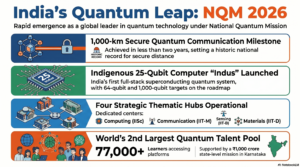
Looking ahead, the roadmap is ambitious. Plans for quantum satellites will extend secure communication beyond terrestrial limits, potentially covering the entire Indo-Pacific region. Expansion of inter-city quantum networks and the integration of quantum-safe protocols across sectors like finance, energy, and telecom will further embed this technology into the national fabric.
In that sense, the 1,000-km milestone is less an endpoint than a foundation. It demonstrates capability, validates strategy, and signals intent. For India, the message is clear: in the coming era of quantum disruption, security, sovereignty, and strategic advantage will belong to those who build early—and build at scale.
And in this race, India has just taken a decisive step forward.